





In the darkness, the performance does not begin with light alone, but with text. Words slip into the scene, not merely read but seen, as though they are part of the theatrical body itself rather than simple accompaniment. In the play “Returning,” staged at the Lebanese National Theater in Beirut’s Hamra district, formerly the Colisée Cinema, and organized by actor and director Qassem Istanbouli, the audience does not stand before a conventional performance. Instead, they enter a sensory experience in which image, sound, and text intertwine to the point where it becomes difficult to separate what is spoken from what is performed.
Before an audience of more than one hundred spectators, most of them displaced families from Beirut’s southern suburbs and southern Lebanon, the stage transforms into a shared space of memory and pain. Through a heavy silence, the play succeeds in condensing the suffering of war and displacement into a single hour, gathering fragmented scenes of pain that nevertheless summarize years of human loss.
A Deceptive Beginning Before the Explosion
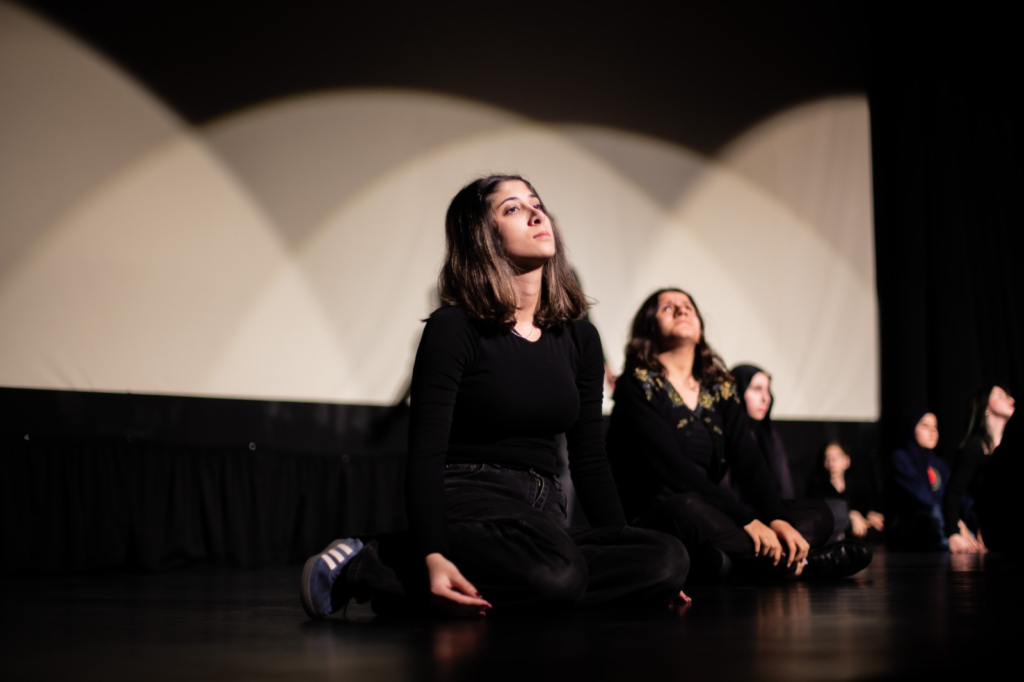
The play begins with a deceptive calm that almost convinces the audience they are witnessing an ordinary moment. On stage, the outlines of a simple daily life begin to emerge: silent faces moving across the scene, bodies carrying invisible tension within their smallest details. At first there is no screaming, only a dense anticipation of something left unspoken. Gradually, sound creeps in like an extension of memory. Whispers and footsteps slowly transform into the sounds of bombardment and confusion. The rhythm collapses, and the opening becomes a direct gateway into the world of war, where there is no return.
“Foul or Hummus?”
The play opens with a displacement scene that condenses a collective feeling. Aid organizations enter and ask displaced families what they need: “Foul or hummus?” Yet the question is not received as help, but as shock. The response erupts in a voice heavy with anger: “We did not leave our homes to search for food. We left everything behind, our houses, our land, our memories.” In a moment of direct confrontation, the harshest question emerges: “Who said we are extending our hands to beg? We are the owners of this land, and we will return to rebuild, no matter how long it takes.”
الغارة: من الكلام إلى الهروب
The performance leaves no room to breathe. Suddenly, the scene shatters under the sound of an airstrike. The lighting changes, smoke rises, and the sound swells like a shockwave that drags everything back to zero. Words become movement, and memory becomes action. The characters run and stumble as though reliving the moment of fleeing death all over again, a moment with no time for thought, only escape and abandonment. Here, the play no longer narrates displacement; it recreates it before the audience with all its fear, confusion, and sudden uprooting from life itself.
The play moves through harsh human scenes that expose the fragility of life during wartime.
The performance shifts between painful human scenes that reveal the fragility of life in times of war: from a mother’s birthday turning into tragedy after she becomes the victim of an Israeli missile before the eyes of her children, to a paramedic forced to carry his own parents at a moment when the line between professional duty and personal loss completely collapses. Meanwhile, the sounds of shelling and destruction remain present not merely as sound effects, but as living memory, part of an experience inhabiting bodies and reproducing fear again and again.
Art in the Service of People
In this context, actor and director Qassem Istanbouli explains that the work does not come from a place of entertainment, but from the true role of theater in reaching people and creating direct human interaction with them. He explains that presenting the performance free of charge aims to break barriers and encourage people to attend and participate. He emphasizes that theater becomes a space for hearing people’s voices and expressing their suffering and stories, considering this the essence of the role of culture and the arts in serving society, especially in difficult times. He also dedicates the work to the souls of the martyrs, paramedics, and journalists who carried cameras to convey the truth.
A Stage That Brings Lebanon Together
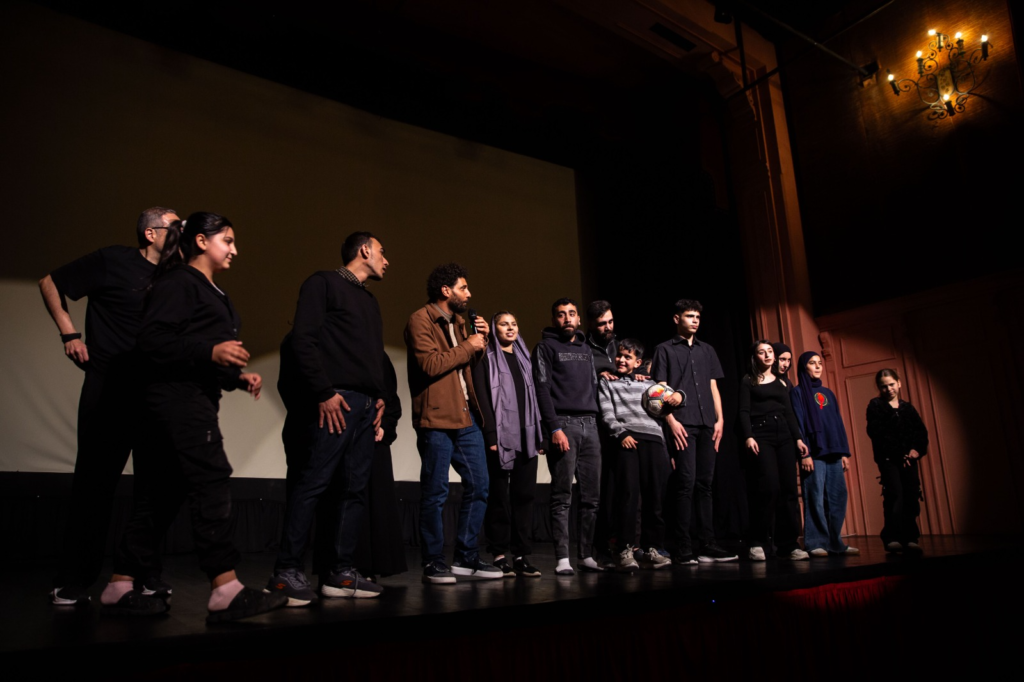
The performance is also distinguished by the diversity of its participants, bringing together actors from different Lebanese regions and backgrounds, including Beirut’s southern suburbs, Abra, عين الرمانة, Jbeil, Habboush, and various southern areas, alongside participants of Arab nationalities such as Syrians and Egyptians. The scene reflects the reality of displacement and fragmentation. This diversity was not a passing detail, but an essential part of the spirit of the production, transforming the stage into a shared space where different experiences meet to express a single collective suffering.
Art as a Means of Survival
Lara, displaced from southern Lebanon and currently living in Beirut’s southern suburbs, says she chose to be part of the performance in order to deliver her message “through the method she knows best,” considering art a way to express the experience of displacement she is living through. Farida Al Mousawi, a fifteen-year-old from Riyak who portrayed a girl trapped beneath the rubble, explains that preparation for the play took only one week, but was filled with enormous enthusiasm and energy from all participants. Meanwhile, Ghassan Haidar, a Lebanese artist from Jbeil living in Beirut, describes the experience as entirely new for him, considering theater a space for expression, relief, and an opportunity to convey what people are enduring despite the destruction and grief.
The Audience: “This Is What We Lived Through”
Audience reactions confirmed the power of the performance’s impact. One attendee stated that the play portrayed reality truthfully through a theatrical framework, especially in scenes inspired by real events such as what happened on Mother’s Day. Another viewer described the production as deeply moving because it condensed the suffering and experiences of ordinary people, emphasizing that what made it so painful was how suddenly and brutally it reflected the loss of family members, homes, and dreams in a single moment.
“Returning” does not merely narrate war; it reconstructs it on stage. The scenes become living memory, and silence at times speaks louder than words. Within a single hour, the war does not end, but it becomes more visible, more intimate, and more painful. It feels as though the performance does not simply present a story, but opens a collective wound before the audience, a wound everyone knows yet rarely articulates with such intensity. This is where the work derives its power: in its ability to move the experience from observation to feeling itself. The spectator does not leave as they entered, but carries away something of these stories, this loss, and this fear that has not yet ended. At a moment when events accelerate and details are quickly forgotten, theater arrives to anchor memory once again, not as an archive, but as a living presence. It is as though this play is not merely being performed, but resisting forgetting itself, insisting that what happened cannot be reduced, erased, or forgotten, but must continue to be told, even through silence.
This report was supported by: