





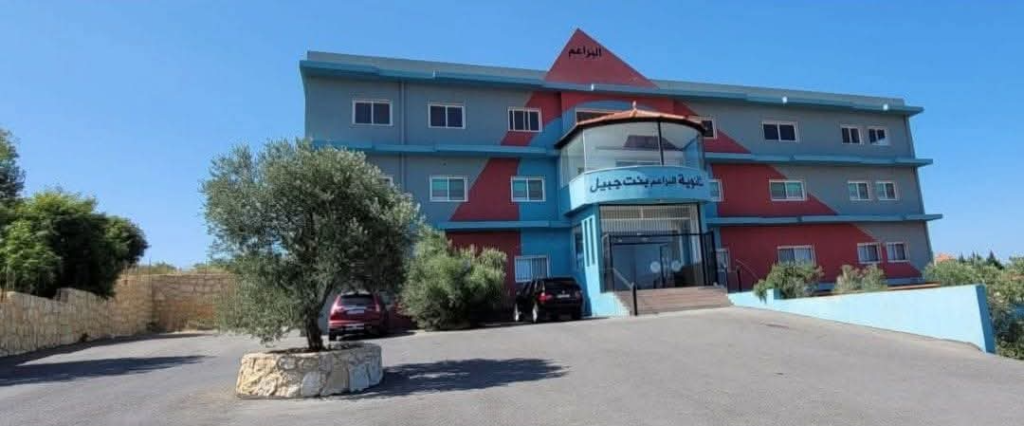
Lia, the four-year-old, knew her way to Al-Baraem School in Bint Jbeil the way children know their way to joy. There, the school was not, for her, merely a building of floors, classrooms, and small desks, but a whole world of colors, songs, and movement. She would dance during the activities, laugh with her friends, learn new letters, and return home loaded with small details that may not seem important to grown-ups: a drawing the teacher hung up, a game in class, a new word she had memorized, and a friend who sat beside her.
Then the war came, and Lia was taken from her school, first by displacement. The morning route was gone, the classroom was gone, and the courtyard in which she had been growing up quietly was gone. After that, the school itself was taken away again, when it was destroyed. For the child, the loss was no longer a big idea called “the education sector,” but a simple sentence that sums up what reports cannot say in full: “I love my school, and I want it to come back the way it was.”
A war on the educational infrastructure, in numbers
UNICEF noted in its humanitarian report issued in December 2024 that the start of the 2024–2025 school year was delayed by several weeks, disrupting the education of more than one million students in Lebanon, and that a preliminary assessment conducted by UNICEF and the Ministry of Education showed at least 14 schools destroyed and about 105 schools severely damaged, in addition to about 500 schools that had been used as shelter centers and sustained minor damage.
As of April 2026, the Ministry of Education still does not have a final count of the number of schools damaged or completely demolished for 2026. An informed source at the Ministry told Silat Wassel that an official count is not possible as long as the war continues in the south, and as long as the specialized teams are unable to enter every village and conduct a comprehensive field survey. According to the source, the actual survey will begin after the war ends completely, to cover both public and private schools and to classify the damage between total demolition and partial damage. Even the numbers of martyred students and teachers still have, according to the same source, no final, documented figure.
Targeting schools… and targeting the conditions for return
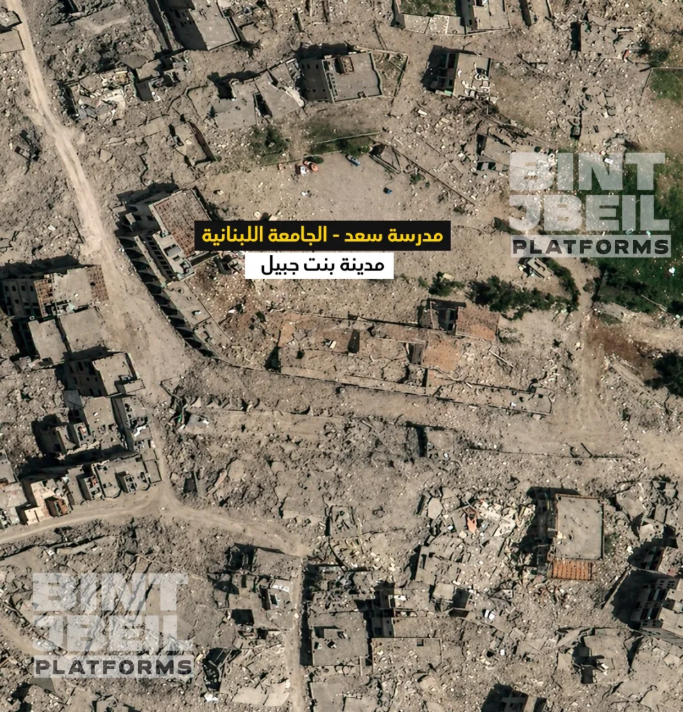
In the city of Bint Jbeil, for example, the school does not represent a building that serves the city’s residents alone, but an educational hub for the surrounding villages. The mayor of Bint Jbeil, Mohammed Bazzi, says: “What the city and the villages of the south are subjected to in terms of widespread blasting and destruction, especially after the announcement of the ceasefire, cannot be dealt with merely as war damage, but as a policy of organized destruction targeting the civilian built environment, the historical identity, and the economic and social structure of the city.” He adds that the data and aerial maps the municipality obtained as of April 27, 2026, confirm the expansion of this pattern of destruction.
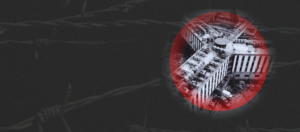
In the education sector, Bazzi explains that before October 2023, Bint Jbeil used to attract around 12,000 students, about 10,000 of them from outside the city and around 2,000 from within it. After the support war, the number fell to around 5,500 students, 70% of them from outside Bint Jbeil and 30% from within it. According to Bazzi, Bint Jbeil contains 14 educational establishments, three of which suffered total destruction: Al-Baraem School, Al-Ishraq School, and the Lebanese University building, while the rest of the institutions sustained partial damage.
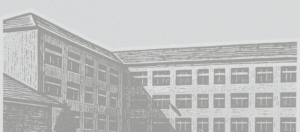
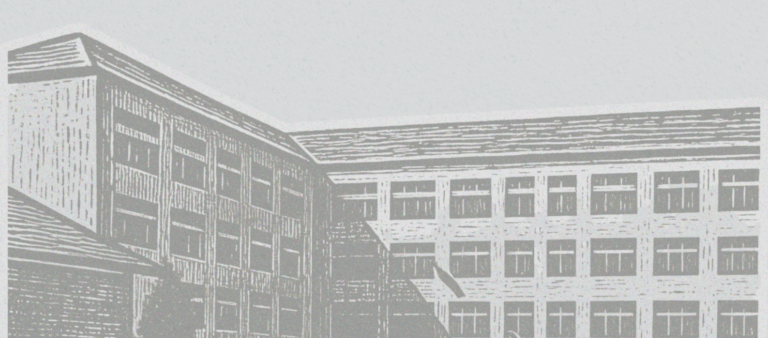
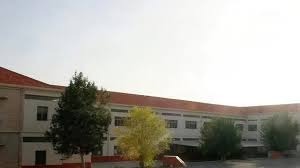
Al-Baraem School appears as a clear example of this kind of compound targeting. The administration of Al-Baraem School says the school opened in 2019 with the aim of supporting the steadfastness of residents in the border villages and towns by providing education for their children. Despite the difficult security conditions before the war, the number of its pupils exceeded 300, distributed across Bint Jbeil and the towns of Beit Yahoun, Haddatha, Kounine, Aynata, Aytaroun, Blida, Yaroun, Al-Tiri, and Hanin.
“The administration of Al-Baraem School says the school opened in 2019 with the aim of supporting the steadfastness of residents in the border villages and towns”
Nevertheless, the school’s educational role did not stop at the building’s walls. The school administration describes what happened as the targeting of an educational establishment “that has nothing to do with military operations,” and says that the school, despite its destruction, continued teaching remotely to safeguard the pupils’ future. The administration adds that, after the return, a tent will be set up on the school grounds to continue education.
In Aytaroun as well, four educational institutions used to attract hundreds of male and female students before October 2023. Fatima Touba, principal of Al-Jaafariya School in Aytaroun, noted that the Martyr Said Mawasi public school had about 220 students, Al-Wafaa School about 200 students, and the Martyr Hussein Awada public secondary school about 130 students, while Al-Jaafariya School attracted around 300 students. After 2024, these numbers declined as a result of the war and displacement, and the schools were destroyed. Touba points out that Al-Jaafariya School had undergone renovation after the 2024 war, but it was demolished again, completely, in the current war. In Blida, one school used to attract around 175 students, and it was demolished in the 2024 war.
In this context, UNICEF reported in April 2026 that education in Lebanon suffered severe disruption as a result of the escalation and displacement, as 364 public schools and 58 vocational and technical education institutions were used as shelter centers out of 669 collective centers, while 439 public schools remained closed in the south, Nabatieh, the Bekaa, Baalbek, and Beirut’s southern suburb due to insecurity, evacuation orders, or proximity to conflict areas. The report estimated that these closures directly affected around 256,000 students, in addition to disrupting 16,400 young people’s access to vocational education because of the conversion of 58 vocational institutions into shelter centers.
When the building is demolished, what happens to learning?
Nidal Jouni, a specialist in educational leadership, says: “The school building is not a ‘set of walls.’ It is an educational, psychological, and social structure that organizes educational life and gives the child a sense of stability, safety, and belonging. When this building is demolished, we do not only lose a place for education; we lose a daily system that helped the child organize their life.” The school, as she explains, is not just classrooms, desks, a board, and computers, but a morning routine, arrival and departure times, a break, attendance and absence, and rules of social interaction. Inside the school, the child acquires “the profession of being a pupil,” and moves from their identity as a child at home to their identity as a learner within an organized group.
Jouni points out that a child in a shelter or displacement center experiences a complete overlap between their personal life and their educational life: sleep, food, noise, cramped space, lack of privacy, and the mixing of ages and levels. Education may be technically available, but “learnability” itself becomes limited and fluctuating depending on the family’s circumstances. She notes that the absence of temporal and spatial organization affects not only discipline, but also basic skills such as reading, because reading requires perceiving the temporal and spatial gaps between words and sentences.
Jouni adds that rebuilding schools must be treated as a priority in reconstruction, because it is a matter of educational and social justice. The school building rebuilds trust: the child’s trust that they have a fixed place, the family’s trust that return is possible, and the teacher’s trust that they are not working alone. She points out that the existence of the school is important for teachers as well, because they need professional learning communities within schools, where they exchange experiences and support one another in facing the burdens of post-war education.
“Jouni adds that rebuilding schools must be treated as a priority in reconstruction”
Local testimonies from Bint Jbeil, Aytaroun, and Blida reveal that the destruction of schools strikes an entire social function: anchoring families in the villages, easing the cost of commuting, connecting villages to an educational hub, and giving children a sense that daily life is still possible. Therefore, targeting or destroying them does not strike only the educational present, but strikes the very conditions for return.
In the end, the question is not only how many schools were demolished, important as that number is. The deeper question is: what happens to a border village when it loses its school? And what happens to a teacher who is asked to rebuild meaning without a building, without tools, and without a stable school community? When a school is shelled, it is not only the classroom that is shelled. What is shelled is school time, belonging, routine, return, and the very idea that a child has a place in which their personality takes shape and which awaits them every morning.