








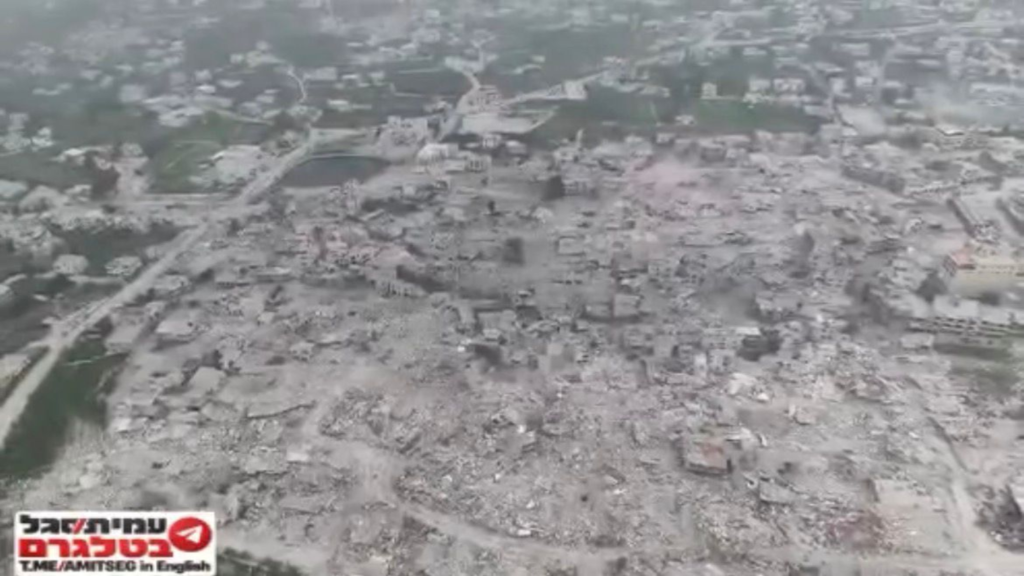
The destruction in Bint Jbeil was not confined to homes. Aerial imagery and local testimonies reveal that the targeting reached a wide network of facilities on which daily life in the city depends — from infrastructure and commercial establishments to schools, hospitals, roads, and public buildings. With the aggression ongoing and the conditions for a safe return absent, all of the city’s residents were forced to flee. The Bint Jbeil municipality, through the displacement platform it created, documented around 2,000 displaced families scattered across different regions of Lebanon. In this reality, the question is no longer limited to the number of demolished buildings, but rather to the capacity of a city that has lost a large part of its population and essential facilities to receive its people once again, and to secure the minimum conditions for housing, work, and stability.
"Around 2,000 displaced families scattered across different regions of Lebanon"
A Map of Destruction That Goes Beyond Homes
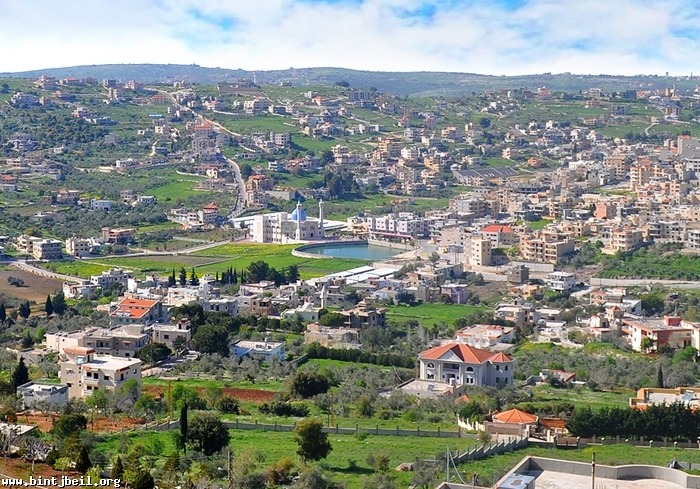
A visual investigation published by Al Jazeera on April 28, 2026, based on satellite imagery and open sources, showed that more than 1,500 buildings were destroyed in Bint Jbeil, as part of a broad pattern of destruction in the border villages and towns of southern Lebanon. The significance of these images lies not only in showing the scale of the rubble, but in revealing how the damage was distributed across wide parts of the city and its vital centers.
The mayor of Bint Jbeil, Mohammad Bazzi, likewise confirms that the destruction and bulldozing reached the infrastructure and vital facilities that form the foundations of life in the city. He points out that the electricity, water, and internal road networks were destroyed or extensively damaged, and that the damage also affected the commercial market, the municipal stadium, the Ogero building, the government serail of Bint Jbeil, the social affairs center, and most of the city’s schools, in addition to Salah Ghandour Hospital and the public hospital, all to varying degrees of damage.
Bazzi adds that a family considering return does not need only a house, but a passable road, water, electricity, a school, a health center, and institutions able to function. Without this network, return becomes a decision fraught with instability.
Commercial Facilities Out of Service
Bazzi says that the demolition operations, which expanded after the ceasefire, struck large establishments selling household goods, hardware, electrical appliances, clothing, and footwear, in addition to small and medium-sized shops such as supermarkets, vegetable stores, butchers, and bakeries. The damage also reached other commercial areas inside the city, including Saff al-Hawa, alongside establishments spread across more than one location.
These facilities were not merely points of buying and selling; they secured the residents’ daily needs, employed dozens of families, and connected Bint Jbeil to the surrounding villages that rely on it as a hub for services and trade.
Bazzi notes that there are not yet precise final estimates of the material losses in the city. However, preliminary estimates point to millions of dollars, especially since the damage affected large commercial establishments, along with a wide network of small and medium-sized enterprises, as well as infrastructure and public facilities.
The Chain of Economic Loss
Economics professor Sawsan Jaber reads this scene as a direct disruption of the local economic cycle. When the owner of a shop or an establishment loses their source of income, the loss does not stop at the individual, but extends to the family, the employees, the suppliers, and the consumers.
Jaber explains that declining income pressures consumption, weakens investment, and shrinks job opportunities within the city, gradually leading to higher unemployment and a lower standard of living.
She also draws attention to the difference between small shops and larger establishments. A small shop may support a single family, with its owner and family members working in it, while a larger establishment may employ 25 or 30 people — that is, dozens of families that depend directly on the continuation of its work. In this sense, the loss of a single establishment is not an individual loss, but a social one that extends to an entire network of economic relations.
"Jaber explains that declining income pressures consumption, weakens investment, and shrinks job opportunities within the city"
Jaber believes that the possibility of recovery is tied to several factors, including the residents’ attachment to their land, the role of Bint Jbeil’s sons in the diaspora — especially in the United States — as well as the possibility of cooperating with donor bodies. She considers that rehabilitating the essential facilities, reopening the shops, and re-employing families can gradually restore the economic cycle, provided that funding and stability are available.
This reading also aligns with the conclusions of the United Nations Development Programme report issued in January 2025, which was based on a survey covering 135 affected areas between December 5 and 15, 2024, and which showed that local recovery does not rest on restoring buildings alone, but on restoring the capacity of municipalities, infrastructure, essential services, and local institutions to function anew.
What Bint Jbeil has lost cannot be measured by the number of demolished buildings alone. The places where people work, where children learn, where the sick receive treatment, and where residents buy their daily needs have all been damaged. For this reason, reconstructing the city does not mean rebuilding stone alone, but restoring the conditions of life that allow its people to return and to stay.