





In the town of Hammana, the kitchen was no marginal detail in the daily life of displacement during the 2024 war. It was the place from which the simplest and harshest daily questions began: What will people eat today? Who will cook? Who will cut the vegetables? Who will wash the dishes? And who will bear, every single day, the pressure of feeding hundreds of families who had fled their homes in haste?
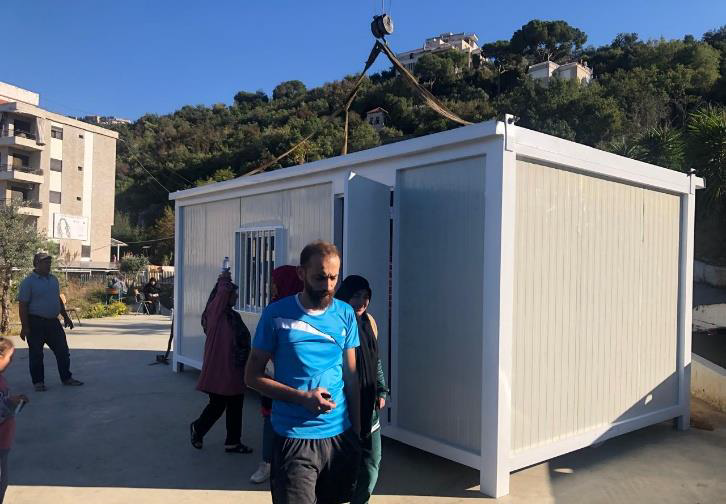
Fatima Nemer, one of the participants in the community kitchen who later took part in the discussions around preparing a community-kitchens guide, recounts that a small group of women took on the responsibility of preparing large quantities of food at the Hammana school. Fatima, an experienced cook, was among the women who carried the heaviest burden. The kitchen did not serve only those staying at the school; at times it was part of a wider system to feed displaced people spread across more than one center.
Every day, the team had to start from scratch: securing supplies, washing vegetables, cooking, distributing, cleaning, and then thinking about the next day’s meal. Over time, a problem emerged that was not tied to food alone, but to the distribution of effort. A small number of women worked long hours, while some residents refused to take part — either because they were not used to this kind of work, or because they felt that helping in the kitchen should be paid.
The situation worsened when a rumor spread that the women working in the kitchen every day were being paid an allowance. The rumor was untrue, but it left its mark. Some began to ask: why should we help if they are getting paid? The number of new volunteers fell, the team’s morale dropped, and the kitchen turned, at certain moments, from a space of solidarity into a place where suspicion, reproach, and misunderstanding intersected.
When the Kitchen Carries the Women’s Exhaustion
What happened in Hammana was not a passing dispute over work inside the kitchen. This experience revealed that the community kitchen is not limited to producing food; it also exposes the relationships within a displacement center: who works and who waits, who feels they carry the heaviest burden, and who is accused of taking advantage or falling short. This conclusion aligns with what studies on collective kitchens and food security point to, including a study by Engler-Stringer and Berenbaum, which sees these spaces as turning also into places that produce mutual support, social relationships, and sometimes tensions related to trust, fairness, and the sharing of work.
In this sense, community kitchens became a broad field test: How can people in displacement be fed without turning them into passive recipients? And how can food become part of organizing life inside the shelter, rather than just a meal that arrives in a box and ends at the door of the room?
From Feeding the Displaced to Organizing Food With Them
Dr. Rami Zurayk, an expert in food systems and food security and vice-president of the Dalla association, explains that the importance of the community kitchen lies in shifting the food response from the logic of “feeding the displaced” to the logic of “organizing food with them.” Ready-made food, despite being necessary in the first hours or days of displacement, remains limited in its ability to last. Its cost is high, the rate of waste in it is greater, and it often does not account for dietary and health differences or local customs.
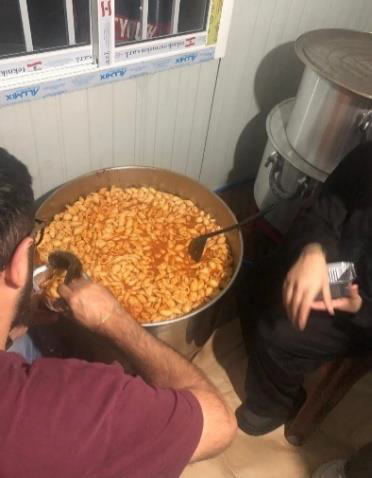
By contrast, the community kitchen, when well managed, allows meals to be planned according to local, seasonal ingredients, and in a way that suits people’s tastes and needs. Mujaddara, stews, rice, lentils, salads, and the dishes people know and welcome can be prepared, instead of food becoming a uniform box that has nothing to do with their customs, their health, or their daily memory.
"When well managed, the community kitchen allows meals to be planned around local, seasonal ingredients"
But this model does not work automatically. As Zurayk points out, the community kitchen needs clear management, equipment, training, a rotation system, food-safety standards, accountability, and clear communication with the displaced and the host community. Without that, the kitchen may turn into an additional burden, especially on the women or volunteers who find themselves responsible every day for preparing hundreds of meals.
In Dalla’s experience, the goal was not only to secure food, but to build what was called a “standardized emergency food system” — a model that links the kitchen to a wider chain of local supply: grains and oils from relief partnerships, vegetables and fruits from local farmers, and protein sources from nearby markets. In this way, aid does not remain isolated from the place where the displaced families settle, but becomes part of the economic cycle of the host community.
When the Experience’s Success Is Not Enough
Jihad Tabboush, a civic activist and sports volunteer at the Hammana public school, says the food file in displacement centers was supposed to be handled by a clear official body, under the supervision of relevant ministries such as Health and Social Affairs, and with direct state support. But amid the absence of this official role and weak support, the centers were forced to rely on youth initiatives, civil-society associations, and partisan and sports groups.
Tabboush notes that the central-kitchen experience in Hammana during the previous war was relatively successful, after an equipped kitchen was secured with funding from a supporting party. The presence of a professional cook who had run a kitchen in Tyre before being displaced with her work team to the Hammana public school also helped. This contributed to organizing the daily work inside the kitchen, alongside securing the oven, equipment, and raw materials, while those running the center covered additional expenses such as transport, delivery, and plastic supplies.
In the current war, Tabboush explains, the situation is entirely different, especially in terms of financial and in-kind support. It is no longer possible to run a central kitchen as before, which has pushed the centers to rely on small kitchens supported by youth and partisan bodies and civil-society initiatives.
For this reason, Tabboush believes that talk of community kitchens cannot remain within the framework of temporary initiatives or individual zeal. These kitchens need stable funding, a clear emergency plan, defined management and responsibilities, and food-safety standards, instead of relying each time on the capacity of a small group of volunteers to endure and carry on.
"Tabboush believes that talk of community kitchens cannot remain within the framework of temporary initiatives or individual zeal"
Baalchmay: When Cooking Turns Into Daily Tension
Hassan Ghadban, who works on the displacement file at the Baalchmay center, says the experience of cooking inside the schools was not as easy as it first seemed. When the option was raised for each school to cook its own meals according to the needs of the families staying in it, daily disputes quickly emerged among the displaced over the distribution of roles: Who will do the cooking? Who will wash the dishes? Who will chop the vegetables? Who will take part in the work and who will abstain from it?
Ghadban explains that some families refused certain meals, or objected to the type of food offered, on the grounds that their members do not eat this kind of food. Over time, organizing the kitchen inside the center turned into an additional source of tension among the families, instead of being a means to ease the burdens of displacement.
For this reason, the center returned, according to Ghadban, to the option of providing ready-made meals, while informing families in advance of the type of food set for the next day. If the meal was, for example, rice and fish, the families are told, and whoever does not wish to eat it tries to secure a suitable alternative.
The Kitchen as a Miniature Local Economy
Sara Salloum, head of the Agricultural Movement association and one of the participants in the dialogue sessions on preparing the community-kitchens guide, affirms that this guide gained particular importance because it was issued by the American University of Beirut, which gave it, in her words, “high credibility” that associations and bodies working in the food response can benefit from. She believes that documenting the experience is no less important than implementing it, because many initiatives enter the field of relief work without a clear framework or accumulated knowledge.
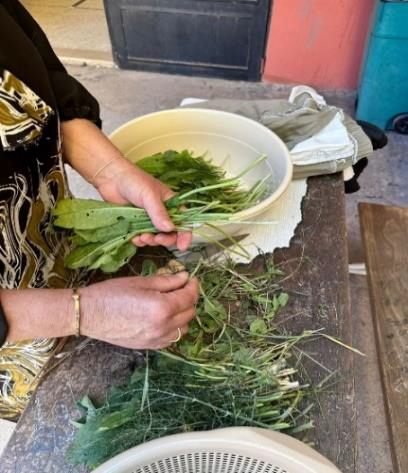
Salloum notes that the previous war saw the equipping of a number of kitchens in shelters, in addition to kitchens that cooked and distributed food or raw materials. Among these experiences, she recalls the “Bouzour Sour” (Seeds of Tyre) kitchen, where ingredients originally preserved as basic mouneh — such as mulukhiyah and okra — were used before quickly being turned into food for the displaced.
In the current war, Salloum explains, the association’s focus has become greater on supporting “the steadfast” — those who remained in their villages and homes — not the displaced alone. For this reason, the association helped the “Bouzour Sour” kitchen financially and logistically, and sent foodstuffs and fresh vegetables from the land, such as onions and cabbage, to shelters and kitchens. It also supported social kitchens in Beirut and sent fresh produce from local farmers, especially those who rely on little or no chemical farming.
"Salloum explains that the association's focus has shifted more toward supporting 'the steadfast' in their villages and homes, not the displaced alone"
What Do People Actually Eat?
Salloum points out that the support was not limited to cooking, but also included food baskets for the steadfast, containing mouneh, olive oil, za’atar, kishk, jam, olives, labneh, pickled cowpeas, eggs, and fresh vegetables. In this context, she criticizes the standards adopted by some international bodies in food baskets, considering that they do not take into account what people actually eat or the nature of the local kitchen, as they often focus on rice, oil, and lentils, without paying attention to essential elements of daily Lebanese food.
This observation brings the discussion back to the essence of food security: the issue is not only the number of calories reaching the family, but the quality of the food, its edibility, its connection to local customs, and its ability to preserve a minimum of health and dignity. A family used to having olives, za’atar, kishk, labneh, vegetables, and eggs in its daily food cannot have its needs reduced to a bag of rice and lentils and a bottle of oil, especially when the crisis drags on and relief food becomes part of the daily way of living.
Salloum adds that the challenges in this war are harsher, because of the high cost of transport, the rising price of gas, and the declining purchasing power of displaced and steadfast families, in addition to the shrinking of aid despite the growing number of people in need. She believes that what is happening is “a systematic reduction of aid,” at a time when families are draining their savings and gradually lowering the quality of their food at home.
Supporting Farmers as Part of Relief
Salloum affirms that supporting farmers is an essential part of any fair food response. Buying vegetables, eggs, and fresh produce from them does not only help families in need, but also protects the farmers’ ability to continue producing. She explains that the association is currently trying to secure alternative protein sources, such as mushrooms, alongside searching for fodder for the steadfast farmers who raise cattle and sheep, because their continuation is part of the resilience of the entire local community.
In this sense, the community kitchen is no longer merely a place to cook. It becomes a link connecting the displaced, the farmers, the volunteers, the shops, the associations, and the host community. When vegetables are bought from a local farmer, or home mouneh is used in a communal meal, or fresh produce is sent to a shelter, the food response also becomes a protection for a small economic cycle that the war is trying to disrupt.
For this reason, community kitchens are not a side project — provided they do not turn into a substitute for the state’s responsibility or into an additional burden on women and volunteers. What is needed is not kitchens that only secure food, but networks capable of keeping people organized and able to carry on. In a country living through repeated displacement and an open war, it is not enough to ask: who will feed people today? But rather: how do we help them remain active and capable within the web of life that the war is trying to dismantle?