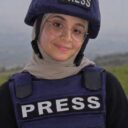





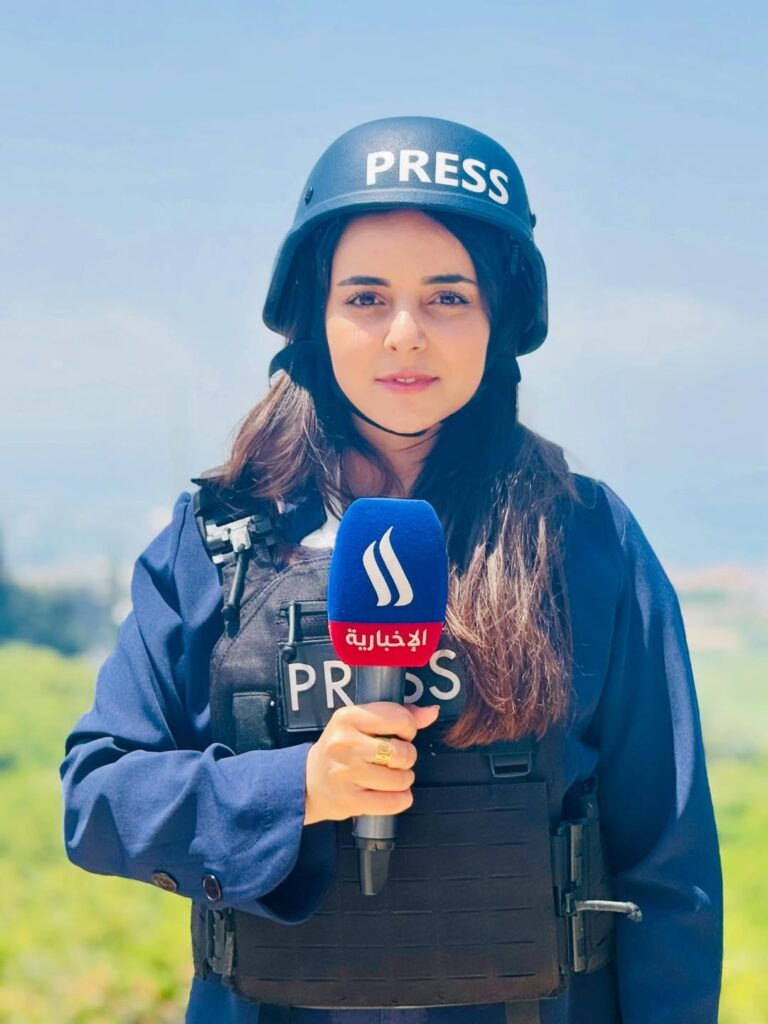
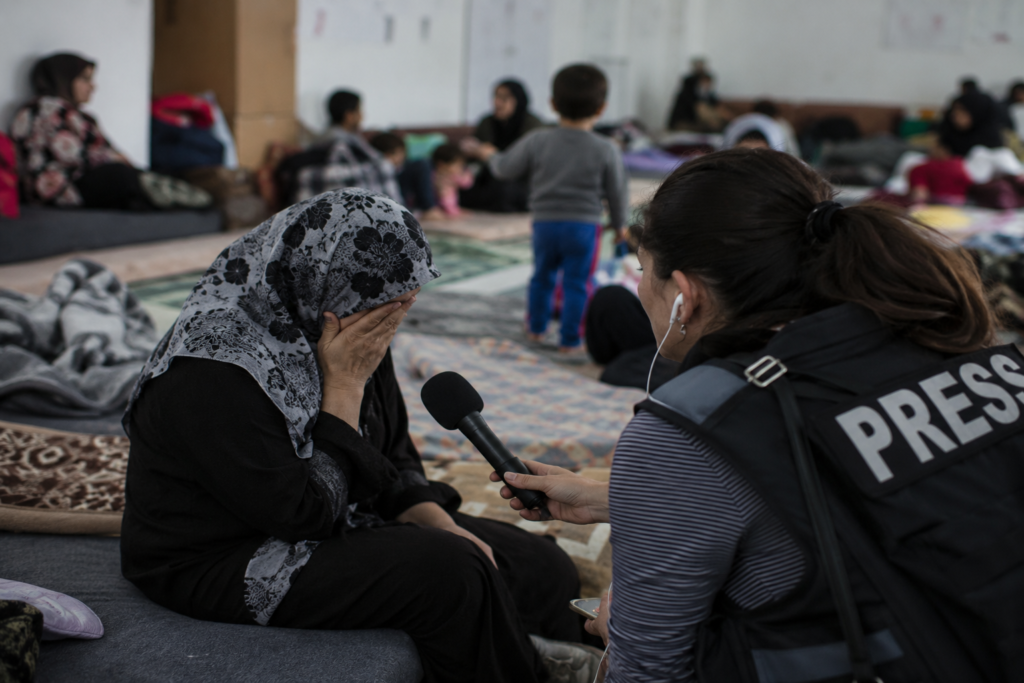
Just days after publishing an interview she had conducted with a displaced woman from the southern village of al-Kharayib, Ryan Abd al-Nabi, a correspondent for the Iraqi News Channel, received news she never could have anticipated. The correspondent had met the woman inside the displacement center at Sports City in Beirut, where the woman spoke on camera about water shortages, poor sanitation, and the absence of basic services. The interview was no different from dozens of other stories she had covered during the first months of the war, when she moved daily between displacement centers to document the conditions of displaced families and carry their voices to the public.
The video spread quickly across social media and became widely circulated material. For Abd al-Nabi: “The goal was clear: to shed light on the suffering of displaced people in the hope that it would prompt the relevant authorities to intervene and improve conditions inside the center. But what happened next was entirely different. Just two days later, I learned that the woman had been expelled from the displacement center following the video’s spread.”
"The goal was clear: to shed light on the suffering of displaced people"
Abd al-Nabi says this incident was among the most impactful experiences of her professional career. Rather than helping to improve the woman’s circumstances, the report ended up compounding her suffering. Since then, she has come to view human-interest interviews from a different angle — one that goes beyond the importance or journalistic necessity of the story, extending to a consideration of the potential consequences for the people who agree to speak on camera.
During the war, journalists found themselves navigating a complex landscape. On one hand, there was a professional duty to report what was happening inside displacement centers and to give voice to those affected; on the other, there was an ethical responsibility toward people living through extraordinary moments of loss, fear, and uncertainty. Between these two considerations, new questions emerged about the boundaries of journalistic coverage and the ethics of engaging with the most vulnerable groups.
Between the Need to Document and Respecting Refusal
The incident involving the displaced woman from al-Kharayib was not the only case that led Abd al-Nabi to reconsider her relationship with the camera and the people she interviews. At one of the displacement centers in the southern village of Bnaafoul, she encountered a displaced family that included two young men with hearing impairments. She saw in their story a model of compounded suffering worth telling, especially given the difficult circumstances the family was enduring.
However, one of the two young men refused to appear on camera or speak to the media. Abd al-Nabi says she was convinced that sharing his story could help communicate his needs and perhaps improve his circumstances — yet her professional desire came up against his personal wish not to be shown publicly. In the end, she chose to respect his decision, settling for conveying a portion of the family’s reality through other members.
She explains that this type of situation recurs constantly during field coverage, particularly inside displacement centers. Many people are willing to speak with journalists away from the camera, but hesitate when it comes to public appearances or the disclosure of details from their personal lives.
"Many people are willing to speak with journalists away from the camera"
She also recalls another experience while preparing a report on pregnant women and new mothers inside displacement centers. Some women would speak about the challenges they faced regarding healthcare or living conditions, yet refused to share these details on camera. Others preferred not to show their children or reveal their identities. Each time, the journalist had to find a way to convey reality without crossing the boundaries that the subjects themselves had set.
The Angle We Choose Says Who We Are
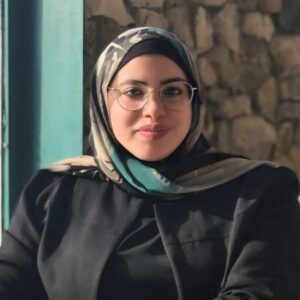
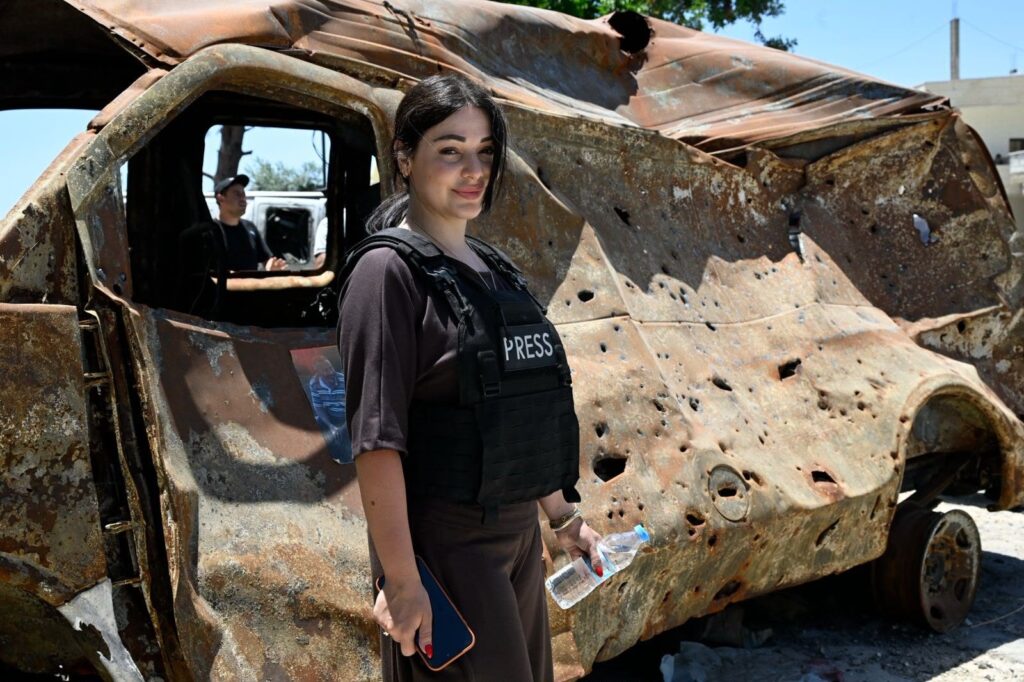
For independent journalist Fatima al-Bassam, the matter does not begin at the threshold of consent to filming or its refusal — it connects to a deeper understanding of the role of those working in journalism. She believes that journalistic work reflects the character of the person who practices it and the values they hold, and that the way human stories are told reveals much about the journalist’s view of people and of the profession.
Al-Bassam says that any story can be approached from dozens of different angles, and that it is ultimately the journalist who chooses which angle to adopt. In situations of displacement and war, this choice becomes more sensitive, because the people who appear in coverage are not mere sources of information — they are individuals living through harsh circumstances who possess dignity and privacy that must be respected.
She explains that she always takes care to choose an approach that allows the message to be conveyed without causing embarrassment to the people involved or exposing them to further harm. The purpose of coverage, in her view, should not merely be to produce compelling material, but to tell a story that respects its subjects and preserves their humanity.
She also points out that the problem does not end at the moment of publication. In the age of social media, interviews and photographs can become material for bullying, mockery, or judgment, adding a new burden on people who are already living with the effects of war and displacement. She therefore believes that journalists must think in advance about the impact the content may have after it is published — not only at the moment of its production.
Among the most sensitive issues, al-Bassam highlights the handling of children during media coverage. Photographing children or interviewing them without the consent of their guardians, or pushing them to relive painful experiences they have endured, raises ethical questions that cannot be ignored. She considers that a child is not journalistic material, but a person who requires heightened protection in conditions of war and crisis.
"She considers that a child is not journalistic material, but a person who requires heightened protection in conditions of war and crisis"
She adds that a journalist can test their professional decisions through a simple question: would I accept being treated — or having a member of my family treated — in the same way if I were in this situation? For her, this question serves as a fundamental standard before taking a photograph, asking a question, or publishing a human-interest story.
A Manual Born from the Heart of War
As debate over the ethics of media coverage during the war widened, the need for a professional reference to help journalists navigate these challenges began to emerge. Here, journalist and member of the administrative board of the Lebanese Journalists’ Union, Safaa Ayyad, notes that objections to photographing displaced people and conducting interviews with them increased from the outset of the Israeli aggression against Lebanon — both inside displacement centers and during moments of displacement along roads and in public spaces.
"Objections to photographing displaced people and conducting interviews with them increased from the outset of the Israeli aggression against Lebanon"
She explains that these observations prompted the preparation of a guidance manual for journalists covering wars and displacement, developed in collaboration between the Lebanese Journalists’ Union and the Social Workers Syndicate, with the participation of the Ministry of Social Affairs.
The manual did not emerge from a vacuum — it drew on experiences that journalists themselves had lived through during their war coverage, and on problems that recurred in the field, where many found themselves struggling to balance their professional duty to report events with respect for the privacy and dignity of those affected.
Ayyad notes that the manual calls on journalists to assess the psychological and social state of individuals before conducting interviews or filming, and to choose the appropriate time and place to engage with them — particularly when they are in a state of shock, distress, or deep grief.
"The manual calls on journalists to assess the psychological and social state of individuals before conducting interviews or filming"
It also emphasizes the necessity of obtaining free, informed, and prior consent from individuals after explaining the purpose of the interview and how the media material will be used, while affirming their full right to refuse participation or withdraw at any time without any pressure or embarrassment.
Among the principles contained in the manual: avoiding questions or images that may exploit people’s suffering or re-enact the trauma they have experienced; protecting privacy and identity when necessary; verifying information before publication; and adopting media language that respects human dignity and steers clear of stigmatization and prejudgment.
The manual draws particular attention to children as the most vulnerable group in situations of war and displacement, calling for interviews with them or disclosure of their identities to be avoided except in necessary cases that serve the best interests of the child and ensure their safety.
Ayyad explains that the manual is not distributed to journalists alone — it is also adopted inside displacement centers, with the aim of deepening the understanding of center staff, photographers, and journalists of the principles that govern professional and ethical coverage in times of war.
During wars, the camera becomes a witness to the daily losses people endure. Yet it is equally capable of becoming a source of additional pressure if not used with sensitivity and responsibility. Between the need to document reality and amplify the voices of those affected, and the duty to protect the people living that reality, complex equations take shape daily — equations for which there are no easy answers.
For Ryan Abd al-Nabi, the story of the displaced woman from al-Kharayib remains present in her memory every time she picks up a camera. For Fatima al-Bassam, the way a story is told is no less important than the story itself. And as professional institutions today seek to establish clearer standards for coverage, the question that accompanies every interview, every photograph, and every testimony remains: how can the full truth be conveyed without those who lived it paying an additional price?