







Investigative Report – Part One
The face of life in Lebanese cities has changed drastically. Despite their beauty, pollution has spread everywhere. Foul odors now fill the streets, hover over homes, and beaches have turned into dumps for waste and breeding grounds for insects after untreated sewage water began flowing through hundreds of outlets scattered along the coast. Pollution has taken over, epidemics and diseases have spread, lives have been lost, and money has been drained.
Among more than 70 wastewater treatment plants in Lebanon — most of which are now completely shut down — Tyre’s plant stands out as a stark symbol of disappointment. After years of anticipation and hope that the city and its surroundings would finally tackle the sewage crisis, improve the lives of thousands, and reduce environmental pollution, the facility came to a halt. Today, Tyre faces an escalating environmental catastrophe. This investigation seeks to uncover the truth behind the funding allocated to Lebanon’s sewage sector over the years and sheds light on the current situation in Tyre and its outskirts, while answering urgent questions surrounding this tragic reality.
Massive Funding… Catastrophic Outcomes!
Statistics on Sewage Project Funding
Statistics from the “Gherbal Initiative” revealed that the value of loans and grants allocated to waste management, pollution control, and sewage projects from 1990 to 2024 exceeded $2.205 billion. This sector ranked as the third largest recipient of loans, with a share of 14.1%, as shown in the figure below:

Source: Gherbal Initiative
It’s worth noting that the Lebanese state received 1,089 loans and grants amounting to $9.8 billion from 228 entities between 2001 and 2021. These came from both local and international sources, based on information provided by only 28 state administrations out of 204 approached. According to the Gherbal Initiative’s fifth annual report, titled “Transparency in Lebanese Public Administrations 2022”, 96 administrations failed to respond, while 108 replied — of which only 28 provided full data, whereas 80 supplied incomplete information.
Despite spending $1.3 billion on the sewage sector… Lebanon faces an almost total shutdown of wastewater treatment plants.
A report issued by the Council for Development and Reconstruction (CDR) stated that 463 contracts were signed in the sewage sector, worth $1.392 billion, to implement projects across various regions of Lebanon. Moreover, loans and grants approved between 1992 and 2024 in this sector reached $1.298 billion, with the European Union standing out as the largest contributor, providing $454 million, as shown in the chart below:

Source: Council for Development and Reconstruction (CDR)
Another CDR report highlighted that the value of ongoing contracts in the sewage sector exceeds $657 million, with an overall completion rate surpassing 74%.
The table below shows two wastewater collection and treatment projects in the Tyre coastal area, with one valued at $358,719 and the other at $24,134,305, both recorded in 2021.

A table showing the value of contracts for sewage projects in Tyre City.
In light of these figures and statistics, questions are growing over how Lebanon’s sewage sector has reached such a catastrophic state despite the enormous funding it has received in the form of loans and grants. The frustration deepens when examining the dire state of Tyre’s coastline in particular, which has now become a stark symbol of the failures in managing this sector.
The Current State of Tyre’s Beach
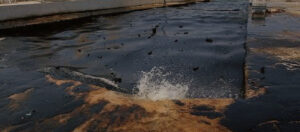
On Tyre’s beach, a disastrous scene unfolds, reflecting the extent of neglect and corruption plaguing the country. Once one of Lebanon’s most beautiful beaches, it has now turned into a sewage dumping ground. Pools of untreated wastewater overflow onto the shore, and even from a distance, the pollution stretching far across the surface of the sea is clearly visible.
On Tyre’s beach, a disastrous scene unfolds, reflecting the extent of neglect and corruption plaguing the country. Once one of Lebanon’s most beautiful beaches, it has now turned into a sewage dumping ground. Pools of untreated wastewater overflow onto the shore, and even from a distance, the pollution stretching far across the surface of the sea is clearly visible.
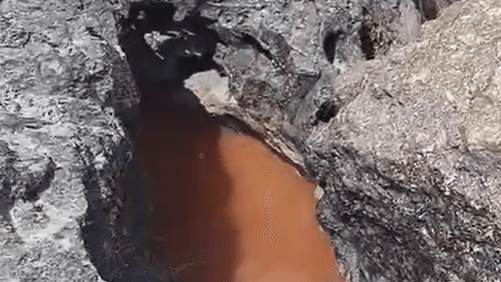
An image from Tyre’s beach, where untreated sewage water flows directly into the sea.
Shocking Testimonies from Tyre Beachgoers Confirm the Gravity of the Situation
Many visitors to Tyre’s beach have expressed deep frustration over its worsening conditions. In a statement to Sila Wasl platform, one beachgoer described the situation as “catastrophic,” calling for urgent solutions to address this environmental tragedy. Another added:
“The waters have become heavily polluted due to sewage discharge. We can no longer swim safely, and even sitting by the beach has become unbearable because of the foul odor coming from the water.”

Untreated wastewater flows directly into Tyre’s sea.
According to the National Council for Scientific Research (CNRS) report on the “Environmental Status of the Lebanese Coast 2024”, released on July 4, 2024, the results of marine surveys conducted at 37 coastal sites from Akkar in the north to Naqoura in the south revealed that the public beach in Tyre is among six sites classified as “cautionary to critical” and unsafe. The report further highlighted that bacterial pollution levels in Tyre’s seawater are considered moderate but the beach remains intermittently or conditionally polluted.
Dr. Tamara El-Zein, Secretary-General of the CNRS, emphasized in the same report the importance of continuous environmental monitoring of Lebanon’s coastline and linking it directly to factors that influence its condition — particularly the performance of wastewater treatment plants.