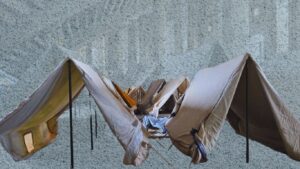









Despite the ceasefire remaining in effect, the tents set up in the Tayouneh area and along Beirut’s waterfront in the Biel district have not disappeared. Instead, they seem to expand with every new threat targeting the south and every airstrike that forces residents to ask the same question: where can a place truly be safe? Inside these tents, displaced families are not living through a brief transitional phase, but rather an open-ended stay until the day they can return. The ceasefire may have reduced the intensity of the bombing, but it did not end the fear, rebuild the homes, or provide families with any real guarantee of return.
From southern evacuation warnings to tents on Beirut’s waterfront
These tents are part of a broader pattern of repeated displacement. The International Organization for Migration indicated that the ceasefire announced on April 17, 2026, contributed to slowing displacement movements compared to the first stage of escalation. However, renewed attacks and the continuation of war in the south, along with repeated and almost daily evacuation orders, undermined this relative stability. Reuters reported on May 3, 2026, that the Israeli army called on residents of several towns in southern Lebanon to evacuate and stay away from their homes. Al Jazeera also stated that the warnings included more than ten towns and villages, among them areas in the Nabatieh district north of the Litani River. Yet these warnings have not stopped to this day. Alerts were recently directed to seven villages in southern Lebanon, with residents instructed to remain at least one kilometer away before airstrikes were carried out.
The Israeli army called on residents of several towns in southern Lebanon to evacuate and stay away from their homes
These warnings were accompanied by renewed shelling in the south and casualties, including civilians and a paramedic, according to reports from agencies and news outlets. Concern has grown further with the escalation reaching the outskirts of Beirut itself. On May 6, 2026, Reuters reported that Israel struck Beirut’s southern suburbs for the first time since the latest ceasefire, saying it targeted a commander from Hezbollah’s Radwan Force. The following day, Reuters footage showed rescue teams searching through the rubble of a building in the suburb after the strike.
The Ministry of Social Affairs calls on displaced people to move to Sports City
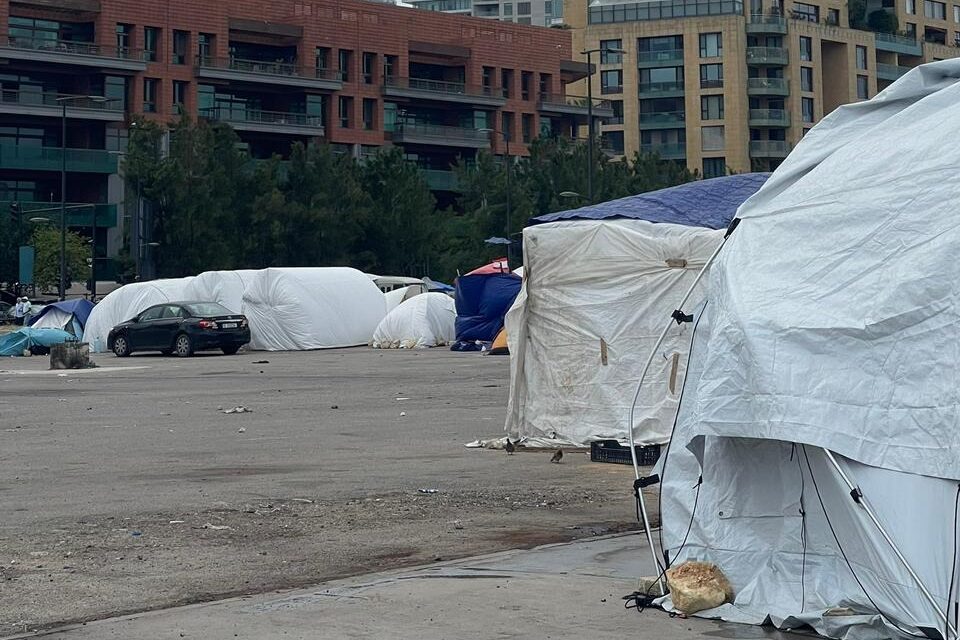
As tents continue to multiply along Beirut’s waterfront, the Ministry of Social Affairs attempted to move the issue from the streets to a more organized shelter center. LBCI reported on Friday, May 8, 2026, that tensions prevailed before Social Affairs Minister Hanine El Sayyed arrived at the waterfront to communicate with displaced families regarding their transfer to Sports City, prompting her to head directly there without passing through the waterfront area. After touring the equipped tents and available services, El Sayyed appealed to displaced people still living on the streets to relocate to Sports City. Local media also reported that a planned visit to the shelter center on Beirut’s waterfront was canceled following objections from a number of displaced residents before the official delegation arrived.
Testimonies from inside the tents
Despite families insisting on staying in the tents, suffering remains present and intensifies with every new wave of displacement. Ali Hussein Atwi, from the town of Siddiqine in the Tyre district, says he was displaced because of the “Israeli aggression” and found no refuge other than the street. “We came here, to the street, and set up this tent and lived in it because we cannot afford to rent a house due to the high costs,” he says. At first, the tent was made of plastic, “and the wind kept tearing it away,” he adds, forcing him to reinforce it with wood at a cost of fifty dollars for the materials. Despite the ceasefire, Atwi says he still cannot return to his hometown in the south because the shelling continues.
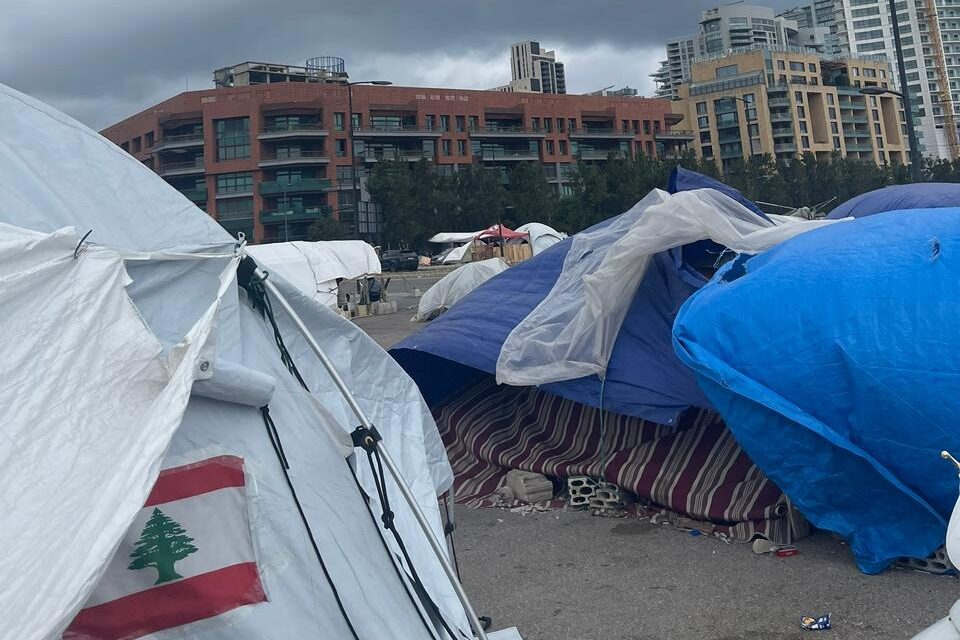
Abeer Yahya, displaced from Kfarkela, experienced a gradual journey of displacement. She first moved from Kfarkela to Nabatieh, then from Nabatieh to a tent in the Biel area. She says she has been living there for three months and arrived accompanied by the dogs she takes care of, while her daughter and grandchildren remained in Nabatieh because they refused to be displaced once again to Beirut. She adds, “If someone offers us help, we take it, but generally we are cut off from everything.”
A war that continues through fear, poverty, and the waiting for a return no one knows when it will become possible
In another scene, Abeer Ali, a Syrian displaced from Beirut’s southern suburbs, says she has not returned to where she used to live because she is afraid and no longer feels safe. “If I go back and then am forced to flee again, where would I go?” she asks. Yet her suffering does not stop at fear of bombardment or the absence of shelter; it is compounded by her status as a displaced Syrian. She says she faces discrimination in receiving aid and that support does not reach her as it does others. She also recounts that her son was threatened because he is Syrian, and that she neither received an aid package nor was allowed to enter a shelter center.
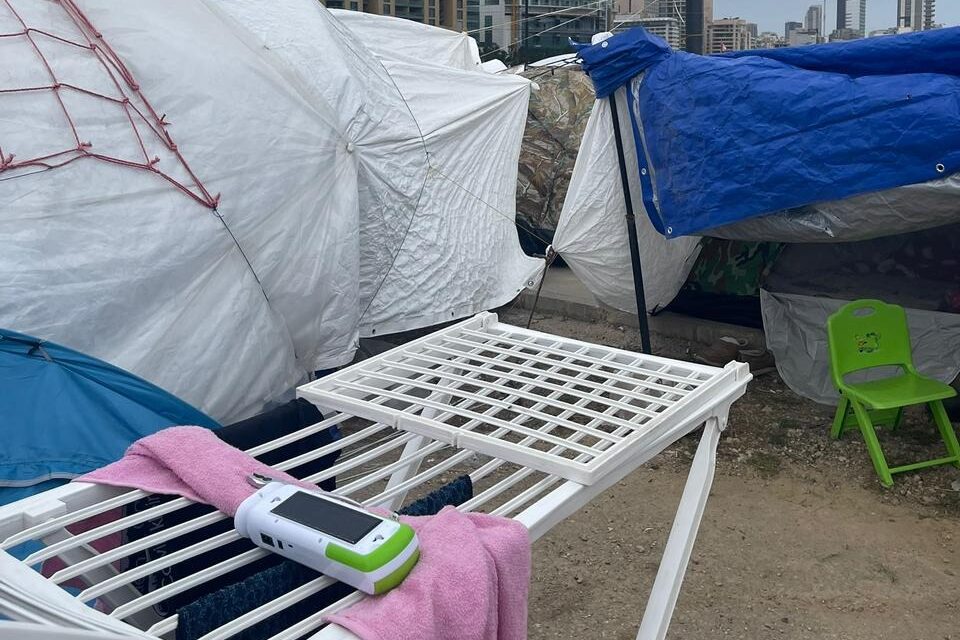
As for Ali Dib, displaced from the Hadath area, he cannot return because the house he had been renting was destroyed. He says he is Syrian and has lived in Lebanon for thirteen years, and what he suffers from most today is the lack of electricity and the inability to charge his phone inside the tent. He is forced to go to Ain El Mreisseh to charge it with the help of one of the guards. Even the bathrooms, he says, are about three kilometers away.
These testimonies show that the ceasefire has not turned into a return home. Southern Lebanon remains under the pressure of warnings and airstrikes, while Beirut’s southern suburbs have once again entered the circle of targeting. Families who lost their homes or their ability to rent now find themselves trapped in tents along Beirut’s waterfront. Here, the tent becomes a witness to a war whose effects have not ended: a war that continues through fear, poverty, and the waiting for a return no one knows when it may become possible.
This report is supported by: