






Over 13,000 pregnant women are currently displaced by the war from Israel in Lebanon, facing malnutrition, extreme stress, and a lack of medical privacy. Between makeshift shelters and a strained healthcare system, these mothers-to-be are struggling to protect their unborn children. Reporting from Sidon and Beirut, we look at the daily battle for maternal health and the specialized networks working to provide a safety net in a time of exile.
Maya is about to light her daily hookah when we meet her at the Ma’rouf Saad school in Sidon. Like her, nearly 550 people have found refuge here, fleeing the Israeli bombings that have forced over a million Lebanese to abandon their homes. Beneath an oversized sweater, the young woman hides her six-month pregnancy. Little Amir is due in three months. “Inshallah,” she smiles, adjusting her brown ponytail. Inshallah, because on this Wednesday, April 8th, the Israeli army once again struck around a hundred targets across the country in minutes, leaving behind nearly 357 casualties and over 2,000 wounded.
Since March 2nd, the date Israeli bombings resumed, a classroom has served as Maya’s home. Exhausted, the mother-to-be recounts her hasty escape: “It took us about eight or nine hours. The roads were saturated; we were moving bumper-to-bumper.” Was she able to bring any supplies to prepare for the baby’s arrival? “Honestly, nothing. We left in our pajamas. We were about to go to bed when it started. We just got up and fled into the night.”
With a weary gesture, the thirty-something woman strokes her belly. “Some women love being pregnant. But me, I am suffering. Since the beginning, I haven’t had a moment’s rest.” The thought of welcoming her first child far from her home village of Ansar causes her deep anxiety. Maya watches the days go by, alternating between brief walks on the corniche with her husband, Ali, and persistent physical pain. The stress has taken a direct toll: she is suffering from severe dehydration. “I forget to drink. Without my medication, I could go three days without water and not even notice.” For her baby’s safety, and despite a brief attempt to return home, she has chosen to stay at the Sidon school, where Amir’s future remains in suspense.
Nutritional precariousness
Also originally from Ansar and staying in the same school, Layal, 28, is experiencing her third pregnancy in conditions radically different from the first two. “For my first two pregnancies, I ate an egg and drank milk every day. Today, I no longer drink milk and the smell of eggs is unbearable when we are all living in a single room.” For Layal, medical follow-up was made possible by the Amel Association, which visits the shelters to perform regular ultrasounds. It was under these conditions that she prepared for the arrival of little Zaynab.
Born on April 17th, on the day of a “ceasefire” that existed in name only, Zaynab quickly had to leave the school; her two older sisters had caught the flu there. To protect the newborn and regain some postpartum privacy, Layal eventually moved to the southern suburbs of Beirut, preferring the uncertainty of the bombings to the overcrowding of the displacement center.
The trauma of “birth under the bombs”
For some, the war reopens deep wounds. Diana, met in Sidon, had to flee Tyre during the surge of Israeli bombings in September 2024. It was at that moment that she gave birth to her daughter, Mila. “I was eight months pregnant when I took refuge at the school. Fear triggered the childbirth. The doctors tried to give me sedatives, but I lost my water because of the terror of the bombings.” Contractions began at 6:00 a.m., followed by a C-section at 12:30 p.m. By the next day, the saturated hospital was already pushing her toward the exit.
Multiple conflicts have scarred the country, and fear and stigma sometimes prevent women from heading to hospitals
Although the staff at the Ma’rouf Saad school are kind, returning there this spring brought the trauma flooding back: “After the birth, I couldn’t even hold my daughter or breastfeed her. With my asthma and the stress, I was suffocating. Walking to the bathroom at the end of the hall was an ordeal when I could barely stand.”
When asked about the possibility of another child, Diana shakes her head categorically: “Sometimes I think about it, but as soon as I remember what I went through, I change my mind. I’m too afraid the war will start again. One child is enough.”
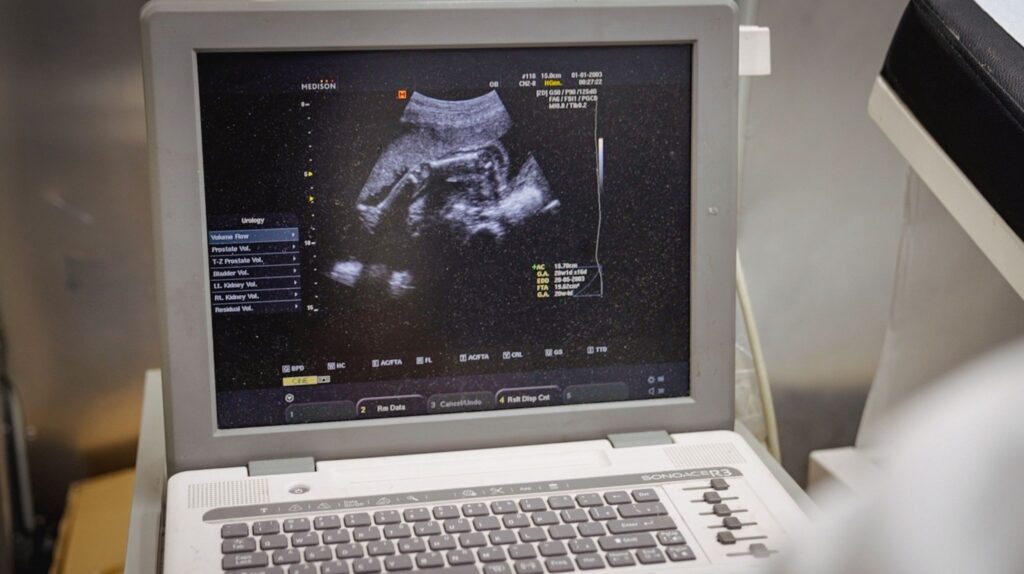
An echography during a consultation from the mobile clinic of SIDC Lebanon
A medical system mobilized by emergency
Faced with these uncertain destinies, medical personnel are attempting to compensate for the collapse of formal structures. The United Nations Population Fund (UNFPA) estimates there are 325,000 displaced women of childbearing age in Lebanon, approximately 13,500 of whom are pregnant. To protect them, the Lebanese Order of Midwives established a free hotline (70 118 723), offering medical and psychological support.
Met in mid-March, Rima Cheaito, the President of the Order, insisted on the necessity of this network: “Teams go directly to the reception centers or the apartments rented by families.” Having lived through the multiple conflicts that have scarred the country, she knows that fear and stigma sometimes prevent hospital consultations. “It is essential to go to them and have midwives who belong to their community to reassure them.”
In the southeast of the country, just a few kilometers from the border, Hassana Hajjoul is a midwife at the Marjayoun hospital. Due to staff shortages and mass displacement, the maternity ward has had to close its doors. “We no longer handle deliveries because the doctors have left. We receive patients at the primary care center and do our best,” she confides over the phone, her voice betraying exhaustion. Nearby, daily clashes between the Israeli army and Hezbollah in Khiam dictate the rhythm of life. The medical team works under constant pressure in a zone that, for now, remains outside the occupied area.
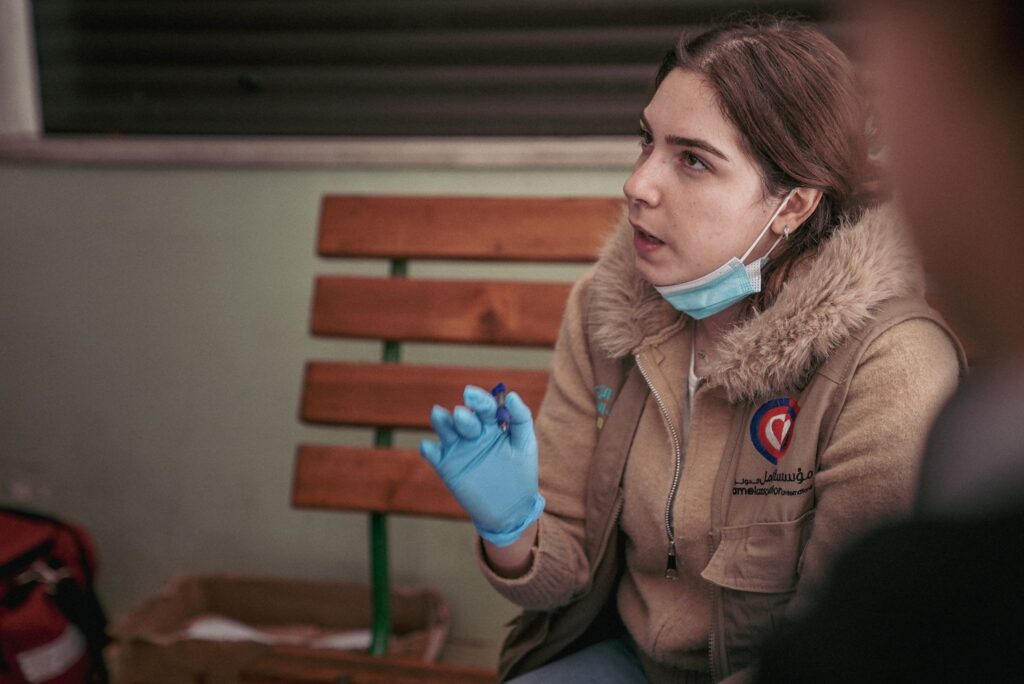
A medical staff from Amel association during a visit in a displaced center in Hamra.
The perils of hygiene and water
One of the most critical dangers for these women lies in access to water and sanitation. At the Sidon school, 240 women share twelve toilets. “Sometimes, I hold it in because I know it will be too crowded,” Maya admits. This lack of hygiene and the difficulty of accessing clean water are major risk factors.
“Take the example of E. coli bacteria,” explains Ghadir, a midwife with the Amel Association. “It causes urinary tract infections (UTIs), and it can come from the tap water they drink or the water they use to wash. When a UTI sets in, the bacteria travels up the ureter to the bladder.”
The absolute priority is the isolation of sanitary facilities for pregnant women
Burning during urination, incontinence, and pelvic pain are all symptoms that alert caregivers to potential urinary or vaginal infections. They then provide the necessary treatment free of charge. “If we don’t treat the problem from the start, it can evolve into pyelonephritis (a severe kidney infection), which can trigger premature labor at any month of pregnancy,” Ghadir warns.
Dr. Rawan Azaki, a volunteer gynecologist for SIDC Lebanon, also warns of the consequences of premature births: “The babies are born with low birth weight… they can have respiratory problems or require an incubator.” To this is added malnutrition which, according to midwife Hassana Hajjoul, causes generalized anemia among displaced mothers, as well as potential drops in blood pressure.
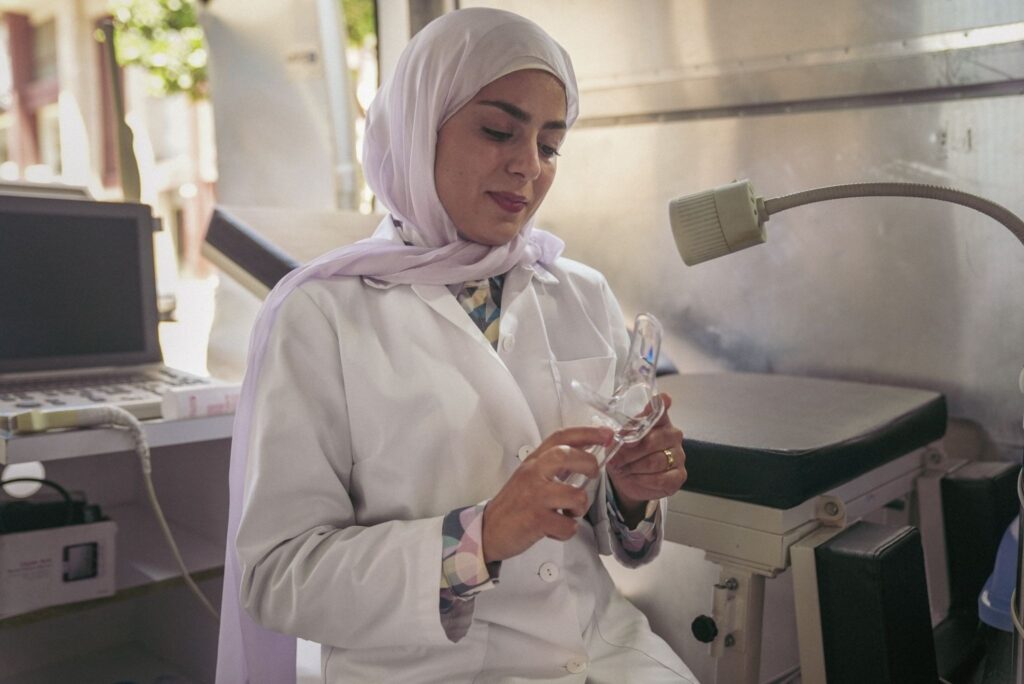
Dr Rawan Azaki after a consultation for SIDC Lebanon in a displaced center in Hamra.
Care via hotlines and mobile clinics
Hassana Hajjoul continues to manage patients in Marjayoun despite the maternity ward’s closure. “We only see them at the primary healthcare center,” she explains. In the face of such distress, caregivers try to recreate a safe “cocoon.” “I tell them: ‘No matter what happens, I am here. You can call me at any hour,’” insists Hassana, who has kept her private clinic open for them.
In Beirut’s Zarif neighborhood, SIDC Lebanon deploys mobile clinics. Inside a customized truck, Dr. Rawan examines Amal*, who is six months pregnant. “The heartbeat is very good,” she reassures her. But behind the physical care, the psychological diagnosis is often darker. “A patient once told me: ‘I don’t want to live anymore. Life no longer has any meaning for me,’” the gynecologist reports. Despite the scale of the needs, Hussein Nasr el Din, a manager at the Amel Association, remains determined: “We try as much as possible to meet the needs so that no one is neglected, especially pregnant women.”
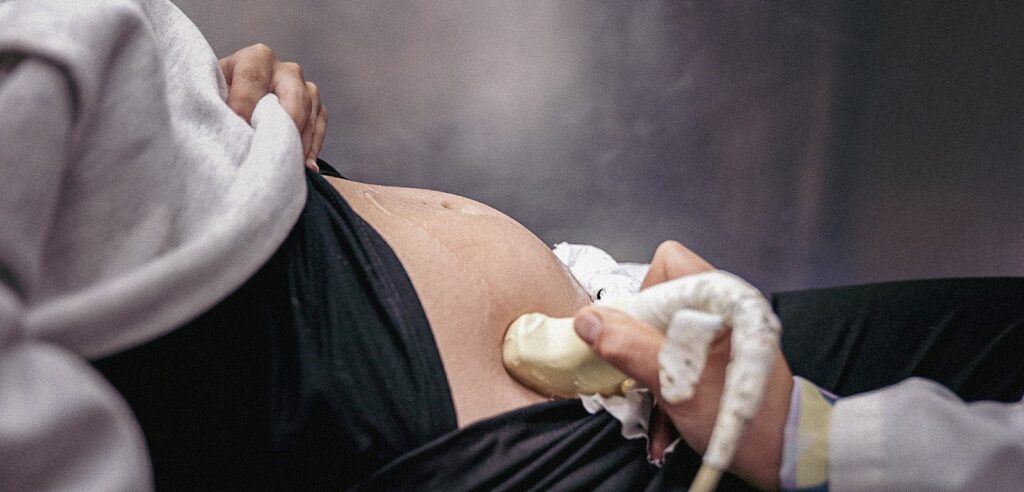
Amal* is having a consultation with Dr Rawan Azaki. She is currently displaced from the south and resides in one of the displacement centers in the Hamra area.
Potential solutions
When asked about concrete solutions to mitigate the risks displacement poses to pregnant women, caregivers are unanimous: the focus must be on sanitary facilities and access to potable water.
“The absolute priority is the isolation of sanitary facilities for pregnant women,” Ghadir asserts. “Specific toilets should be reserved for them. If a center hosts five pregnant women, they should have their own facilities. This would drastically reduce the risk of infection and, by extension, the risk of prematurity.” Regarding water, the midwife suggests installing “dedicated clean water tanks” so that pregnant women can wash and drink safely. “It is a long-term public health issue,” she sighs, exhausted by yet another war.
In this war, healthcare workers remain the last line of defense, ensuring that mothers like Maya, Layal, or Diana are not forced to choose between their own survival and that of their children.