







Rasha Abass (pseudonym), who is thirty-four years old, realized the extent of the psychological pressure she would face if she revealed receiving a direct threat to her person and reputation via a social media application. The threat came two days after she attempted to participate and express her opinion on a matter concerning her village.
In the sphere of promoting freedom of opinion and expression, we find ourselves facing dark horizons that conceal digital violence, which manifests through practices that, in some cases, amount to threatening the safety of journalists, both female and male.
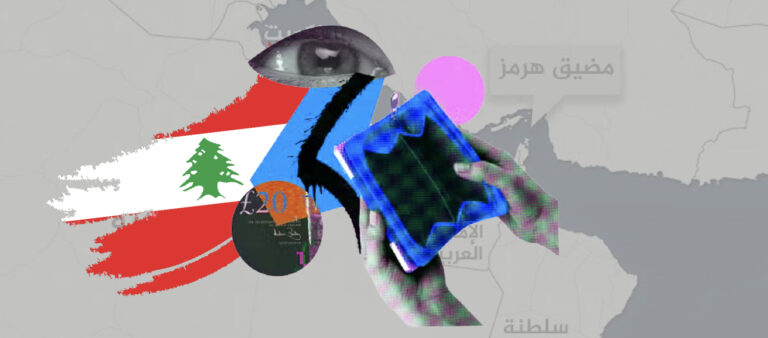
According to the ‘Digital Violence Victims Counter 2025’ report issued by SMEX organization, we are in the eye of the digital storm.
We find ourselves facing dark horizons that conceal digital violence... which manifests through practices that, in some cases, amount to threatening the safety of journalists, both female and male.
Moussa Saleh, a digital rights advocate, asserted in his interview with Silat Wassel that ‘no one is one hundred percent protected.’ He added: ‘We can say that we are more aware of the method of communication we use, what we talk about, and the general precautions related to the source of the Internet from any provider, any browser, and any application.
Saleh stresses the importance of awareness and measures at the individual level and at the level of state laws. The problems don’t stop at the need to be aware of digital risks and take measures concerning them but extend to putting the laws under scrutiny for their ability to keep pace with digital developments and the evolution of crime.
Furthermore, they must be scrutinized for their capacity to create a balance between the requirements of public order—and the evolution of its concept in light of cybersecurity imposing itself on this system—on the one hand, and the exercise of the right to opinion and expression on the other.
Digital Space and Serious Violations
Journalists are subjected to digital violence attacks. The Digital Safety Support platform affiliated with the SMEX organization receives cases involving extortion, content deletion, account suspension, false information, and hate speech. Most of these attacks carry a personal nature, such as threats to publish photos.
Zainab Ismail, a journalist and editor at SMEX, says, “Digital safety experts at SMEX examine devices and help solve the problem, such as the presence of a spyware virus or malicious software.
If none is found, we suffice by offering advice related to securing accounts, especially when there are indicators such as the battery draining quickly or the phone heating up without having been used for a long period—though these are not prerequisites for the existence of digital attacks.
She affirms that women are the most vulnerable to these attacks.’
Ismail adds that it is important to know the reasons for the targeting, which could be retaliation, an attempt to silence the individual, a random collective attack, or due to accidentally clicking a phishing link.
She emphasizes: ‘Securing accounts is not enough to achieve digital safety; what’s required are government efforts that put a stop to the greed of technology companies and make them feel that they are under surveillance and cannot dispose of individuals’ private data.
Relative Protection for Laws
In the context of discussing laws that aim to protect owners’ data from digital risks, human rights and political activist and lawyer Ali Abbas reviewed some of the laws related to digital safety in his interview with Silat Wassel. He points to Law 81/2018 concerning Electronic Transactions, which he believes does not address all cybercrimes and therefore does not ensure adequate protection if we further develop the subject of digital transactions.
In this context, Abbas stresses the necessity of stiffening the penalties for perpetrators of cybercrimes, given that they sometimes outpace digital safety measures. He adds that work is currently underway in the House of Representatives to update this law to keep pace with continuous development.
Protecting people while preserving constitutional freedoms
Regarding Law 659/2000, which concerns e-commerce and the protection of individuals who use platforms to purchase goods, lawyer Abbas stresses the importance of being proactive in exposing platforms that deceive and extort people and obtain their personal data.
Furthermore, he emphasizes that we must establish a bank of critical information and raise individual awareness about these threats
As for placing controls for protection against hacking or electronic fraud, such as blocking websites in some countries, he says: ‘The matter puts us on a fine line between suppression and complete freedom, which poses a risk to people and also reflects on the freedom of opinion and expression.
Therefore, the requirement is to be precise in terms of protecting people without infringing upon the freedoms stipulated by the Lebanese Constitution and the agreements signed by Lebanon.
He adds, “There are agreements related to the subject of electronic transactions, data, and information exchange.
Today, we are moving toward a digital government, which obliges us to be open and to have a space for electronic transactions that must be worked on in a way that does not resort to suppression or the prevention of electronic development under the pretext of protecting people and their data.
Imbalance or Balance?
Brigadier General and Doctor of Penal Law Adel Mashmoushi indicated to Silat Wassel that the legal system must provide the necessary protective measures for all individuals, such that it is prohibited for any one of them to exit those protective frameworks.
However, in the event of a conflict between ensuring public interests and private interests, it is necessary to establish controls that guarantee a balance between them through:
- The existence of prior legislation that clearly defines cases of restriction.
- Precise definition of the concept of public order to prevent its broad interpretation.
- Authorities must provide reasons for their decisions, stating the legal basis and the protected public interest.
- Parliamentary Oversight and Specialized Judicial Review.
- Finally, the civil society’s action in exposing cases of misuse of the concept of public order to restrict freedoms.
He adds: ‘It is possible to formulate the equation for balance, which I consider to be non-automatic; rather, it is a complex legal framework that integrates constitutional principles (legality, proportionality, non-discrimination, necessity) with executive and oversight mechanisms that prevent abuse and ensure that any restriction is temporary, necessary, and transparent.
This formula is as follows: Real Threat + Explicit Legal Text + Extreme Necessity + Proportionality to the Goal + Non-Discrimination + Judicial Oversight.
In light of the increasing digital risks,
it is assumed that there should be laws capable of addressing all crimes in preparation for confronting them.
Mashmoushi believes that the conflict concerning public order requires a trade-off between two interests that both seek to protect society and its stability, and to preserve human dignity and protect the individual and their rights, foremost among which are their freedoms.
For his part, lawyer Ali Abbas considers that public order always has an open appetite for suppressing freedoms. He affirms that this open battle with public order requires laws that protect people who express their opinions on social media and prevent them from being persecuted for their expression. He adds: ‘We see many of these cases being prosecuted due to posts on social media or other platforms.’