




Over the course of 127 years, the Kurdish press has faced immense challenges and difficulties owing to the complex policies practiced against the Kurds across the four parts of Kurdistan, particularly on the political, historical, and cultural levels, producing in the process a Kurdish reality that was ambiguous and entangled, especially in western Kurdistan (Syrian Kurdistan) until the outbreak of the Syrian revolution in 2011. At that point a modern, new phase began for the advancement of the Kurdish press and the continuation of journalistic work, starting with the publication of the first Kurdish magazine, “Hawar,” in 1931 in Damascus, following the publication of the first Kurdish newspaper in the Kurmanji language in the Egyptian city of Cairo, titled “Kurdistan,” by Prince Midhat Jaladat Badrkhan on April 22, 1898, in eastern Kurdistan (Iranian Kurdistan), in a form and shape that keeps pace with the current journalistic reality, particularly with regard to providing full support to Kurdish women journalists who do their utmost to work professionally amid the challenges and obstacles they face.
The reality of the Syrian Kurdish press
“If we compare the reality of the Kurdish press in Rojava / northeastern Syria today with two decades ago or even less, we would perhaps see a vast difference between the two scenes. In the past, the Kurdish press was entirely banned and prohibited by the former Syrian authorities under the rule of the al-Assad family, but with the events and the revolution in Syria, the Kurds were able to present a new model that interacts with events through their own press, as well as through Kurdish women and men journalists who became active and turned into effective sources in Syrian, Arab, and international journalism, thereby achieving a qualitative leap in the field of journalism in the region. Meanwhile, the Kurdish press itself developed alongside the major technical and media advancement, benefiting from the technology and the developments witnessed by the entire world in this field, especially in the field of publishing and increasing interaction with the public via social media and other means. The Kurdish press and Kurdish women and men journalists were also able to become an important part of fighting terrorism through their material and journalistic reports,” says journalist correspondent Abdul Halim Suleiman to the Silat Wassel platform.
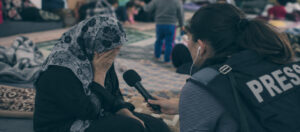
Along the same lines, the journalist correspondent for the Kurdish Rudaw channel, Dilkhwaz Mohammed, says in his interview with Silat Wassel: “The Kurdish woman journalist has proven, and worthily so, her ability to work under all circumstances, especially field work and on the front lines of combat. She has come to play an effective role in conveying facts from areas and places that are difficult to reach, which confirmed that she is no less capable than the man and can practice her journalistic work with merit despite all the difficulties. Many women journalists who are also mothers have practiced their work with full professionalism and have come to play a major role in covering battles in areas of armed conflict, particularly in recent years. We can therefore say that the Kurdish woman journalist is able to manage herself by herself and to develop herself and her work, and she has actually proven that all these obstacles will not stand in the way of her passion.”
Are there challenges facing them?
Suleiman adds, regarding the challenges facing Kurdish women journalists: “The period I spoke about, and up to now, represents a leap of a unique kind for women journalists. Perhaps in the past Kurdish women journalists were limited to some writings and very rarely worked in this field, but now they have become an important part of the journalistic community among the Kurds in Syria, and they have progressed through most stages of the media and journalistic production process, as editors, correspondents, photographers, producers, and presenters, not to mention administrative positions within the Kurdish media institutions operating in the region.”
Meanwhile, the executive director of the Adar Press news website, journalist Suheila Sofi, clarifies something that completely contradicts Suleiman’s words, saying: “There are a number of challenges that face us as Kurdish women journalists, among them the absence of harmony between what we aspire to journalistically in order to rise to the required level and the publishing policies agreed upon within the media institution.”
She adds in her remarks to Silat Wassel: “Through my work for more than 15 years in the media system, the challenges and obstacles remain the same and are even increasing. For example, there are intruders and interlopers in the profession who have caused grave damage to it, such as social media activists, where everyone has become a journalist and a media activist, circulating the news with complete ease without verifying the background or the credibility of the news, and this constitutes a major challenge for us. It even hinders us from carrying out our tasks at the required level because of the misinformation and falsification of many journalistic news items. In addition, when it comes to the journalistic scoop, we have not risen to the required level; rather, it has become the chief preoccupation of many and has affected us negatively, with no accountability that draws for them the professional boundaries at which they must stop. Likewise, the withholding of information from us by requiring authorization from any official while preparing a journalistic report constitutes an obstacle to moving forward, even now.”
Sofi adds: “As women journalists we have become accustomed to a single mold, with no additions or touch-ups to update and develop our knowledge and experience despite the enormous development observed in the field of journalism and media. There is an absence of rehabilitation and refresher programs, as well as of conferences concerned with the journalistic field for the purpose of developing it. Along the same lines, there is an absence of academic training workshops for women journalists to keep pace with the media development in Rojava, and I believe the same applies to Kurdish men journalists, with no one case prevailing over another. This, in sum, is what I find to be the most pressing need in order to overcome all the obstacles we face, whether working within specific institutions or independently.”
Media professional Sawsan Khalaf agrees with her on several points, saying: “Women working in the field of Kurdish journalism face many challenges and societal restrictions that constitute an obstacle to their profession and limit their movement and the development of their journalistic work. An example of this is the exclusion of women journalists and media professionals from the management of media institutions, and discrimination in wages, tasks, promotion, and training remain ongoing challenges to this day, in addition to gender discrimination, particularly when it comes to providing accurate information at any media event that women journalists cover.”
“In most cases, women are excluded from covering important events such as demonstrations, conflicts, or marches, and they are often only allowed to present social, entertainment, and morning programs, not to mention the stereotypical image that diminishes and belittles their work in most of our media institutions in Rojava / northern and eastern Syria / despite their excellence in media work. Women working in the field of field journalism, and correspondents in particular, suffer the greatest hardship because they are exposed to direct targeting, being on the front lines and in direct clashes, with an absence of personal protection, in addition to being subjected to a great deal of bullying stemming from the traditional nature of society.”
“The monopolization of ideas and information, especially in digital and electronic media, is among the most dangerous challenges facing Kurdish women journalists, because they are always afraid of having their ideas or media material stolen, material into which they put enormous effort to bring out in the ideal form. And despite the Autonomous Administration putting in place deterrent laws to protect women journalists, the violations unfortunately still persist and continue,” according to Khalaf.
Ways to break down the challenges?
Journalist Suleiman adds: “Naturally, Kurdish women journalists, like the rest of the Kurdish journalists, most of them were not graduates of journalism colleges or academics in this field; rather, many of them entered the profession through the gateway of experience and the need for this sector in the region, and that was a challenge for them. Women journalists, like the rest of the emerging journalistic community, even if we speak of around 14 years of intensive and serious work, it remains newly formed in the Kurdish community in general, and this journalistic community needs scientific, technical, and professional support and a comprehensive legal and journalistic culture, which would increase expertise and enable it to play its role as a watchdog press and a source of accurate and correct information in the region.
There are many areas through which support can be provided to them, whether at the level of producing information, keeping pace with events and how to cover them, or working inside the media and journalistic institution, especially since the living and economic conditions greatly affect those working in the journalistic field, as well as the media institutions in general, which also need development in the administrative field.”
Journalist Sawsan Khalaf lays out for us proposals that must be implemented so as to keep pace with the current journalistic context for Kurdish women journalists, saying: “There is a need to focus on programs that strengthen women journalists’ confidence in themselves through training, providing psychological support, and raising their awareness of their rights to ensure they do not fear submitting complaints or reporting any violation committed against them. Work must be done on the importance of strengthening cooperation among women journalists to demand their rights equally. Confidence must also be restored between women journalists and the unions concerned with the affairs of male and female journalists that defend their rights, and they must be trained professionally in the field of digital security and occupational safety, especially in areas covering conflicts and wars.”
Khalaf stresses the necessity that the unions regulating the work of the Syrian press create working partnerships and put in place deterrent laws to compel media institutions and oblige them to conclude work contracts that guarantee the rights of women journalists and media professionals, so that this becomes one of the basic conditions for granting work licenses to media outlets.