
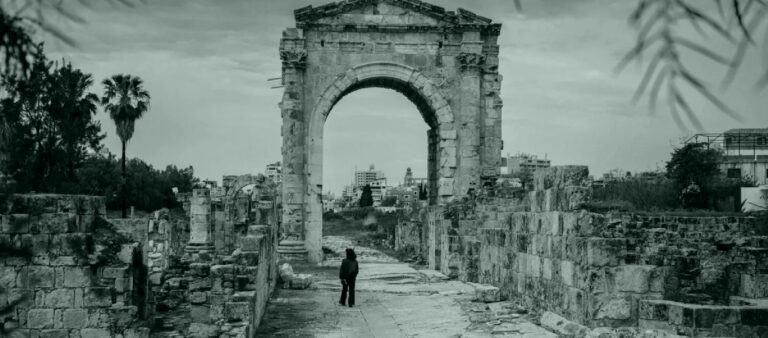






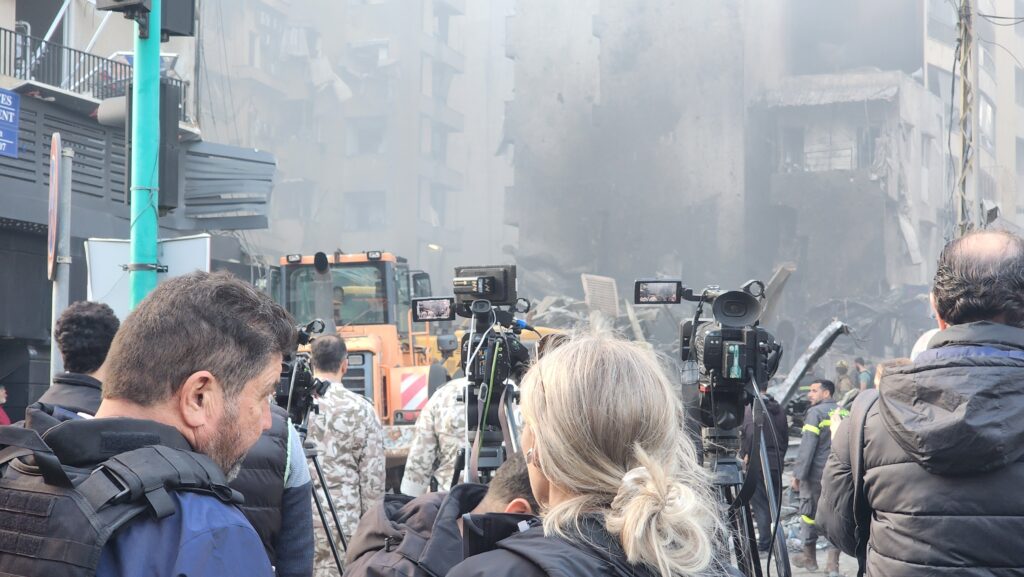
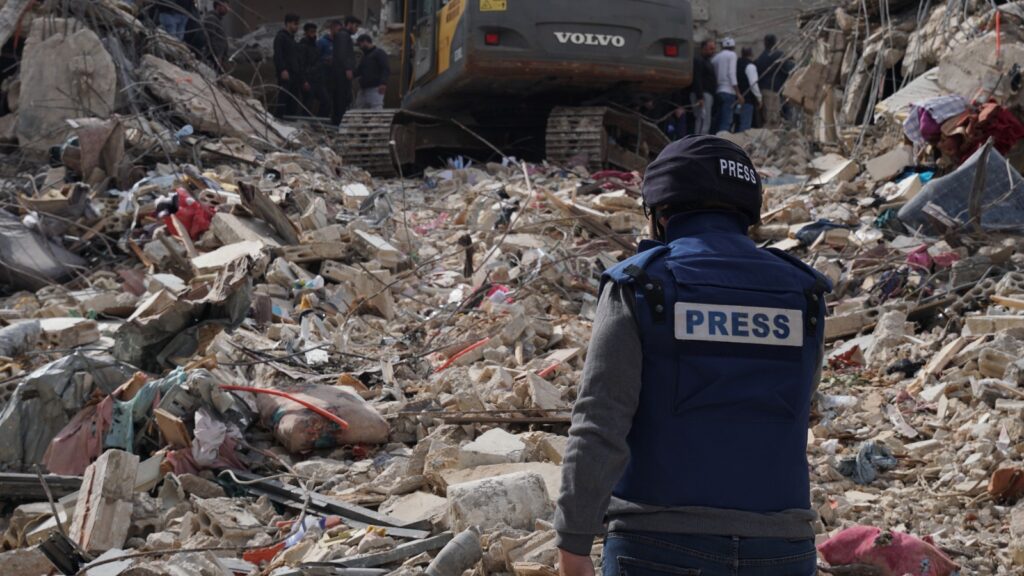
The danger journalists face is not limited to being targeted and the risk of injury from shrapnel; there is also an invisible danger represented by the air they breathe after covering sites of shelling and air raids. The smoke, dust, and toxic materials resulting from the shelling also threaten their health and safety, especially given the repeated exposure to these pollutants while performing their duties.
The Shelling Does Not End When the Raid Ends
“I felt as if I were dying, as if something were pressing down on my chest. I was trying to breathe without being able to.” With these words, journalist Rana Jouni describes what happened to her during her journalistic work in southern Lebanon.
On November 14, 2024, Rana was heading to Deir al-Zahrani for media coverage. On that day, Israel targeted the area with two raids; the second raid occurred close to Rana. She survived the raid, but her proximity to the targeted site led her to inhale the rising dust and smoke. From that moment on, Rana has felt health changes in her respiratory system from the effect of inhaling those materials. “My body changed and I am no longer comfortable, and the more I am exposed to inhaling these materials, the more the fatigue increases.”
On the first day after the raid, Rana went to the hospital after becoming unable to breathe, and her condition required receiving oxygen and an injection to alleviate the symptoms of shortness of breath. In addition, skin symptoms appeared on her, represented by severe itching that began to appear directly the following day.
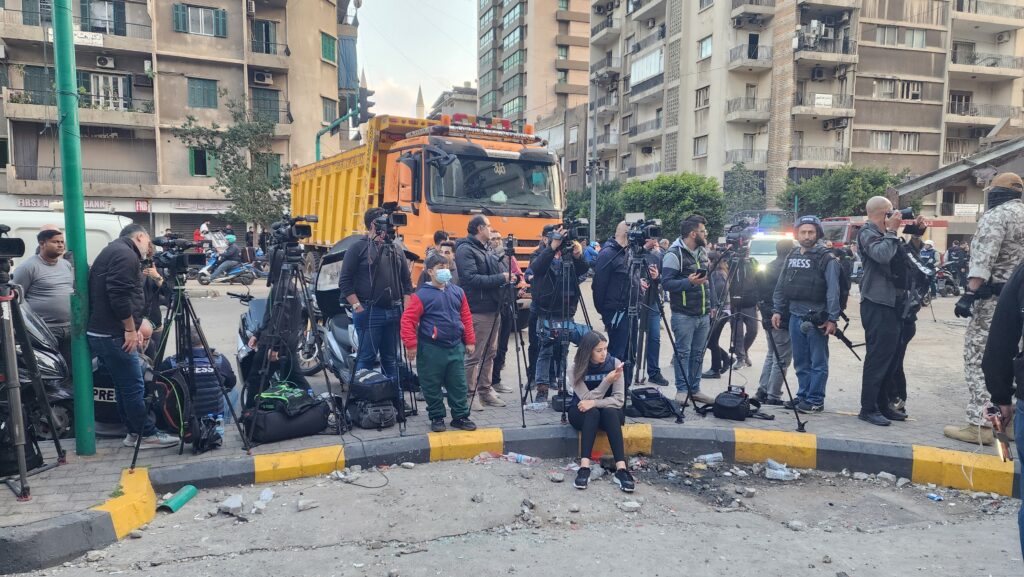
The Shelling Leaves Its Mark on Journalists’ Bodies
Rana’s experience is not an isolated case among the journalists and photographers who covered sites of shelling; the health symptoms that appeared on them directly after inhaling the smoke and dust resulting from the shelling seemed similar.
Zakaria Jaber, a press photographer who covered the October 17 demonstrations in Lebanon, suffered at the time from a skin rash after being exposed to tear gas and other agents used to disperse the demonstrators. Jaber suffers from health problems in the upper part of his stomach, and in his case the symptoms appear on his skin over the shoulders and the upper stomach. But he describes how, after covering areas of shelling and areas where raids took place, the rash and pimples spread to various parts of his body, and the itching lasted for a while.
Jaber recounts to “Silat Wassel” that after covering a raid on the Bachoura area, he and his two colleagues who were with him developed several symptoms, including dizziness, coughing, and vomiting, in addition to a sudden feeling of intense drowsiness. Shortness of breath and pains around the lung area were among the symptoms that appeared on Jaber. “Recently, we all feel pains in the area close to the lung. This pain has become continuous.” Jaber adds that the shortness of breath increased over time: “The shortness of breath increased and became more continuous, especially since most of us do not take care of our physical health in terms of nutrition or exercise because of work conditions. Something worsens after every stage of covering a place that was subjected to shelling.”
"Recently, we all feel pains in the area close to the lung. This pain has become continuous"
Jaber compares the symptoms he feels today with what he was exposed to while covering the October 17 demonstrations, saying: “We did not smell gunpowder as happens today, but there was a type of gas that causes the same allergy and skin rash that we feel now when we enter sites of shelling, and it is also linked to the type of gases used.”
Doctors and specialists in air pollution advise journalists who carry out media coverage of shelling sites and rescue teams to wear masks to reduce the effects of the polluted air on their respiratory system. As a journalist, Jaber considers that the protective vest alone is not enough; and as important as it is in protecting them in cases of direct danger during the coverage of shelling, to protect against shrapnel, it is no longer necessary after the event ends except in cases where parts of buildings collapse. In contrast, the mask remains essential because the area is covered with the smoke and dust of the materials used in the shelling.
In a similar context, press photographer Mohammad Qlait recounts his suffering with respiratory symptoms that lasted for months after his coverage of the war. Health symptoms appeared on Mohammad during his coverage of the 2023 war and afterward, including shortness of breath and a cough that lasted for a period of about five months. Mohammad consulted the doctor, who told him that the cause was due to “exposure to the dust resulting from the shelling or the inhalation of white phosphorus,” advising him “of the necessity of wearing an (N95) mask even while covering places of destruction and rubble, in order to reduce the pressure on his respiratory system.”
What Do We Inhale After the Raids?
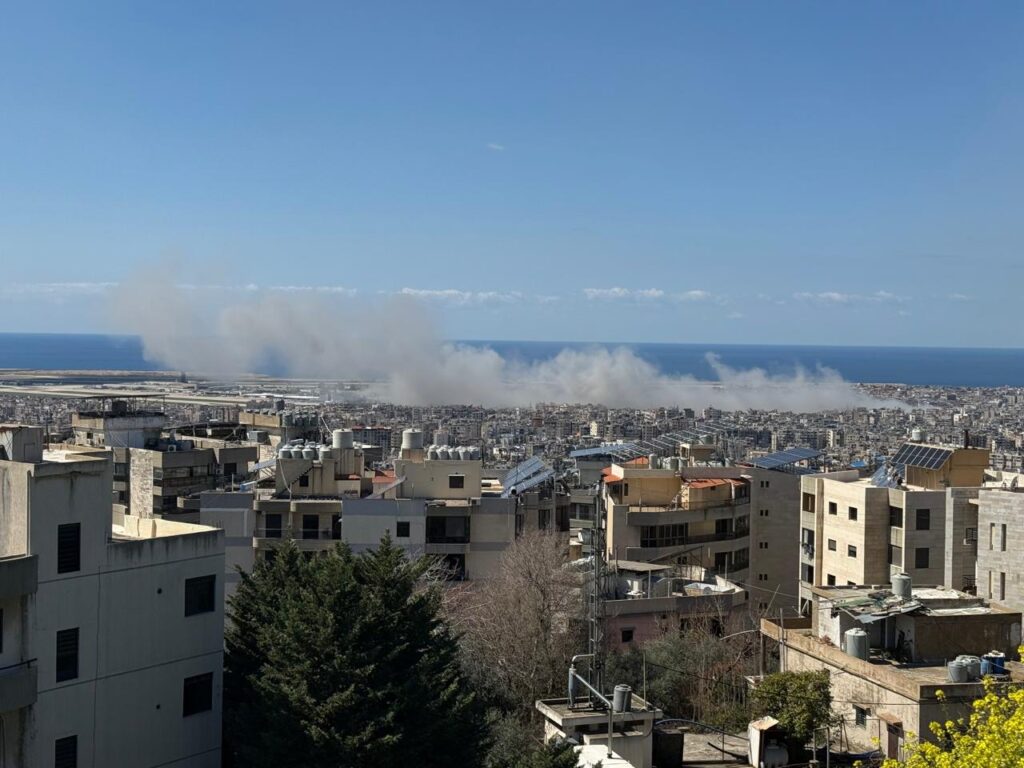
Although the level of pollution in some places has decreased due to the reduction of some traditional sources of pollution such as emissions from cars, the level of air pollution has risen in the areas subjected to shelling. The shelling of buildings and their collapse, along with the materials they contain, in addition to the emissions resulting from the burning of materials such as household furniture, plastic, cars, fuel stations, and others — all of these are factors that increase the level of pollution in the air we breathe today.
Professor Charbel Afif, an expert in air pollution and the technical director of the Center for Analyses and Research at Saint Joseph University in Beirut, explains that “in war and during periods of shelling, pollution levels are very high, and not only in the area directly subjected to shelling, but also in areas far from it; the pollutants reach a distance of 5 and 10 kilometers, but in the first or second kilometer the concentrations are very high. Even if we no longer see the black smoke emitted from the shelling and the burning of materials in front of us, and we think we have become far away, in reality it reaches great distances.”
"In war and during periods of shelling, pollution levels are very high, and not only in the area directly subjected to shelling"
According to Afif: “The weapons used in the shelling, such as missiles, cause great damage, but there are no large direct emissions from them. This does not mean that the shelling in itself does not produce pollutants, but the quantity of emissions resulting from the fires that arise from the ignition of furniture and the burning of cars, for example, and the pollutants resulting from the demolition of the building itself, produce large and dangerous pollutants.” Afif emphasizes that “the most important factor is the concentration; how high it is determines the quantity of what enters the human body.”
The foul smell and smoke resulting from polluted air are not the only indicators that we are inhaling it, and the respiratory system is not the only one harmed. According to Afif: “Studies have proven that air pollution affects all organs of the body, including the brain and the nervous system. Fetuses are also affected by this pollution, due to the very fine particles that are much smaller than the thickness of a hair. These particles, which are produced by generators, cars, and burned materials as well, have no filter in the body or anything that captures them to prevent them from entering; some of them enter directly into the bloodstream of the body, and then they carry many toxic substances, which exacerbates the harm to the body.” Among the effects, according to Afif: “a decline in the level of intelligence among residents who live in polluted areas, which studies have proven.”
The Dust of War: Toxic Particles That Enter the Lungs
In the face of questions about the nature of the materials inhaled during field coverage and their effect on the body, the specialist in chest diseases, asthma, and allergies, Mohammad Zaraket, explains to “Silat Wassel” that “the danger is concentrated in the structural injuries to the lung resulting from the direct inhalation of fine solid materials.” He clarifies that “the dust of destroyed buildings (the rubble) is composed of fine particles of cement, concrete, sand, and metals. It contains toxic materials such as asbestos (largely in old buildings), silica, and heavy metals such as lead and glass fibers.”
According to Zaraket: “These particles cause severe inflammation in the respiratory system, coughing, and shortness of breath, and can lead to chronic diseases such as silicosis (silica disease), asbestosis (pulmonary fibrosis), and lung cancer. This leads to immediate irritation in the eye, nose, and throat, and can cause poisoning by gases, burns in the respiratory tracts, and acute oxygen deficiency (suffocation). The danger is concentrated in acute chemical poisoning and rapid inflammations that may lead to sudden death.”
The danger of exposure to the materials emitted from the shelling does not end after direct exposure to them, because of the inhalation of the dust resulting from these materials. According to Zaraket: “There is danger even in indirect exposure (after hours or days) to the deposited polluted dust or the continuous smoke, because it carries very high risks. This is called environmental pollution resulting from conflicts, represented by the inhalation of deposited dust (resuspended dust); the dust that covers the streets and houses, when it is moved by the wind or by movement, and is re-inhaled, transports heavy metals and asbestos to the lung.”
The danger is not only represented in exposure to the gases emitted from the shelling materials; there is also toxicity in the rubble. According to Zaraket: “Research has revealed that the dust of war resulting from bombed buildings is more toxic than ordinary demolition dust; it contains higher proportions of carcinogenic substances such as dioxins and PCBs resulting from the high heat of the explosion.” Also, “the dust of collapsed buildings must be treated as toxic and dangerous materials, and its inhalation must be avoided by all means, even if the fires were extinguished days ago.”
Zaraket points out that “repeated exposure to the smoke of war and the rubble can lead to serious chronic respiratory diseases, including asthma, pulmonary fibrosis, and chronic obstructive pulmonary disease (COPD). Living near destroyed areas or cleaning rubble also poses a continuous risk to health. Based on environmental and medical health reports, the smoke of explosions and fires resulting from war contains a complex mixture of fine particles, heavy metals, toxic gases, and chemicals resulting from the burning of buildings and infrastructure.”
The danger of exposure to these materials is considered a silent danger because of “its threat to individuals’ health by infecting them with cancer; because the health effects and tumors of this danger appear only after years or decades of exposure to it,” according to Zaraket.
According to Zaraket, there is “a real and scientifically proven danger that exposure to potentially carcinogenic materials as a result of shelling and military operations stems from the destruction of buildings, infrastructure, and the weapons used, which leads to the release of toxic materials into the air, water, and soil. In addition to the carcinogenic materials resulting from the shelling, such as asbestos, which is released when old buildings are destroyed; its danger is that its fibers are invisible and settle in the lungs, causing lung cancer and mesothelioma (cancer of the lung membrane) after years of inhalation.” In addition to “heavy metals: such as lead, cadmium, and arsenic, which are released from building debris and munitions, and are toxic and carcinogenic materials. And the remnants of weapons (such as depleted uranium): in case of its use, which produces radioactive and toxic dust that affects living tissues.”
Zaraket continues, saying that “the immediate danger is represented through the inhalation of the dense dust and smoke resulting from the explosions and fires. As for the long term, the danger results from the deposited dust, if the dust polluted with asbestos and heavy metals remains in residential areas and is re-inhaled with the wind.” Regarding the groups most exposed to danger, Zaraket mentions: “Journalists and rescue teams who work without protective equipment, residents returning to their destroyed homes before cleaning them, as well as children because of their proximity to the ground where the dust settles.”
From the Air to the Soil: A Danger That Goes Beyond the Respiratory System
The matter does not stop only at air pollution; the transfer of this pollution to the soil and groundwater is possible, which increases the probability of contracting diseases other than those that affect the respiratory system.
Afif confirms that “the pollution does not disappear, but moves to the soil; if the concentrations are high, the pollution is deposited in the ground, and with rainfall it enters deeper into the soil, and may move into the food chain. It then affects crops and moves to animals and enters the entire chain. But this needs time, and not all pollutants remain for long periods; some of them are short-lived, but there are long-lived pollutants such as some organic materials, heavy metals, dioxin, furan, and others.” However, as long as the quantity that entered the soil is not very large, it may return to the air, move, and then be deposited again, and begin to disperse, which leads to a decrease in concentrations. With the decrease in concentrations, there becomes room for something like cleaning the soil of pollutants, according to Afif.
With these materials and pollutants reaching the soil and groundwater, the danger is no longer confined to the respiratory system nor to skin diseases, but turns into a serious long-term threat to the rest of the body’s organs, and to contracting cancer.
Dr. Maggie Tamraz, a public health nutrition specialist and a doctoral candidate in epidemiology, says of the air pollution resulting from war that it “is mainly linked to an increased risk of lung cancer as a result of inhaling fine particles and dioxins, but it may also contribute to higher rates of bladder and digestive system cancer due to the absorption of toxins and heavy metals through polluted water and food. The most affected organs are the respiratory system, which is directly exposed to the pollutants, followed by the heart and blood vessels, in addition to the liver and kidneys in which heavy metals accumulate, and the nervous system, which is affected by lead and mercury in the long term. This makes the health risk comprehensive, combining chronic diseases and multiple cancers.”
Environmental Issues as News According to the “Trend”
Despite all these risks from the pollution of air, soil, water, and others, even before the war, environmental issues in Lebanon unfortunately do not occupy space in the media unless they are event-driven news that stirs a media uproar that is covered for a short period, which is confirmed by the journalist and environmental researcher Mounir Kablan to “Silat Wassel.”
Kablan considers that “the attention given to environmental issues in the Lebanese media does not receive sufficient interest, and the proportion of journalists specialized in environmental issues is small. Environmental issues are not a popular topic unless they become a (trending) issue, at which point they are highlighted in the media for a few days and then the story is forgotten. Likewise, institutions look for the topics that bring in money and the trending topics more than highlighting the topics that affect the citizen directly.”
Kablan points to the obstacles facing journalists specialized in environmental affairs, saying: “Before the war, the difficulty of accessing information was the most prominent of these obstacles. As for now, with the existence of the right-to-access-information law, especially with the Ministries of Environment and Agriculture, the matter has become easier. And sometimes, if the topics are related to politics, it becomes difficult to obtain information.” He adds: “As for what concerns the war, during the war it is difficult to work on monitoring crimes against the environment because of the danger. And I stress the importance of documentation, and we often rely on citizens’ documentation of the shelling and the violations against the environment.”
The War Hampers Measuring the Extent of the Pollution
Today, because of the continuation of the war, it is not possible to determine precise figures or to study the extent to which the air is affected by the pollution resulting from the shelling, due to the difficulty of experts reaching the places that were subjected to shelling to take samples, including the danger that threatens their safety. According to Afif: “Despite the prior coordination with the Ministry of Environment, the World Bank, and the UNDP, no field samples were collected because of safety risks to the team of experts.”
However, in this context, the Ministry of Environment released the results of the environmental impact study of the attacks, in which it was stated that the levels of fine particles PM2.5 exceeded the limits of the World Health Organization (micrograms/m3) at the LAEC site, where consistently higher pollution levels were recorded, and the existence of strong local sources linked to the war from heavy metals is likely, while the Arab University site BAU recorded lower and more stable levels. The rise of pollution sources at the LAEC site was linked to the site’s proximity to areas of explosions, fires, rubble, smoke, and dust.
It is worth noting that air pollution also costs the state economic losses; the latest study, according to Afif, “conducted between 2018 and 2019 showed that the loss resulting from air pollution alone reaches about one billion dollars annually.” Afif emphasizes that it is essential, immediately after the war ends, not to neglect studying this environmental impact and to leave matters to worsen toward the worst, “because we will be facing a different ecosystem and there will be greater pressure on resources, especially water, particularly since Lebanon already suffers from pollution problems resulting from the mismanagement of the waste file.”
Personal Protection as a Necessity in the Field
In light of the absence of environmental awareness and the failure to provide the necessary protective equipment for journalists from the relevant parties except in some cases, including the Union of Journalists, and in the face of the increasing health risks associated with repeated exposure to the smoke and dust resulting from the shelling and the effects of the rubble, the means of personal protection become an essential necessity.
In this context, Zaraket offers a set of medical recommendations to persons exposed to danger on a continuous basis, such as paramedics and journalists in conflict areas; there is a set of medicines and necessary supplies that must be available in their personal first-aid kit to deal with emergency injuries or environmental hazards, and these are considered personal first aid and not a substitute for professional medical care, including:
- Inhalers and respiratory supplies: bronchodilator inhalers (for asthma/shortness of breath) such as the “Ventolin” inhaler for people who suffer from respiratory problems, since the gases cause severe difficulty in breathing.
- High-quality masks: N95 masks or specialized gas masks for protection from gases and dust.
- Antihistamines: such as “Telfast” or “Zyrtec” for allergies resulting from dust or chemicals.
- Painkillers and anti-inflammatories: such as “Paracetamol” or “Ibuprofen” (to relieve mild pains).
- Eye Wash solution: small bottles for washing the eye immediately when exposed to any irritating substance.
To reduce the inhalation of these pollutants, it is advised to take the following preventive measures:
- Personal protective equipment (PPE): Respirators are the most important; ordinary medical (surgical) masks do not provide protection from fine dust and gases. At least N95 masks must be used, and masks containing activated carbon filters for chemicals are preferable.
- Goggles: to protect the eyes from suspended particles that may contain toxic materials.
In a country that already suffers from environmental crises, the war came to add a greater environmental impact that threatens the health of the residents. The danger does not end after the raid occurs; part of it remains suspended in the air, forming a danger to the health of our respiratory system and what we inhale, so that the air becomes an invisible danger threatening our health today, with its effects appearing in the long term.