





The War Uproots Southern Lebanon’s Tobacco Farmers from Their Land
In the towns of southern Lebanon, the tobacco season has long ceased to be a fleeting agricultural event; it is a struggle for survival for thousands of families who have depended on this crop for decades. But the war has not only stolen the harvests — it has driven farmers from their land and turned talk of the tobacco season into a longing for a life that stopped suddenly.
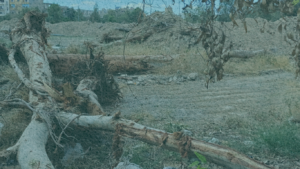
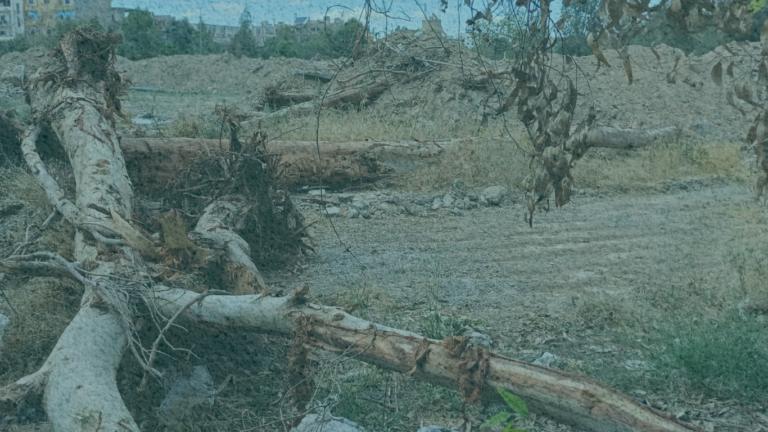
“We’ve already forgotten how to grow tobacco.” With this phrase, the farmer Mohammad Farhat, a native of the southern town of Aytaroun, sums up the scale of the tragedy his townspeople have been living since 2023. He says that three years of war were enough to ruin farmland, demolish houses, and bulldoze entire neighborhoods, adding: “Losses beyond price, and exile and uprooting from our land and our livelihood… and you ask me about the tobacco season?”
"Losses beyond price, and exile and uprooting from our land and our livelihood"
With these words, Farhat describes the reality of Aytaroun’s farmers and the losses that have befallen them and their village as a result of the war, at a time when entire families face an unknown fate after losing their land and their only source of income — agriculture, and tobacco cultivation in particular — which for decades has been the primary livelihood for thousands of families in the southern towns.
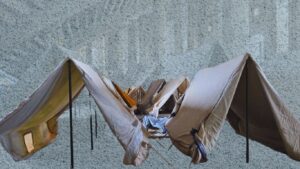
From one farmer to the next, the contours of the catastrophe facing tobacco farmers in southern Lebanon emerge — especially in the town of Aytaroun, one of the largest tobacco-producing villages — after they lost their crops and their livelihoods: from tobacco to olives, all the way to lands that have been bulldozed or now fall under occupation. To speak about the situation and the losses of the tobacco season in particular with the farmer — who has already been driven from his village, displaced either in shelters, at a relative’s home, or in roadside tents — is like speaking of past glories and minor losses compared to his present reality.
Some farmers refused even to recall the matter or name it; the farmer has lost everything and has no hope of returning to his village soon — or even in decades, as many of the elderly put it — yet despite that, return remains the only hope left to them, and the return of farming is the air the farmer breathes through his land.
A Sharp and Catastrophic Decline in the South’s Tobacco Season
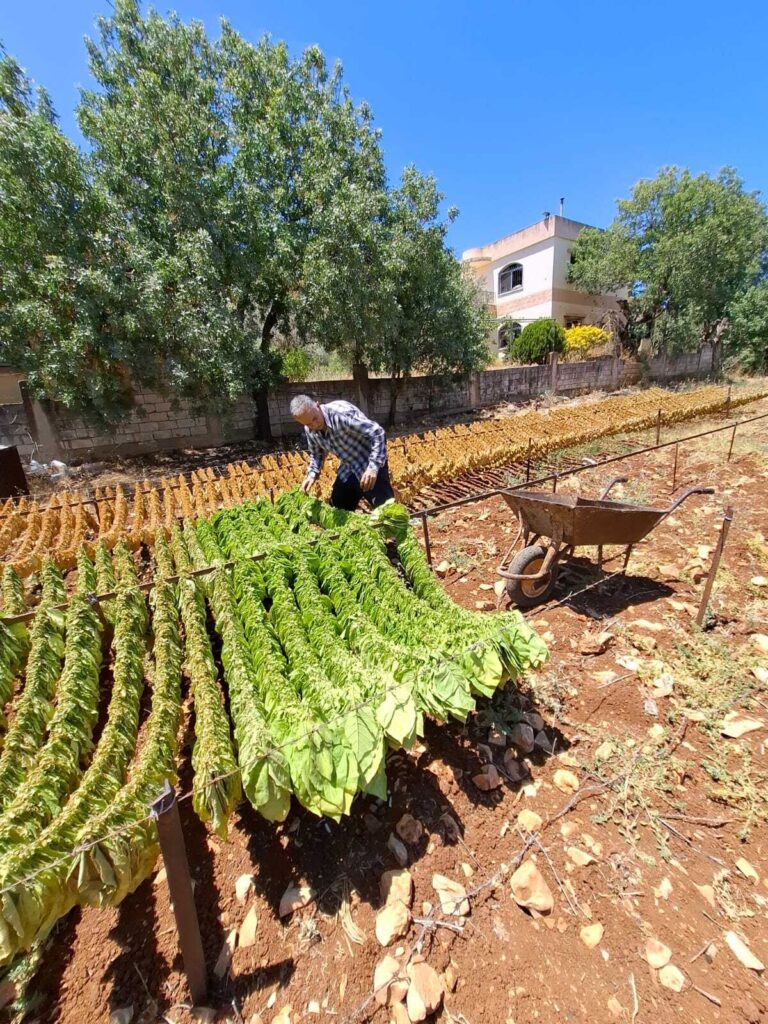
The repercussions of the war are not limited to demolished houses and direct material losses; they begin with the land itself and the agricultural seasons that form the livelihood of thousands of families in the south. With every round of escalation, tobacco cultivation retreats further, leaving vast stretches of land abandoned, while farmers lose their seasons year after year, in a crisis that has been striking one of the south’s most prominent agricultural sectors for decades.
The Director of Tobacco at the Lebanese Régie (Régie Libanaise des Tabacs et Tombacs), agricultural engineer Abd al-Mawla al-Mawla, notes that “what is befalling tobacco cultivation in the south goes beyond ordinary losses — it has become something that cannot be measured by any rational standard, especially in the villages of the Yellow Line, where farmland turns into abandoned spaces with every military escalation; the war comes at the start of the planting season, so farmers abandon their land before the agricultural cycle actually begins, and vast areas remain uninvested.”
"What is befalling tobacco cultivation in the south goes beyond ordinary losses"
Al-Mawla explains that “towns such as Rmeish and Babliyeh remain among the few areas still able to preserve part of their tobacco cultivation, while in other towns farming has turned into an individual gamble carried out by some farmers despite the risks, as is happening in Deir Aamess, al-Biyada, and Burj al-Shamali.”
In figures, al-Mawla narrates the scale of the collapse hitting this sector: “Tobacco production in the south, which reached around 2,200,000 kilograms in the 2025 season, is falling in 2026 to between 500,000 and 700,000 kilograms, after the south was producing around 5,200,000 kilograms annually before the 2019 economic crisis.”
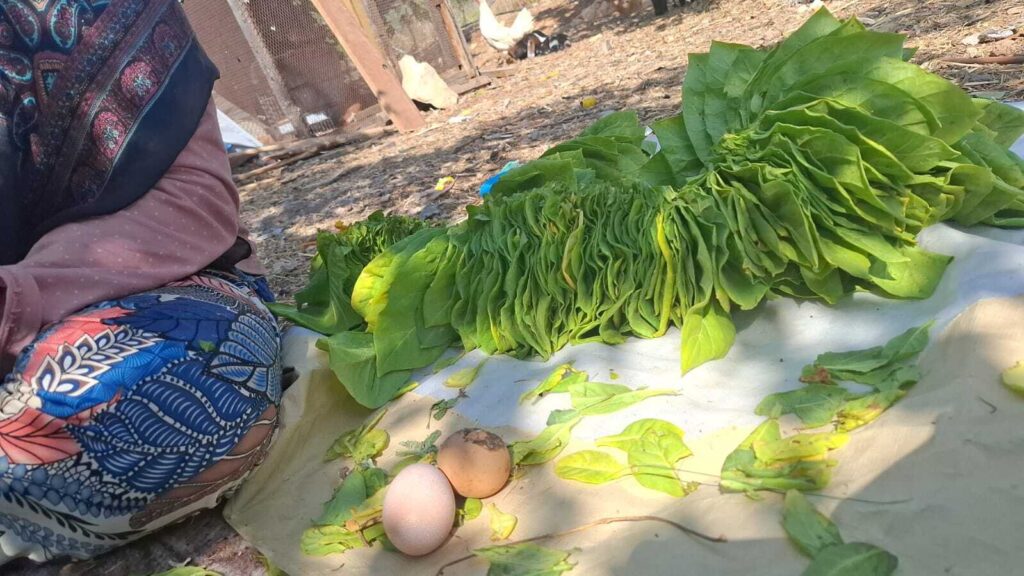
But the crisis, according to al-Mawla, does not stop at the drop in production alone; it extends to every detail of the agricultural process: “Farmers lose nurseries, plastic sheeting, sprayers, and agricultural equipment, while some lands disappear or have their terrain changed entirely as a result of bulldozing, destruction, and military operations.” Despite that, “the Régie is trying to maintain a minimum agricultural cycle by establishing special nurseries in al-Saadiyat to supply farmers with seedlings, alongside distributing pesticides and providing whatever support is possible — but the security conditions prevent full benefit from these initiatives.”
Al-Mawla describes what key tobacco-producing villages such as Aytaroun are experiencing as “lean years,” after the town used to compete with Rmeish for top tobacco production in the south — before the war became a force that uproots the land and its seasons together.
A $300 Advance for Farmers
According to al-Mawla, “the institution is trying to keep farmers on their land, even minimally, by providing an advance of $300 to each farmer. Within less than a week, around 1,400 farmers benefit from this advance, and the number is expected to rise to around 4,000 farmers across various regions.”
As tobacco cultivation in the south declines at an unprecedented rate, al-Mawla clarifies that “the production picture in other regions is also still unclear; the Bekaa, which was supposed to produce around 1,200,000 kilograms of tobacco, still has no clear actual figures, while Akkar’s production is expected to reach around 1,460,000 kilograms.”
In the south, however, the crisis appears deeper than mere numbers; the official count of tobacco-license holders is around 13,000, but the actual number on the ground does not exceed 5,000 farmers, as many have resorted to operating licenses through relatives or guaranteeing them for others to avoid losing them after two consecutive years of non-use. Even this figure, according to al-Mawla, was not achieved in the 2025 season — the actual number of farmers did not exceed around 2,500.
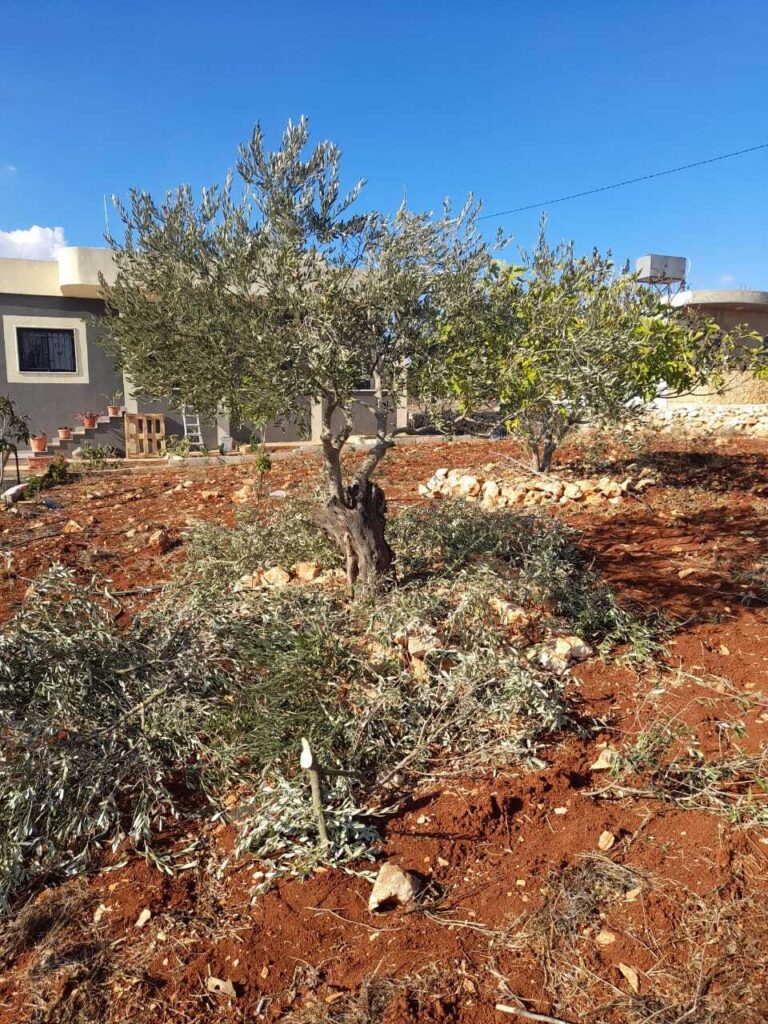
Al-Mawla estimates “the direct losses for tobacco farmers in the south at around $8 million as a preliminary total, without counting the indirect losses linked to the loss of land and homes, or the loss of members of farming families who depend on this sector as a primary source of livelihood.”
In the southern villages, families are trying to hold on to the agricultural season despite everything. The young woman Mariam Khreizat recounts how the townspeople acted after their return in 2024 on the assumption that the war had ended — many began renting farmland in towns such as Aynaata and al-Tira and other distant areas, paying from their own pockets to rehabilitate the land and prepare it for cultivation, in the absence of any real economic alternative. Mariam explains “that the townspeople began preparing agricultural nurseries before the 2026 war broke out, believing the season would return as it was, before the same losses repeated themselves with every new escalation.”
Despite the fading hope of returning to Aytaroun, Mariam affirms her attachment to the land and to tobacco cultivation, saying “life in the city does not resemble the villages or their people”; she says “the land belongs to those who planted it and invested in it,” even if the seasons have turned into a losing gamble. She notes that her family of eight cultivates around 15 dunams of tobacco, yet at the start of every season they incur losses of between $200 and $300 per dunam, covering the cost of water, plowing, and preparing the nurseries — large sums for a family that depends almost entirely on farming.
She explains that “the war always comes at the peak of preparation for the agricultural season, after farmers have already spent everything they have to rehabilitate the land following years of displacement and emigration.
Even water, which is the foundation of the agricultural nurseries, becomes an added burden; a single water tanker load costs no less than $15, and is enough to irrigate only one nursery, so losses accumulate season after season with no real return.”
Mrs. Iman Khreizat considers “farming to be their primary livelihood,” and recounts how she returned with her family to their home in Aytaroun after the 2023 war, amid the burden of supporting six children. She notes that they were forced to use the $10,000 they received as housing aid to build two rooms and buy some household necessities after their main home was destroyed — but the amount was not sufficient, causing debts to accumulate.
As they tried to rebuild their lives, the family began tilling the land again and preparing to grow tobacco. But because of working conditions in the border areas of Aytaroun, the townspeople were at that point forced to rent land in the two towns of Aynaata and Kunin. Khreizat explains “that rehabilitating the land after years of displacement is very costly, especially for a family that has just come out of a war; the work includes plowing, spraying chemical materials, and preparing agricultural nurseries.” On the night of the second of March, with the war breaking out again and the shelling intensifying, the family was forced to flee their new home toward a safer village, leaving everything behind — even their identity documents.
Amal Mansour considers “the $300 advance that the Régie offers to tobacco farmers in the south insufficient,” saying that “the farmer, who forms the primary source of the Régie’s production and a source of revenue for the Lebanese state, needs real financial support — not an advance that is later recovered from him when he returns to farming his land.”
As for Fatima Awada, from the town of Aytaroun, she confirms “that tobacco cultivation is the primary source of livelihood for her family of five — along with their families,” noting that this crop forms a fixed income alongside their other work. After the 2024 war ended, the family was forced to search for new land in areas farther away and less suitable for tobacco cultivation. She explains “that after farming two dunams of land, she has to buy basic work equipment — iron tools, farming implements, transport carts, and plastic sheeting — after losing their main home and agricultural supplies.” At the start of the new season, the family began preparing again for the tobacco season hoping to face the harsh living conditions — but they suddenly found themselves before a new wave of displacement, this time toward the Khalde area.
More than 1,000 Dunams Planted with Tobacco in Aytaroun
The mayor of Aytaroun, Salim Murad, recounts how the town’s people, after the 2024 war, are trying to restore life to their land and relaunch the agricultural economic cycle, despite the destruction and losses that follow them with every season. He explains that “around 400 farmers begin at the start of March to prepare their land for tobacco cultivation — they plow the soil, apply basic fertilizers, and prepare tobacco seedbeds in the hope that the season will return as it was. But with every security escalation, the townspeople are forced to abandon their land and be displaced again, turning agricultural preparations into open-ended losses.”
"Around 400 farmers begin at the start of March to prepare their land for tobacco cultivation"
Murad estimates the areas planted with tobacco in Aytaroun at between 1,000 and 1,100 dunams, noting that “the cost of preparing a single dunam starts at around $100 for plowing, $100 for fertilizers, and around $50 for preparing the seedbeds — meaning no less than $250 as the direct cost per dunam before cultivation actually begins.”
But the loss, as he says, “does not stop at the money paid to prepare the land; it extends to the loss of the entire agricultural season. A single dunam produces around 150 kilograms of tobacco, worth approximately $1,500 — sums that many of the townspeople depend on as their primary livelihood throughout the year.” According to the municipality’s estimates, the direct losses from land preparation alone exceed $250,000, distributed among around 400 farmers — but the greater loss remains the loss of the tobacco season itself, and what it represents as a fundamental economic resource for tens of families in the town, alongside the loss of the land and the cycle of life and livelihood tied to it.
In the same context, the agricultural correspondent in the Aytaroun area, Mahmoud Atwi, confirms that “the number of tobacco licenses distributed to farmers in the town currently stands at 866, down from over 1,000 licenses in previous years.” He notes that “a number of farmers, after the 2023 war, are trying to invest in land far from the danger zones.”
Aytaroun currently produces around half its usual harvest — approximately 7,500 bales of tobacco — while in normal years it used to produce around 15,000 bales; the harvest was delivered to the city of Nabatieh, with each bale weighing between 10 and 30 kilograms.
With the start of the war in 2026, “between 200 and 250 farmers began preparing their land and crops by purchasing chemical materials and plowing the soil — but the outbreak of war and security warnings pushed everyone to flee and abandon their fields, despite expectations that production would reach around 7,000 bales.” As for 2025, “the volume of agricultural production did not exceed 500 bales, after work was limited to around 50 farmers, even though Aytaroun is considered one of the largest tobacco-producing villages in the south — having once produced around 30,000 bales annually, with 15,000 delivered directly and the remaining quantity completed through licenses from neighboring villages.” Atwi also notes that “the Régie provides assistance to farmers, including a subsidy of $2.50 per kilogram in one phase, then $2 per kilogram in 2025, in addition to a $300 advance per license during this year.”