











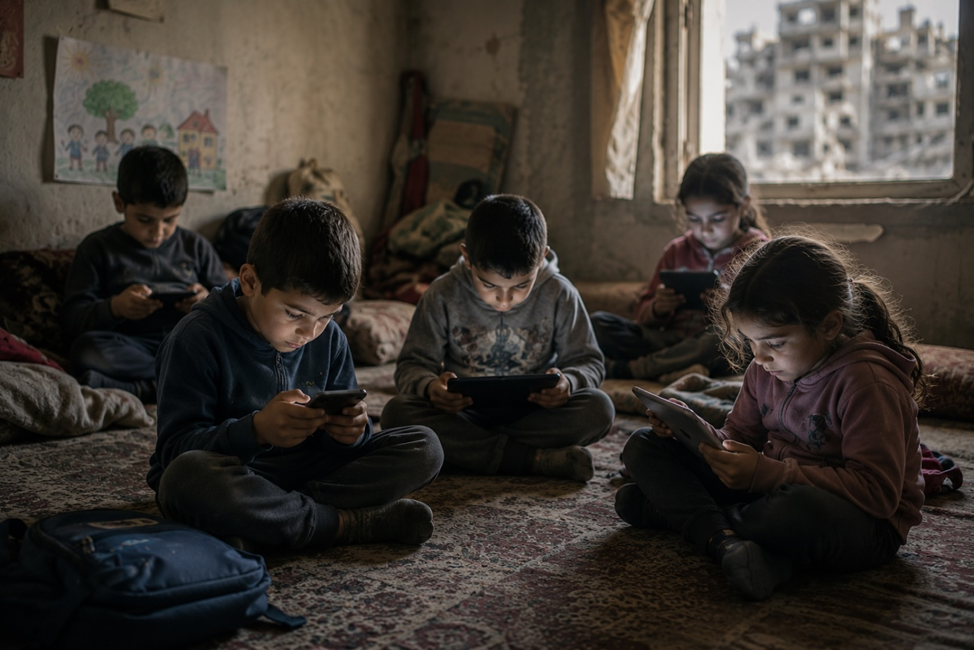
The iPad is no longer just a device in a child’s hand. It has become a small door that shuts out the sounds of the outside world: warplanes, shelling, the news, and the fear of the grown-ups. Inside a single room, the family lives in constant tension, and the iPad is a temporary means to keep the child from hearing everything, from asking too much, and to distract him from a world that no longer makes sense to him.
That is how Zeinab Balout, displaced from Beirut’s southern suburb, describes what happened with her seven-year-old son Mahdi. She did not like the idea of him spending long hours on the iPad, but in her view the war pushed her toward choices she never wanted as a mother. With the relentless shelling, the closure of schools, and the difficulty of going out, the device sometimes became the only way to distract and calm the child, even if only temporarily.
Balout says: “Mahdi started spending far longer hours on the iPad than he did before the war. At first, the aim was to keep him away from the atmosphere of fear, the news, and the tension inside the house. But over time, this use left its mark on him. When I try to take the device from him, he becomes more irritable and tense. And yet, I sometimes feel ‘forced’ into it, given the absence of alternatives, living in this cramped space, and fearing that any added tension could turn into a problem within the place itself.”
"Mahdi started spending far longer hours on the iPad than he did before the war"
For her part, Nermine Faour Balout shares the same situation. A mother of two, her six-year-old son used screens in a limited way before the war and was not attached to them as he is today. He went to school, and in summer to the sports club, and she tried to keep him away from the phone as much as possible. She even strongly refused the very idea of him owning an “iPad.” “He would watch television sometimes, but within the limits I had set for him,” she says.
With the start of the war, and after the family moved to the Hamra area, everything changed. Nermine says: “We found ourselves in a crowded house, ten people in two rooms, full of tension and fear, with an elderly man over 80 years old among us, and everyone living under constant psychological pressure. To keep my son calm, so he would not disturb those present or be more affected by the atmosphere, I started giving him the phone for long periods, and later I was forced to buy him an iPad. Little by little, he became more and more attached to electronic games.”
She adds that she tried to buy games suitable for his age, such as Lego, magnetic toys, story books, and other things, but these alternatives often turned into disputes between him and his sister, which only added to the charged atmosphere inside the house of irritability, tension, and shouting.
Faour explains that these signs were not apparent before the war, when her child’s day was divided between school, the club, and play, with the routine leaving him little time in front of the screen. But they began to appear gradually after the repeated use of the iPad during the war. When anyone tries to take the device from him, his reaction is screaming and crying with intense agitation; he has also become quick-tempered, less focused, and more tense. Even her young daughter, who did not previously use the phone, began asking for it constantly, affected by the atmosphere the family is living through during the war.
The Absence of School and the Expansion of Screen Time
This shift in children’s relationship with screens is something Zahraa Faqih lives through. A mother of three children between the ages of 12 and 16, her family moved during the war from the suburb to the Verdun area. She says her children’s lives before the war were built on a clear daily system: early to bed, early to rise, school, homework, then a limited amount of time on the phone. “If they used the phone, it was for few and controlled hours,” she says.
Faqih explains that her children would log in to the online classroom, then go straight back to playing, while the presence of their cousins in the same place increased their attachment to collective electronic games, as they encouraged one another to play for long hours.
She says: “The war pushed me, like many parents, to be more lenient about the use of electronic devices. “We ask ourselves: how do we keep them occupied so they do not feel afraid?”, she says, noting that the devices also entered their lives under the banner of studying and remote learning, but in practice they turned into a vast space for mental distraction and electronic games.
A World Inside the Game
Faqih notes that her children became more attached to games over time, to the point that some of them became deeply bound to their account inside the game and the levels and points they achieve in it. “I once asked them whether they would be willing to sell their accounts for sums of money, but they refused, because they feel they have reached an important stage inside the game and do not want to lose it,” she adds.
“I find it difficult to deal with this matter inside the home. Being overly strict can sometimes lead to the opposite result, because my son may not understand the ban as concern for him, but may instead feel that I am standing against him. So I try to balance between constant reminders and not turning the phone into a permanent source of tension in my relationship with him.”
“The war makes me feel that this balance is growing harder; we too, as parents, live under constant psychological pressure and tension.” For this reason, she does not see the solution merely in banning the phone, but in trying to understand all the circumstances surrounding the child: the cramped space, the absence of alternatives, the lack of movement, anxiety, and long idle hours. “If we take the phone alone out of children’s lives, that does not mean they will become one hundred percent ideal.”
Games as Psychological Compensation
These transformations are explained by Dr. Mohammad Nemer, a specialist in education and family counseling, as being directly tied to the reality of war and what it imposes on children in terms of losing stability, safety, and routine. Nemer explains that under such conditions a child loses essential elements of his daily life: school, movement, regular sleep, natural play, and even, at times, regular meals.
With the absence of this rhythm, the child begins searching for an alternative that gives him a temporary sense of comfort or accomplishment, and electronic games turn into a space of psychological compensation that gradually replaces free play, imagination, and direct interaction with the surrounding environment.
Nemer believes that war makes children more prone to becoming attached to electronic games, because they live with fear, emptiness, and anxiety every day. Over time, the child no longer plays only for entertainment, but because inside the game he feels accomplishment, control, and appreciation, especially with the system of points, levels, and rewards that many online games rely on.
“Nemer believes that war makes children more prone to becoming attached to electronic games”
The effect of this is not limited to education alone. Nemer warns that sitting for long hours in front of games is reflected in the child’s personality and behavior, as he becomes more irritable, less communicative with others, and weaker in his ability to express his feelings in words. Problems also appear in sleep, concentration, and social relationships, in addition to a decline in physical activity due to long hours of sitting in front of the screen.
As for the solutions, Nemer believes they do not begin with the child alone, but with the parents as well. Many families are bothered by their children’s attachment to electronic devices, but at the same time they may not be ready to undertake the long educational work that changing this behavior requires. He stresses that treating electronic addiction is not a decision made for a day or two, but a continuous process that needs patience, follow-up, and genuine will from the parents, because the effects left by war and displacement will not disappear quickly.
Nemer affirms that the first step is to understand the reasons that pushed the child toward this attachment, for war, fear, displacement, and the absence of stability are all factors that drove children to take refuge in screens. Therefore it is not enough to pull the phone from their hands; alternatives must be provided that give them back what they lost: the sense of safety, attention, routine, and the daily relationship with the parents.
He adds that the child needs ongoing dialogue that reassures him and gives him space to express his fears. Instead of ignoring or denying the fear, it should be acknowledged and the child helped to understand it. “Fear in war is natural,” Nemer says, “but the important thing is that it does not turn into something that paralyzes the child’s life or makes him live in illusions and the worst scenarios all the time.” He therefore calls for listening to children, correcting their thoughts, and reassuring them that the place of displacement or their current residence is safer than the place they left.
He also stresses the importance of rebuilding the daily routine as much as possible, by organizing time between study, reading, play, movement, and a limited amount of time for electronic games without total deprivation or excess. He suggests introducing what he calls “purposeful play” or “effective play,” such as group games, handicrafts, drawing, stories, and activities that develop the child’s social and emotional intelligence, in addition to sports and active games such as running, hide-and-seek, and other activities that pull the child out of a state of lethargy and long hours of sitting in front of the screen.
Nemer warns that some parents try to reduce their children’s use of devices while they themselves spend long hours on their phones. For this reason, he considers setting an example to be an essential element in any attempt at treatment, because it is hard for a child to be convinced of the need to cut down on phone use if he sees his parents engrossed in it all the time.
He concludes by affirming that dealing with the effects of war cannot bear the logic of a “temporary phase.” Many families believe they will address these problems when the war ends or when they return to their homes, while months and years pass and the children grow up amid these conditions. He therefore calls on parents to confront these challenges starting now, and to work on protecting their children gradually, because what is left unaddressed today may become more difficult to treat later.