





The Grand Mosque of Bint Jbeil is considered one of the oldest religious and social landmarks in the city, and one of the architectural testaments embedded in the memory of its people — even if its exact construction date remains unsettled.
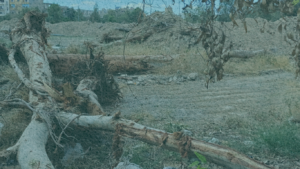
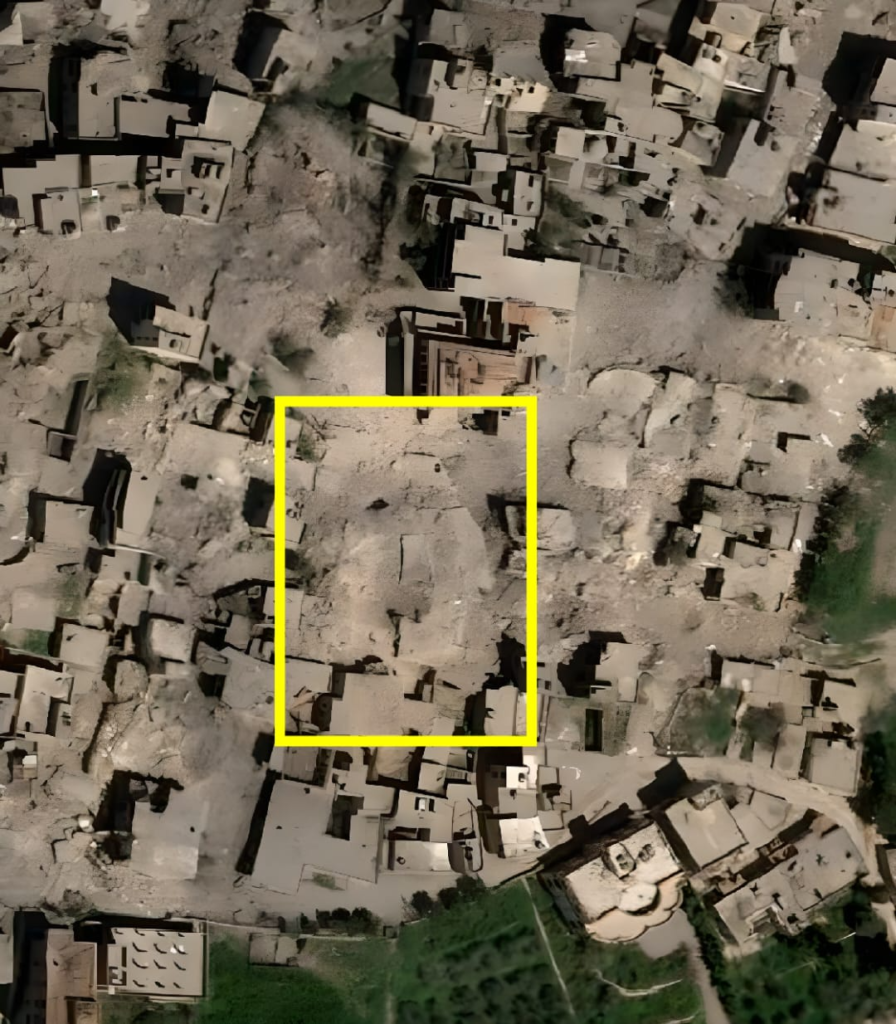
According to Dr. Habib Sadek, university professor and president of the Jadirji Foundation for Architecture and Society, no precise or definitive references currently exist to conclusively date the mosques of the South, as this field still requires further research and scrutiny. Yet this landmark — which remained ever-present in Bint Jbeil’s history and daily fabric — now exists only as rubble, having been bulldozed and destroyed by the Israeli army during the ongoing war in southern Lebanon. The mosque was not merely a place of prayer; it was a space around which generations gathered, where religious rites intertwined with social customs and community life.
A Historical Architectural Memory
The Grand Mosque is considered one of the oldest mosques in the city. An inscription preserved inside a niche in its southern wall states that Hajj Ali ibn Ahmad al-Bazzi renovated its structure in the year 1134 AH / 1722–1723 CE, during the reign of Qablan ibn Hassan ibn Nassar of the Al-Ali al-Saghir family. However, other local accounts suggest that the mosque’s site predates this date, and that what dates to 1722 represents the first documented renovation, not the original construction.
Other inscriptions and local accounts indicate that the mosque underwent multiple phases of expansion and restoration over the centuries. Hajj Suleiman Bazzi rebuilt it in 1300 AH / 1883 CE, during the era of scholar Sheikh Moussa Sharrara, when a large dome was added and the mosque’s area was expanded by architects from Safad in Palestine. As for the current minaret, Ahmad A. Bazzi — citing a Facebook post attributed to Professor Ghassan Hassan Saeed Bazzi — reports that it was rebuilt during an expansion and restoration project in 1948 by Abu Taysir and his brothers. Its stones were carved by residents of the town, and it was distinguished by an internal stone staircase and an architectural character that made it one of the city’s most prominent landmarks.
"The same accounts indicate that the mosque underwent subsequent expansions"
“The same accounts indicate that the mosque underwent subsequent expansions, including an enlargement of the prayer hall in 1349 AH / 1932 CE, the enclosure of the outer courtyard in 1364 AH / 1945 CE, and the construction of an arcade with stone arches and columns on the northern side. The iwan was also added at a later stage, and general restoration and expansion works took place in the late 1960s, followed by comprehensive rehabilitation work after 2000 — before the mosque suffered partial destruction in 2006 and then underwent extensive restoration and expansion in 2007.”
Religious and Social Rituals That Made the Place
For Ali Samir Saad, chairman of the Grand Mosque committee in Bint Jbeil, the mosque’s value is not reducible to its architectural history alone, but to the daily role it played in bringing people together. “The mosque carried its social meaning as much as its religious one,” Saad explains. “Religious and social activities were held there continuously — from weekly gatherings to commemorations of the birth and death anniversaries of the Imams, to two central occasions in the town’s life: Ashura and the month of Ramadan.”
"The mosque carried its social meaning as much as its religious one"
During Ashura, the mosque transformed into a wide space for hospitality and gathering. Saad recalls that the gathering used to bring together around 450 people, and that some residents would arrive as early as two or three in the afternoon — hours before the session began at five — to sit in the mosque’s atmosphere and drink tea. A committee of around ten people handled the preparations, with hospitality including tea, biscuits, and sweets. He explains that the committee would prepare large quantities of tea to distribute among those present.
Saad notes that this hospitality was an extension of old customs that the mosque had preserved through changing times. In earlier days, residents would contribute in kind: one would bring sugar, another tea, a third whatever else was needed for the gathering. Later, the mode of support shifted — people began donating money, while the committee took charge of purchasing supplies and organizing hospitality.
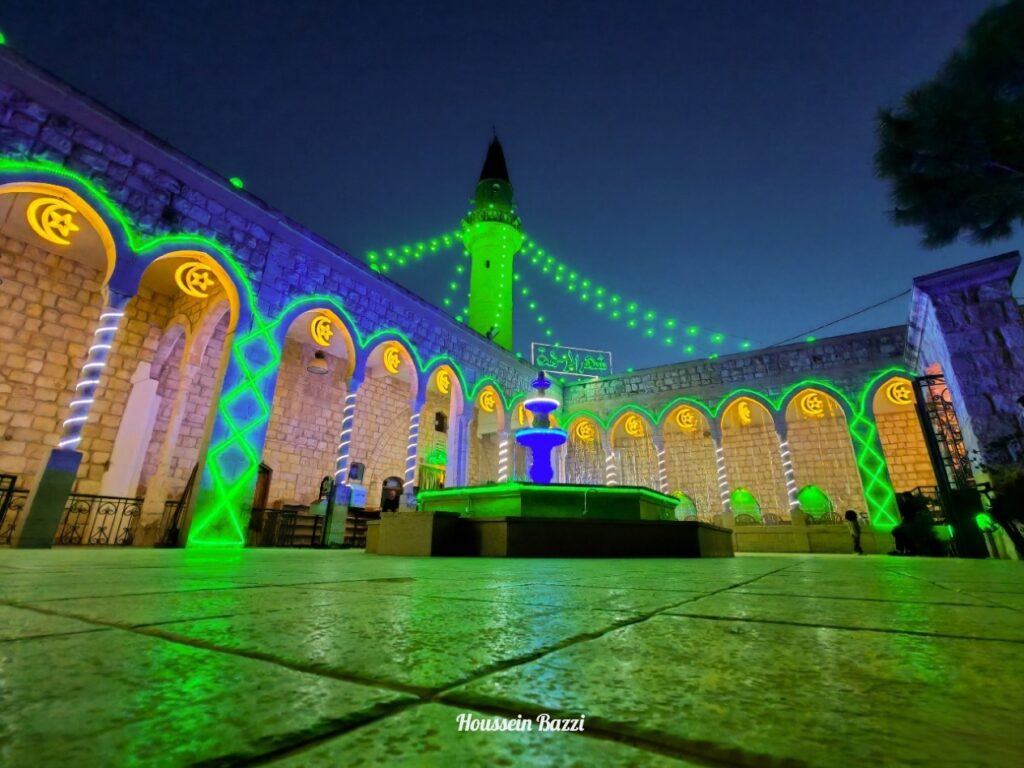
On the occasions commemorating the births of the Imams, religious hymns and mawlid chants would be performed in the mosque’s reception hall, accompanied by the distribution of tea and Arabic sweets traditional to Bint Jbeil, such as namoura and marshoosha. During the month of Ramadan, the mosque had its own special ritual: the committee would begin decorating roughly a week before the month started, and Saad along with a group of young people would hang and arrange the decorations. He says that the mosque’s decorations in recent years were so striking that people would come specifically to photograph them — some requesting they be documented for their beauty and uniqueness.
The mosque’s standing, according to Saad, was not confined to the people of Bint Jbeil. It was visited as a tourist landmark, with visitors arriving on Sundays from Beirut, Ashrafieh, and other areas to learn about it. Saad would receive them and provide information about the mosque, and he also kept head coverings available for female visitors out of respect for the sanctity of the space. He notes that Christian visitors from various regions, including Ashrafieh and elsewhere, would enter the mosque to visit it — making it a space for discovering the city’s heritage rather than a religious place closed off to its own community alone. Saad summarizes the loss in these words: “Even if it were rebuilt stone by stone and returned to exactly what it was, the soul that was in it would never come back.”
“The Village’s Very Own Garden”
At the heart of Bint Jbeil, the Grand Mosque was one of the landmarks fused with the city’s image and daily memory. Zahraa Al-Sayyed, an Arabic literature teacher and writer from Bint Jbeil, describes it as hakoura noss el-daye — the village’s central garden, the heart of the town — meaning a place that residents knew not merely as part of the built environment but as part of their very lives.
Al-Sayyed says her relationship with the mosque began in childhood, particularly after the Liberation, when parents would bring their children to it during religious occasions, especially in the month of Ramadan and on Laylat al-Qadr. She recalls visiting it from the age of six or seven, growing up with this deep attachment to it, and later passing that attachment on to her own children.
For her, the mosque was not simply a religious or heritage landmark but “a piece of the soul” — a place upon which successive generations were raised: the generation of the parents, then her own generation, then the children who grew up loving it. She notes that its location at the center of Bint Jbeil made it accessible to most neighborhoods, so people would walk to it from Al-Birka, the market, or the surrounding districts.
Al-Sayyed recalls the atmosphere of Ramadan and Ashura, when residents would anticipate the mosque’s decorations and come to recite the Opening Supplication (Du’aa al-Iftitah) and attend the gatherings. She says the decorations were so special that residents “saw themselves in them.” She also describes it as a space of warmth and encounter, where people would meet those they hadn’t seen in a long time, turning the place into a point of connection between the city’s residents.
Al-Sayyed believes that the loss of the mosque cannot be measured in material terms alone, because its value extends into memory and the collective consciousness. Its presence, she says, was part of how generations were shaped — religiously, socially — and of their attachment to religious occasions and to community. It is therefore difficult for her to imagine Bint Jbeil without the mosque, without its voice and its presence.
In this sense, the Grand Mosque of Bint Jbeil is not reducible to a religious landmark or an architectural monument alone. It stands as part of the social and urban memory of a city in which it remained present through the daily details of successive generations. Its loss in the recent war is therefore not to be read merely as the loss of a building or a historical site, but as the erasure of part of the place where relationships, customs, and collective identity were formed.