




Nariman Shareem had never imagined that her daughter would be born far from the home she had spent months preparing to welcome her. She left the town of Houla in her ninth month of pregnancy, carrying that particular kind of exhaustion that belongs not only to expectant mothers but to a woman uprooted from her home at the very moment she was preparing to receive a new life.
“We moved from place to place until we reached the displacement center in Beirut — Hamra,” Nariman says. “Before they arranged a bed for us, I was sleeping on the floor. Do you know what it means for a woman nine months pregnant to sleep on the floor? No real sleep, no real food, no real drink.” For her, the problem was not only a lack of assistance, but the loss of everything that makes birth possible with dignity: a home, a bed, a bathroom, privacy, and the people she was accustomed to having around her at this stage.
Nariman went to the hospital exhausted, then returned after a cesarean section to the displacement center. “It’s not like your home.” At home, as she says, a woman can rest in whatever she feels comfortable wearing, go to the bathroom whenever she needs, clean her wound and care for herself without worrying about the door, other people, the queue, and the looks of others. But in the displacement center, even going to the bathroom requires complete preparation: clothes, an abaya, disinfectants, and waiting.
In those small details, another face of displacement reveals itself. For this experience does not fall equally on everyone. Pregnant women and mothers, the elderly and the sick, and people who face discrimination or prejudice because of their difference or identity, experience additional forms of vulnerability that the general statistics of displacement cannot capture.
One month after the start of the war, the United Nations Population Fund estimated in its report covering the period from March 26 to April 1, 2026, that around 1.2 million people had been displaced within Lebanon, including approximately 620,000 women and girls — nearly a quarter of all women and girls in the country. It also notes that tens of thousands were housed in collective centers, where overcrowding and the lack of privacy increase protection risks, including gender-based violence, exploitation, and harassment.
A Birth Away from Home
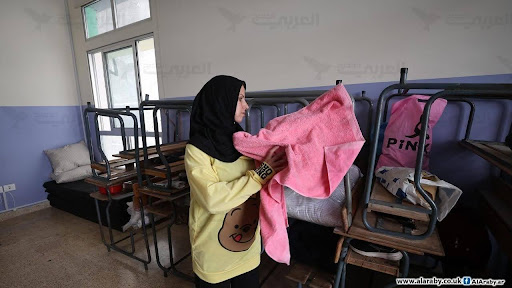
After giving birth, Nariman had to not only care for her newborn daughter but also recover from her surgical wound in a place that bore no resemblance to what a woman leaving the hospital needs. She says she needed to disinfect the wound day after day, to bathe and rest, but everything had to pass through the center’s conditions: the shared bathroom, the crowding, the door open to the sounds of people, and the inability to move freely.
She describes the difference between home and the displacement center clearly, and adds: “In my home, I could wear whatever was comfortable and move freely within my room and my house. But here, I am forced to stay prepared at all times, in modest clothing, because the door could open at any moment, and because the place does not give me the freedom of movement I had at home.” Even her body, at that stage, could no longer respond to its need for rest — it was forced instead to adapt to the conditions of the place.
She adds that postpartum depression returned to her as it had after previous births, but this time it was heavier. “I want to scream and cry. Everything around me is pressing down on me. My children were confined to a specific space, there was no longer any routine, and I no longer knew what rest was.” She would place her daughter beside her mother-in-law and cry for a long time. She was not crying because of the baby, but because of everything surrounding her: the displacement, the fear, the distress, the wound, the children, and the absence of home.
Even breastfeeding was affected. She tried to nurse her daughter, but says that her emotional state was not helping her. “I tried, but I did not feel that I was well. I felt as though the milk had mixed with my tears.”
Nariman’s experience does not appear isolated from the broader context that women face in displacement conditions. A recent study published in 2026 in the journal “Scientific Reports,” affiliated with Nature, on postpartum depression among refugee and internally displaced women in Lebanon, linked displacement, declining social support, difficulty accessing healthcare, and elevated risks of postpartum depression. These findings help situate Nariman’s testimony as part of a wider reality experienced by women facing pregnancy and childbirth amid war and forced uprooting.
When Difference Becomes a Danger
But the loss of privacy does not affect the body alone. In displacement centers, private life itself can become exposed, and difference — or what others perceive as difference — can become a reason for surveillance and exclusion.
Jad Mohsen (pseudonym), 19 years old, was initially staying in the dormitory of the Lebanese University. There, as he explains, he enjoyed a degree of privacy and was not obligated to explain his personal life to others. He says he has romantic feelings toward men, but had not declared this or spoken about it to those around him.
When he moved with his family to a displacement center, things changed. With daily contact with people, his warm, affectionate manner, his appearance, and his way of speaking began to raise suspicions among some of those present. He says: “By nature I say ‘my dear’ to people, I greet warmly, and there is a gentleness to the way I speak.” For him, these behaviors were simply part of his personality, but they led some around him to form judgments and assumptions about his inclinations — before those impressions turned into comments and bullying, then into accusations that reached his family and his place within the center.
The school principal where the family was staying contacted Jad’s mother and leveled accusations against him, among them that he had been filming girls inside the center. For Jad, the accusation was not separate from the atmosphere of suspicion that had preceded it — it seemed like a direct consequence of the judgments that had accumulated around him. He says: “I felt as though the impressions had become a charge.”
Later, when the university dormitory reopened, he returned there even though the war had not ended. The Hadath area was still under threat and bombardment, but he saw returning to the dormitory as a less harsh choice than remaining in a place where he had become an object of surveillance and suspicion.
The Bathroom as a Space of Protection
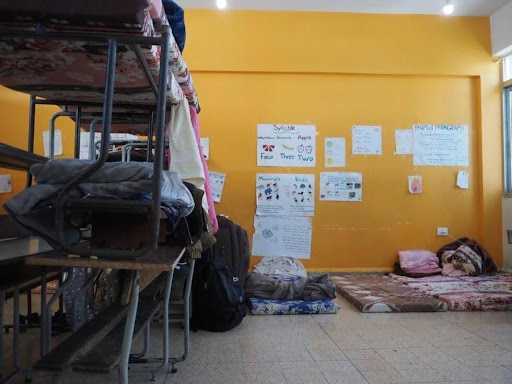
In the testimony of Fatima, a displaced woman from the town of Ansar staying at a shelter center in the Hamra area, the bathroom does not appear as a passing daily detail. It becomes a measure of privacy, and of a woman’s sense that she is still able to care for herself.
Fatima says that the center’s staff do not fall short on cleanliness or water supply, but she sees the problem as the crowding. “At home, I could enter the bathroom whenever I wanted and bathe whenever I needed. Here, everything is tied to waiting and congestion.” During her menstrual cycle, the situation becomes more difficult. A woman needs time, water, privacy, and a space where she does not feel watched or forced to explain why she is standing, entering, or waiting.
These challenges are not confined to Fatima’s experience alone. International humanitarian standards treat privacy and hygiene as components of protection and dignity in shelter centers, affirming that sanitation facilities must enable women and girls to manage menstruation needs with dignity, including safe disposal of hygiene materials, or washing and drying them privately.
Reports from the United Nations Population Fund in Lebanon indicate that some collective shelters lack adequate privacy, which exacerbates protection risks for women and girls, including gender-based violence, exploitation, and harassment, alongside elevated psychological distress.
Illness and Displacement
Naseera Abbas, displaced from Houla, sums up her life in the center in a single sentence: “Life in our homes was so much better.” She arrived at night at the start of the war, and still lives in the Evangelical school in the Hamra area.
Naseera suffers from diabetes and heart and blood pressure problems. At home, she knew how to manage her day, her illness, and her need for the bathroom and hot water. She says: “The bathrooms are not like bathrooms at home. Today I bathed with cold water — had hot water been available, I would not have had to, but my turn did not come until after it ran out.”
Naseera does not speak of herself alone. Her children, who used to gather together in one home, have today scattered between worry, distress, and attempts to adapt to the reality of displacement. What she misses most is seeing them together as they used to be in the family home. She says: “Now our homes are gone, our young men are gone… there is no one left to support us, nothing.”
"Now our homes are gone, our young men are gone, there is no one left to support us, nothing"
A Private Life Laid Bare
But the exposure of privacy does not remain confined to the body or to the use of the bathroom. In displacement centers, personal relationships, secrets, and what a person tries to keep within their intimate circle can quickly travel to corridors, administrative offices, and the conversations of others.
Ryan Ftouni (pseudonym), displaced to Hamaana, recounts another experience of private life becoming exposed inside a building designated to house displaced persons. She was not staying in a collective school, but in a building that granted families some privacy within their rooms — yet this privacy remained limited. The corridors are shared, daily movement is visible, and families live in constant proximity, making any personal conflict easily transferable from one room to another.
Ryan says that no one in her family knows her full situation, except her twin sister who knows some of the details but does not fully understand them. She had been engaged, she says, because society generally pushes girls toward this path, especially in conservative environments.
During the engagement, her problems with her fiancé began to surface gradually. Through her repeated questions and persistent hints, he noticed that she was not attracted to men alone, but also to women. Over time, this became a source of tension between them.
Under ordinary circumstances, this conflict might have remained within the relationship or within a narrow circle. But displacement made those circles narrower and more entangled; the same people met daily in corridors, at room entrances, and at aid and service distribution points. When details of the conflict traveled from her fiancé to one of his friends, then from one person to another, the story reached the management of the displacement building. Ryan then felt that her private life was no longer her own, and that what was supposed to remain inside a personal relationship had become a topic circulating in a setting that gave her no possibility of withdrawal or distance.
She says she had not harmed anyone or crossed anyone’s boundaries — she had simply revealed a part of her feelings to the person she considered closest to her. But that disclosure, in a conservative and overcrowded environment, turned into an additional burden she had to bear.
Extortion Within Vulnerability
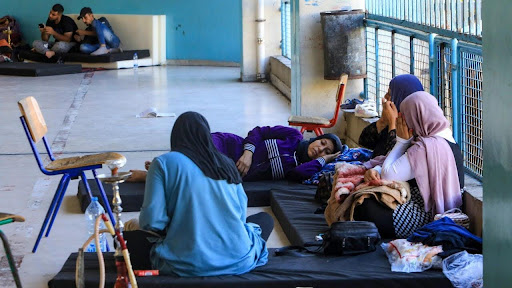
If displacement makes private life susceptible to exposure, the testimony of Haydar Mohtadi (pseudonym), 26 years old, is a harsher account of how private knowledge about a person’s life can be weaponized for blackmail. Before the war, he had come to know a group of young men and women at a mixed-gender sports club in Furn el-Chebbak. There, he began to discover aspects of his own inclinations, met people who resembled him, and felt no shame in this, because they came from environments different from his own.
But displacement reshuffled the worlds. He moved with his family to a shelter center in a building that had previously been a hotel in the Jawwar al-Hawz area. There, he encountered someone he knew from the club, who was working within the municipal staff present around the center. The problem, as Haydar recounts, was not in the person’s official capacity as such, but in his exploitation of prior personal knowledge about Haydar’s private life. This person began hinting that he knew sensitive details about him, then started demanding money in exchange for his silence.
Haydar says he was afraid the matter would reach his family, particularly his parents. He feared causing them shock or psychological harm if they learned of those details, so he paid for a period — until the war dragged on and he could no longer continue. At that point, according to his account, word began to spread inside the displacement center.
Everything changed after that. Young men who used to sit with him stopped speaking to him, and children he had been helping with their studies were kept away from him after their parents forbade them from mixing with him. Hurtful comments began to follow him in the corridors, from young men and women alike. He says: “I felt I had become alone, and I did not know which door to knock on to say that I was genuinely being hurt.”
In his testimony, the pain does not stop at the bullying — it extends to the feeling that there is no institution that can hear or protect him. He says that people, rather than extending a helping hand, added to the pressure and isolation. He adds: “Our home in Dahiyeh was damaged, but the psychological destruction that struck me was harsher than the destruction of the house. A house can be rebuilt — but what collapsed inside me was harder.”
"The psychological destruction that struck me was harsher than the destruction of the house"
Managing Vulnerability
Faced with this kind of vulnerability, managing a displacement center ceases to be purely an organizational matter and becomes part of protection itself. Staff at some displacement centers encountered complex cases linked to fear of private life being exposed. Hassan Qablan, the social and educational expert who works on managing the displacement file in the Mount Lebanon area, says that some of these cases required quiet and sensitive intervention — not to pass judgment or assign a label, but to prevent words and suspicions from turning into direct harm within an overcrowded and tense environment.
Qablan explains that handling these cases was based on protecting individuals and containing tensions, not on condemnation or exclusion. In some situations, as he says, the real danger lay in the reactions of the surrounding community and in the speed with which rumors spread, more than in the case itself.
He notes that the work team tried, wherever possible, to provide safe spaces for dialogue, de-escalate tensions within the center, and defend individuals when the danger to them increased due to bullying or misunderstanding.
He adds: “In displacement conditions, people are already under immense pressure. Any additional rejection can therefore turn into a serious psychological burden. Our role was to reduce that burden, not add to it.”
From a psychological perspective, Hanan Nasser, a psychotherapist drawing on her practice experience, observes that much of the suffering inside displacement centers is tied to the loss of control over the daily life details that had given people a sense of stability — especially women who used to manage the rhythm of home, children, hygiene, and rest. A woman who regulated her children’s sleep times, their meals, and their studies suddenly finds herself in a shared space where she no longer holds the same authority over the simplest details: from bathing and washing clothes, to resting, sleeping, and caring for the children.
Nasser explains that shared bathrooms, crowding, and the absence of privacy are understood not only as service problems, but as daily psychological pressures. Losing the home, for many women, also means losing the role, the order, and the ability to protect the body and private life. This pressure, she says, does not remain confined to women — it transfers within the family, especially to children, who in turn live through the crowding and the loss of daily routine.
More than a Roof
These testimonies do not negate the existence of assistance. Most of those who spoke mentioned that there were people who did not fall short, and that those responsible, or family members, or relatives, offered what they could. But assistance does not always bridge the gap between survival and dignified life. A person may survive the bombardment, yet enter another trial: how to sleep, how to bathe, how to care for a wound, how to protect a secret, how to raise children, and how to remain capable of enduring.
Months after giving birth to her daughter, Nariman keeps returning to the same phrase: “I wished she could have been born in better circumstances.” The sentence is not a reproach of those who helped her — it is a description of what assistance alone cannot compensate for. Home is not only walls. It is the bathroom you do not have to wait your turn for, the bed you know, the door you close when you are tired.
In displacement centers, these small details become the essence of protection. And when they are absent, the displaced do not only lose their homes — they lose something of their ability to own their days, their bodies, and their private stories.
*Note: To preserve individuals’ privacy and personal safety, pseudonyms have been used.