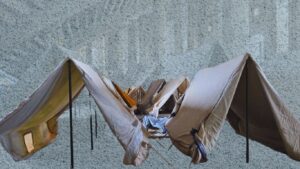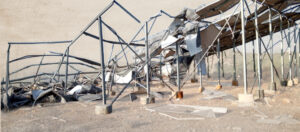







Hundreds of residents in the “Biel” camps on Beirut’s seafront face a harsh reality that strips them of the most basic essentials of human dignity; the absence of hygiene and the accumulation of waste place them at risk of being threatened by epidemics, at a time when these makeshift, overcrowded tents face future health and environmental hazards.
At exactly six in the morning, “Ali” wakes up like any normal human being on the face of the earth, searching for a drop of water to wash his face or brush his teeth, trying to wipe away the remnants of a heavy night of displacement. But here, behind the capital’s seafront, biological basics turn into an arduous daily “journey,” and cleanliness becomes a luxury that requires great effort.
“If I just want to brush my teeth, I have to walk to a very far place, and often exhaustion overwhelms me, so I cancel the idea entirely and postpone this self-evident right for a day or two.” This is how Ali’s daily journey begins, with the “battle of brushing one’s teeth”; this human battle, whose bitter details he recounts to the “Silat Wassel” platform, and if he wants to shower, the suffering multiplies into a march of hardship extending for more than two kilometers on foot in search of a suitable place.
This morning tragedy is not a passing detail concerning Ali alone, but part of collective hardships faced by hundreds of displaced people who suddenly found themselves inside a newly created pocket of misery of adjoining tents; there they wake up daily to spend long hours managing their basic biological needs, which drains their energy and leaves dire psychological and health effects on adults and children alike.
Weather fluctuations multiply the tragedy
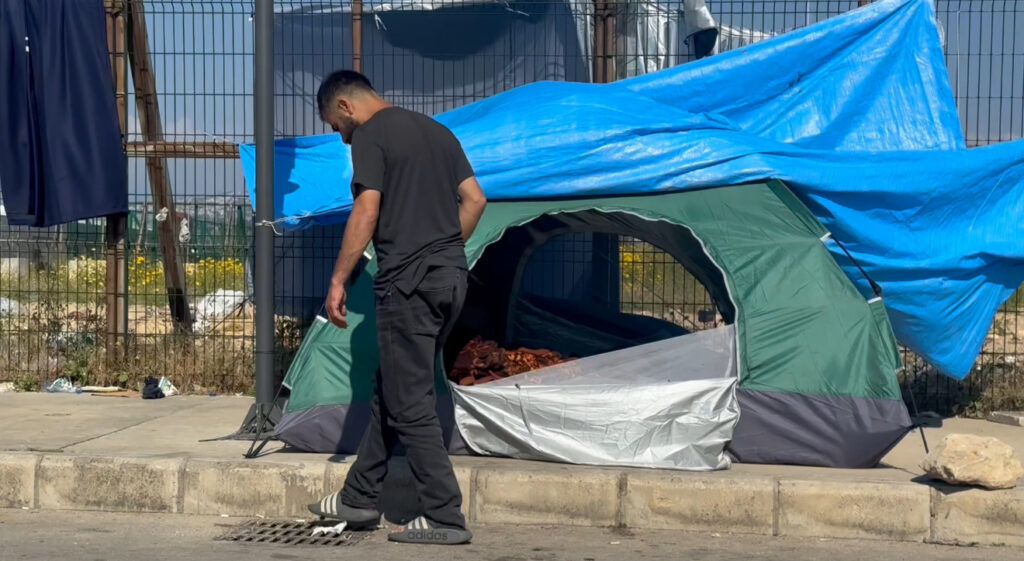
“When the rain falls, we live a second war and another suffering that is hard to resist”; this is how Ali describes the scale of the tragedy with the changing weather of May 2026. “It rained for only one day, and to this day we are still repairing the tarpaulins and dealing with the aftermath of the water. Only yesterday were we able to dry our belongings; we had to take the furniture and items out into the open and wait for them to dry while we sat without shelter outside our soaked tent,” Ali continues.
On the other side of the seasons, summer brings no mercy; with the onset of heat waves, these plastic tents turn into something like suffocating “thermal ovens” that lack ventilation and electricity, which raises the likelihood of heatstroke and severe dehydration among children and the elderly, who do not have the luxury of climatic adaptation, completing the chapters of the daily drama between a frost that drowns the tents and a summer that burns the bodies of their residents.
This latest field escalation came to multiply the fragility of an already strained humanitarian reality; Lebanon is fundamentally facing a multi-layered crisis driven by economic collapse, prolonged displacement, and continuous climatic pressures. Today, more than 2.7 million people in the country lack safe water, while about 20% of school-age children are deprived of education, according to UNICEF figures.
Logistical chaos: the search for hygiene supplies and toilets
“We are in a state of continuous displacement and constant movement; we first fled to Tripoli, and from there to Beirut’s southern suburb, then we went up to the Kfarman area in southern Lebanon, and now we have ended up here in the Biel camp.” This is how Hassan Yahya, displaced from the southern town of Kfar Kila, recounts his family’s journey of dispersal over months; the daily suffering is not limited to the elements of nature, but extends to the impossible details of personal hygiene.
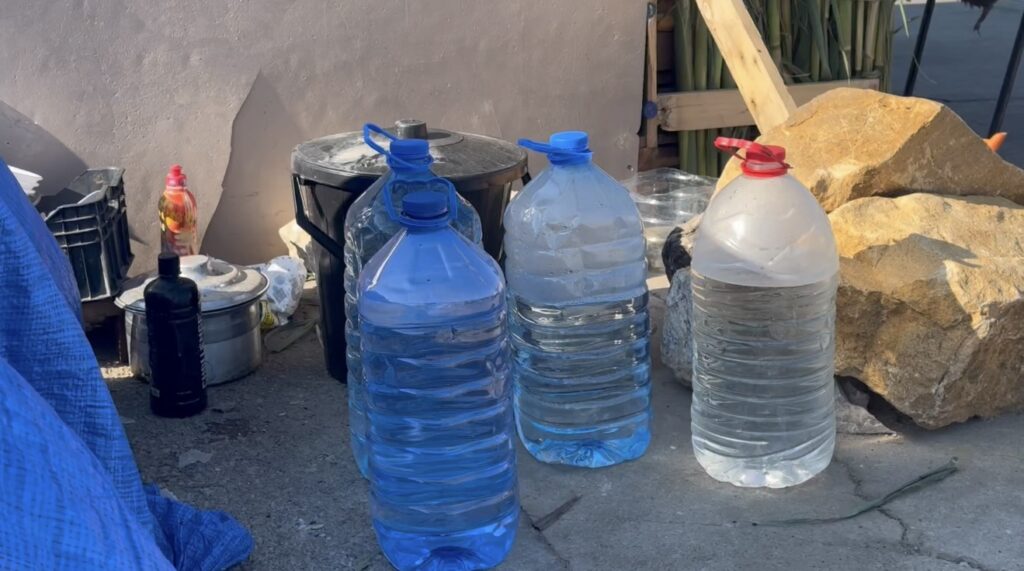
On another note, “securing water represents a very large burden, and the toilets are about 700 meters away from where we live”; this is how Hassan embodies the scale of the suffering that sometimes forces him to travel by car just to fill water in plastic containers, then return to relieve himself and shower inside the tent using that water. He continues, with regret, about the absence of basic relief support, saying: “As for laundry, we faced many problems, which prompted me to buy a washing machine, a refrigerator, and a primitive solar power system at my own expense just to meet our basic needs of charging phones and washing clothes.” As for the aid that reaches him, according to his remarks to “Silat Wassel,” it does not provide a sufficient amount of necessary materials such as laundry detergents and cleaning supplies, “and we are forced to buy them daily out of our own money, which directly affects our personal hygiene and the hygiene of our children.”
On another side of the camp, the displaced man Hussein highlights for the “Silat Wassel” platform the crisis of the absence of medicines and health equipment, considering that “what families need most now is medicine and basic disinfectants (such as Dettol); because the shared toilets completely lack cleanliness and disinfection. And if a person wants to shower, he has to put the water container under the sun’s rays for hours until it heats up, then shower with it inside his tent.”
“What families need most now is medicine and basic disinfectants”
Hussein’s suffering extends to document the crisis of the overcrowded shared toilets, where the displaced have to wait a long time for their turn, and he sums this up by saying: “Six or seven people take turns on a single toilet one after another, which is a nauseating situation. There are toilets located on the outskirts of the camp that require a seven-minute walk to reach, and people are forced to go there because of the severe overcrowding and the piling of tents on top of one another.”
Smells of rot and the threat of the “new Hanta virus”
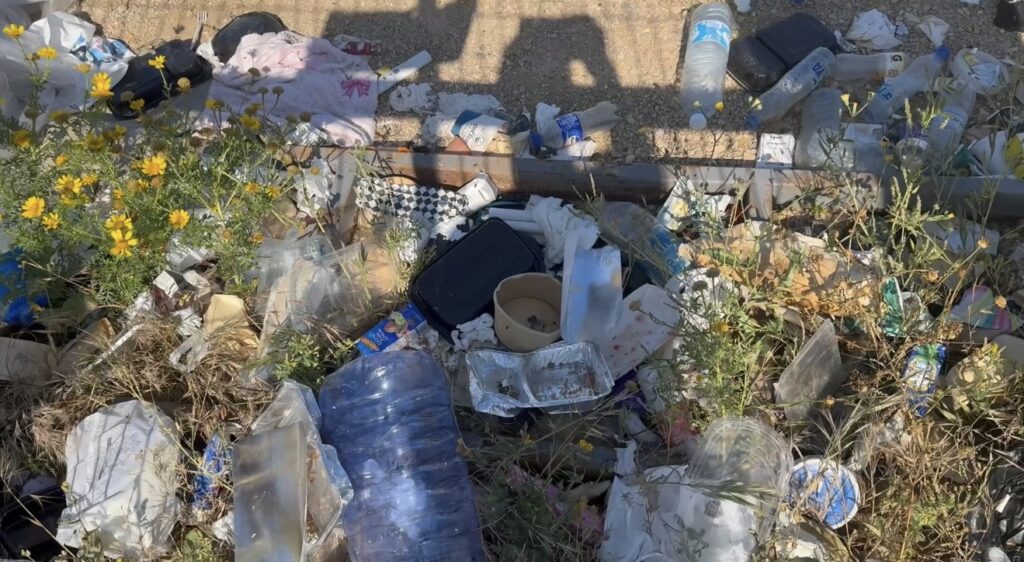
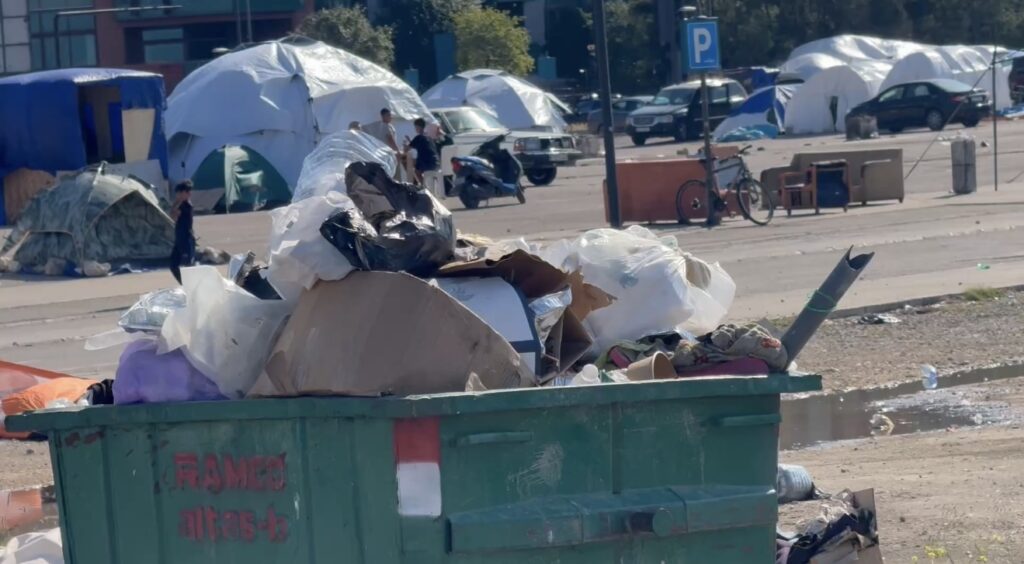
“There are tents that, when you enter them, you are met by very foul smells of rot resulting from the absence of facilities, and the people here are in dire need of alternative mobile toilets that would help solve the crisis instead of leaving polluted water on the ground.” Hussein demands solutions to these problems, for this severe overcrowding, the absence of sewage channels, and the municipalities’ delay in removing the waste containers piled up between the tents have produced a catastrophic environmental reality. This pollution also extends even to people’s daily bread; “even the bread they bring from outside, they leave it out in the open air, which causes it to rot and spoil before our eyes,” Hussein says.
This environmental deterioration raises the level of danger to unprecedented levels; from a medical standpoint, Dr. Salam Abu Rafe warns of an imminent health catastrophe, for under these harsh living conditions, “there is a real risk of the spread of new infectious epidemics, some of which we had basically forgotten existed a long time ago,” Abu Rafe confirms in a conversation with the “Silat Wassel” platform.
Dr. Abu Rafe reveals a heavy health challenge for 2026: “For example, today we face the risk of the Hanta virus (the new hantavirus), which is transmitted directly via rodents and rats, and more than one case has been recorded in Lebanon recently. All age groups are susceptible to infection, especially people who suffer from pre-existing health problems that reduce their immunity and their ability to resist disease, while children in general fall under the category of the groups most exposed to these deadly epidemics and to skin and respiratory infections.”
The absence of the ministry and of official responsibility
In the face of this looming epidemic and environmental threat, some parties are trying to provide minimal solutions; the Ministry of Public Health is leading efforts to activate field hospitals and provide free hospitalization for the displaced in government hospitals for emergency and epidemic cases. In return, a huge gap appears in the work of the relief infrastructure led by the Ministry of Social Affairs in cooperation with the Disaster Risk Management Unit.
Here it must be noted that we repeatedly tried to contact the officials concerned at the Ministry of Social Affairs to learn about the government’s adopted emergency plan for providing solutions for the newly created Biel camps and its effectiveness, but we were unable to obtain any statement or answer; administration sources within the ministry stated that the minister is currently outside Lebanon, leaving the suffering of 400 families hanging.
The rescue plan: who will stop this catastrophe?
“Confronting these future risks cannot tolerate postponement, and requires applying immediate preventive and relief measures before the crisis explodes health-wise”; this is how Dr. Salam Abu Rafe sees it, as he in turn stresses “the necessity of adopting immediate environmental measures, by spraying the floors with appropriate pesticides regularly and in an organized manner, coordinated with the timing of the displaced people’s meals and sleep, as a first line of defense against the rodents that carry (Hanta), along with finding quick solutions to dispose of the waste through proper sorting and keeping it completely away from the tents’ locations.”
On another note, Abu Rafe demands activating the role of international organizations, whose duty, according to his remarks, is to “secure additional mobile toilets subject to continuous disinfection, and provide clean and sustainable sources of drinking and usage water, in addition to setting up specialized field clinics that provide recurrent medical consultations and periodic medicines, especially medicines for chronic diseases that help stabilize the health situation of the displaced, who have been deprived of their daily treatment routine.”
In return, the installation of these mobile toilets must be preceded by a precise geographical and engineering study to determine the channels for draining wastewater, in order to prevent the random dumping of sewage, and to avoid falling again into the trap of “random bathrooms” that Lebanon experienced previously, specifically the environmental catastrophe that befell the course of the Litani River as a result of the flow of water from about 20,000 to 70,000 random toilets, according to the data and statistics of the National Litani River Authority — the terrifying model that everyone fears repeating today on Beirut’s seafront.
In addition to the above, Abu Rafe offers a third solution, which is “activating intensive awareness programs inside the camp that urge personal hygiene (frequent handwashing with clean water), and avoiding direct mixing in large groups as much as possible, with the necessity of quick, immediate reporting when any disease symptoms appear, in order to prevent the spread of infection among the adjoining tents.”
The medical warning: a fertile hotbed for epidemics and infection
“The bacteria of a single infected person are enough to transmit infection to the entire camp because of the severe overcrowding and the narrow spaces”; with this warning, Dr. Samir Ghofari opens his explanation of the biological mechanism for the transmission of epidemics in such environments, confirming that “this severe environmental deterioration places the Biel camp on the brink of an imminent health catastrophe.”
Dr. Ghofari explains that serious and deadly diseases such as cholera and typhoid find in these gatherings an ideal environment for rapid spread through contaminated drinking water, or eating food prepared with unsafe water, or the absence of hand hygiene, especially when oversight is lacking and any mixing occurs between sewage water and daily-use water as a result of the complete absence of formal networks.
As for the groups most affected by this reality, Dr. Ghofari confirms that “children and the elderly are the most helpless link because of their weak immunity, and securing clean water for them has become a matter of life or death.” According to his medical view, the danger is not limited to intestinal epidemics, but extends to contagious skin diseases such as scabies and fungal infections, which past wars in Lebanon revealed how quickly they spread in similar conditions that lack regular bathing and in which basic cleaning and disinfection materials are almost nonexistent.
This grim medical scene is compounded by the crisis of the accumulation of solid waste beside the camp, which “raises the risks of the spread of rodents and insects such as flies and mosquitoes at record rates in the crowded surroundings, which portends a wave of acute respiratory and skin illnesses, especially as the residents resort to harsh options such as burning that waste to get rid of its annoying smells, so that the tent dwellers suffocate between the toxins of epidemics and the smoke of burning,” Ghofari continues.
An emergency plan based on the relief and awareness tracks
In order to protect hundreds of families from a health catastrophe that has become inevitable, the view of Dr. Samir Ghofari intersects with the cautionary vision of “Abu Rafe” regarding the necessity of formulating an urgent emergency plan based on two parallel tracks: the field relief track, and the community awareness track.
On the relief side, the relevant official bodies and international organizations bear the responsibility of securing “mobile toilets” that are sufficient and distributed geographically in a fair manner and close to the tents, provided that they undergo periodic and permanent cleaning and disinfection operations that ensure they do not turn into hotbeds transmitting diseases. In this context, Ghofari confirms that “securing tanks of sterilized drinking water and personal hygiene supplies is a red line that cannot be taken lightly in order to prevent the epidemic catastrophe from occurring.”
On the awareness side, Ghofari points out that community awareness inside the camp represents the first line of defense; where “the role of local and civil associations stands out, called upon to launch intensive and continuous awareness campaigns to urge the displaced to avoid drinking from untrustworthy sources, and to strictly adhere to hand disinfection, with the necessity of safely disposing of used water away from cooking and food-preparation spots. This awareness is complemented by the importance of heading immediately to the field hospitals or the free health centers affiliated with the Ministry of Public Health when the first symptoms of diarrhea, high fever, or skin rash appear, as a decisive preemptive step to prevent the spread and expansion of infection among the adjoining tents.”
Commenting on all of the above, the crisis inside this camp, which houses more than 400 families, is no longer limited to the absence of services, but manifests itself as a comprehensive crime of “human injustice” that is reflected in the details of the displaced people’s daily life; for while justice, in its legal and universal sense, means the right of a human being — whatever their situation and circumstance — to obtain the most basic essentials of a dignified life and to live in a healthy, safe, and clean environment capable of adapting to climate fluctuations, these displaced people today find themselves stripped of any official or humanitarian safety net.
This deprivation of the basics reflects a bitter reality, in which the fragile plastic tent becomes the only front line in the face of the extremity of the seasons and the wrath of nature. Ultimately, this “injustice” does not stop at the limits of primitive housing, but extends to strike the depth of the fabric of life, and is reflected directly in the physical and psychological health of the residents, threatening to turn the “Biel” gathering from an emergency, temporary refuge into an open environmental detention camp that robs a human being of their health, their human dignity, and their future.