


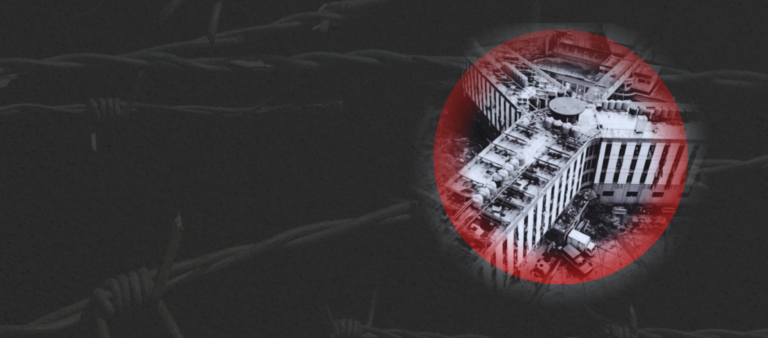


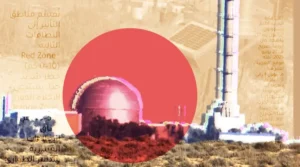



Amid an open war and risks escalating day by day, an environmental–health scenario emerges that is no less dangerous: what if ammonia gas were to leak from Haifa Bay? This is no longer a theoretical question, but a possibility imposing itself amid an increasingly complex regional landscape—especially given that the distance between Haifa and Lebanon’s southern border does not exceed forty kilometers, while wind patterns ultimately determine what may reach… or not reach. Between scientific warnings and the absence of official preparedness, this threat advances as one of the most silent yet most dangerous scenarios—particularly in a country already suffering from fragile health and environmental infrastructures, making any such incident doubly impactful and hazardous.
How does ammonia gas spread?
Chemical researcher Dr. Fouad Bazzi explains that ammonia gas, if released, “disperses in the air and reacts directly with its components,” leading to the formation of compounds known as ammonia oxides, which appear as smoke ranging in color from yellow to brown depending on the degree of oxidation. He clarifies that the gas does not remain in its original state but enters into chemical reactions that may increase both its hazard and its spread.
Ammonia gas, if released,
 disperses in the air and reacts directly with its components.
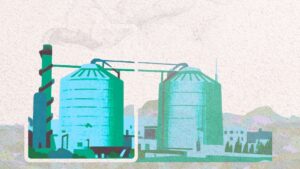
He adds that ammonia is typically stored in large, refrigerated tanks due to its sensitive nature, making its handling extremely precise. Any malfunction in storage systems may lead to a dangerous leak. He further notes that “the extent of the gas’s spread cannot be precisely determined,” as it depends on multiple factors—most notably wind direction and speed, as well as surrounding weather conditions such as temperature and humidity. This makes the possibility of it reaching Lebanon a plausible scenario, though not scientifically certain in advance.
Distance and wind factors
Dr. Ali Hamzeh, a specialist in physical geography and soil biosphere, confirms that the possibility of ammonia gas reaching Lebanon in the event of a leak from Haifa Bay remains scientifically and geographically valid. He explains that “southern to southwesterly winds dominate the region more than 65% of the time,” meaning that wind direction often favors the transport of pollutants toward Lebanese territory, especially the south and southeast. He points out that the distance between Haifa Bay and the Lebanese border is only about forty kilometers—“not a significant distance in terms of gas dispersion,” particularly if wind speeds are high and directionally stable. However, Hamzeh stresses that the actual impact depends on multiple interacting factors, including the amount of leaked gas, the duration of the leak, wind speed, and the stability of its direction—making the scale of a potential disaster complex and variable.
Serious health impacts
At the health level, experts agree on the danger of exposure to ammonia gas, especially at high concentrations. Bazzi explains that exposure may lead to “cases of suffocation and poisoning,” due to its direct effect on the respiratory system. Environmental expert Dr. Fatima Yassin notes that symptoms are not limited to the respiratory system, but also include “irritation of the eyes and skin, which may progress to burns in cases of severe exposure,” reflecting its highly irritant and dangerous nature.
Exposure to this gas may lead to “cases of suffocation and poisoning,”
due to its direct impact on the respiratory system.
She adds that the effects vary depending on duration of exposure and gas concentration, but severe cases may reach life-threatening stages. Hamzeh warns that exposure may cause “difficulty breathing and severe coughing, especially among individuals with chronic respiratory conditions,” and that prolonged exposure may lead to lung damage-placing certain population groups at direct risk.
Environmental and agricultural repercussions
The danger of this gas is not limited to humans, but extends to the environment and agricultural systems-raising additional concerns in a country that relies in part on agriculture. Hamzeh explains that ammonia leaks may cause “direct burns to plant leaves,” disrupting photosynthesis, a fundamental process for plant growth and survival, leading to reduced agricultural production. He notes that this impact is not only short-term but may extend to the medium and long term, contributing to land degradation and the expansion of desertification.
He also warns of the potential formation of acid rain if humidity and fog are present, as reaction compounds return to the soil, altering its acidity and increasing nitrogen concentration-disrupting the natural balance of nutrients. The issue does not stop at soil, as these substances may seep into groundwater through rainwater, opening the door to broader environmental consequences affecting water sources and quality.
Lack of preparedness and preventive measures
Despite the seriousness of the scenario, expert testimonies reveal a clear gap in preparedness levels. Dr. Ali Hamzeh states that “there are, according to available information, no precautionary measures or declared preventive plans” to deal with a potential ammonia leak-reflecting a lack of prior planning for cross-border risks. Dr. Fatima Yassin adds that “international standards and protocols do exist,” but they are “not adequately implemented locally,” raising serious questions about institutional readiness to respond to an environmental and health incident of this magnitude-especially given the current strain on vital sectors.
A silent threat and an open question
Between a possibility shaped by wind movement and a threat that does not recognize borders, Lebanon stands before a complex environmental and health scenario at a time when crises are accumulating and response capacities are weakening. An ammonia leak may not be certain-but it is not impossible. And with no clear plans or preventive measures, this possibility becomes a real source of concern. In this context, the most pressing question remains: will Lebanon wait for the disaster to occur before preparing for it, or is there still time to take serious steps to protect people and the environment from a threat that may arrive with the first shift in the wind?