






Sara (a pseudonym), a mother of three, sits at a small table in the corner of her home, quietly working on the crochet pieces she sells online. With a faint smile masking a deep exhaustion, she says: “Some people criticized me, and others told me ‘bravo.’”
Since her husband was killed in the latest Israeli war on Lebanon, life has become a daily test of endurance. “Every responsibility fell on my shoulders overnight. Everything my husband and I used to share became mine alone.”
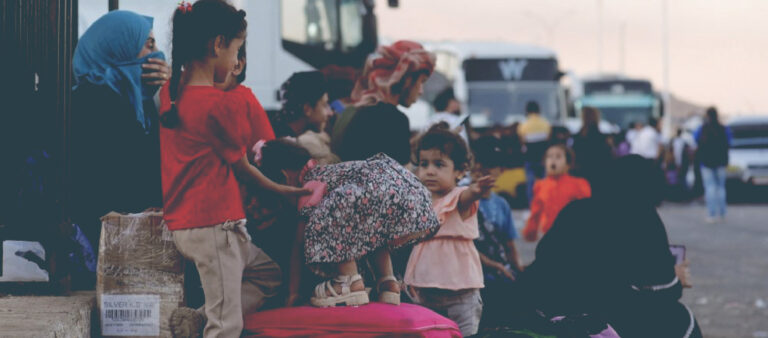
Sara is one of many women who lost their husbands during the war and who suddenly found themselves as the sole providers for their families. Many of them woke up to burdens they were never prepared for, alongside new layers of psychological distress brought on by loss and instability. Yet national agendas rarely acknowledge them, as if their suffering exists in a space untouched by policies and programs.
Lack of Reliable Numbers
In searching for accurate figures on how many women have become the primary breadwinners in Lebanon since the war began-or even how many widows there are in total-we found no official data to rely on.
Still, a UN Women Lebanon report published in December 2024 notes that of the 260,000 families displaced during the war, around 21% were headed by women—roughly 54,600 households. But this figure does not reflect the actual number of widows in Lebanon, as it excludes women outside displacement data and those who lost their husbands during the war but did not relocate.
A report by UN Women Lebanon highlights…
 …that of the 260,000 displaced families, nearly 21% are headed by women
Despite the ceasefire going into effect on November 27, the South continues to witness recurring Israeli attacks resulting in deaths and injuries. This means the very factors that increased the number of female-headed households remain in place, and the real numbers are likely far higher than those documented.
The report also shows how displacement reshaped the lives of women-led households: nearly half struggled to secure safe housing, volatile prices left women with unstable income even more vulnerable, and 23% of surveyed women were forced into informal work just to survive.
Hoping for official information, Silat Wasel contacted the Ministry of Social Affairs to ask whether it holds accurate figures on widows and what approach it uses to support them; however, no response was received by the time of publication.
This absence of data reflects what is known as the “gender data gap”-a systemic blind spot that keeps women invisible in public policy, reinforcing structural inequalities in a patriarchal system that treats women’s suffering as secondary and unworthy of documentation.
Widows: Between Survival and the Weight of Loss
Sara’s family still receives assistance from the Aman Program-support they had before her husband’s death. But beyond that, no additional help reaches her. She explains that every responsibility has multiplied: caring for her children, managing expenses, and navigating daily life in a collapsing economy without any serious institutional support.
Wissal (a pseudonym), who also lost her husband in the war, says her life was turned upside down. Her husband had always managed household finances; now, she faces responsibilities she had no roadmap for. “I struggle to stretch the money until the end of the month. I cut back on everything—food, fuel, everything.”
Even with her job, her income doesn’t cover essentials. Her family and in-laws occasionally help with milk, diapers, or heating fuel. She adds bitterly: “The state doesn’t care. We don’t exist to them.”
Widows after the war are forced to confront a heavy mix of grief, economic strain, and the challenges of raising children alone.
والضائقة الاقتصادية، وتحديات التربية
This institutional failure goes beyond weak social policies. In Lebanon-like in many patriarchal societies-ignoring women’s needs in public policy isn’t an administrative oversight; it’s the product of a gender-blind system designed without women’s lived realities in mind.
Beyond financial burden, widows face complex psychological strain. “I need to release everything I’m holding inside,” Sara says, “but I distract myself instead.”
Wissal describes living as if her husband had not died at all. “I don’t want to look weak in front of my children or others,” she says, though she admits she sometimes breaks down uncontrollably: “I reach a point where I scream and cry in ways I never did before.”
According to Dr. Wissal Halabi, a specialist in social psychology, widows must navigate a layered reality: grief, economic pressure, and the duties of motherhood. The crisis extends into the psychological structure of the household: “Mothers become more irritable, family interactions decrease, and children feel it. Women face three consecutive shocks—the loss itself, the economic crisis, and the psychological burden.”
This psychological and financial pressure often brings constant fear and isolation,
especially in the absence of clear policies to support widows
Halabi notes that losing a spouse is a form of ‘death of the self,’ yet many women keep moving because life doesn’t pause—their families depend on them. She stresses that widows need structured psychological, social, and economic support to restore balance in their lives.
Women’s Organizations: A Crucial Role Despite Barriers
During and after the war, women’s organizations became central actors on the ground. Data shows that 70% provided protection services, 40% offered food assistance, and 28% supported social stability. Yet their presence in official coordination frameworks remains minimal, and many struggle with severe funding shortages.
“The war was devastating for women,” says Layla Mroueh, head of the Lebanese Democratic Women’s Gathering (RDFL). Many women lost their husbands and became sole providers overnight. Women’s organizations stepped in to offer assistance, psychological support, and basic services-often risking their own safety to reach displaced families in shelters, schools, and homes
But this work came with major challenges. Coordination between women’s organizations and official bodies was nearly nonexistent. Aid flowed to municipalities, ministries, religious institutions-but not through the groups most attuned to women’s needs. The lack of coordination, paired with dangerous mobility conditions during bombardments, limited women’s access to help.
At its core, this gap reveals the patriarchal resistance to women’s leadership-reducing their role to “service providers” while excluding them from decision-making.
Research conducted by RDFL identifies three main barriers widows face:
Not knowing which entities provide assistance,
Inability to reach those entities due to war-related risks,
Social restrictions that limit widows’ mobility and place them under community surveillance.
What Is the State’s Responsibility Toward Female Breadwinners?
Despite strong field efforts by women’s organizations, women’s voices are almost entirely absent from official decision-making. Policies related to social and health affairs are drafted without their participation. “Most policymakers are men,” Mroueh says, “and the few women involved rarely come from a feminist background that allows them to understand real needs.” As a result, policies remain detached from widows’ lived realities.
This exposes a deeper cycle of gender discrimination: policies crafted by patriarchal institutions inevitably produce solutions that fit those who do not live the crisis-leaving women to “endure” rather than be supported.
Mroueh stresses that the state-not NGOs-must assume responsibility. She calls on the Ministry of Social Affairs to conduct a national survey to map widows’ numbers, locations, and living conditions. No civil society organization, regardless of capacity, can replace the state in creating sustainable protection systems.
She argues that real support begins with basics: safe housing, healthcare, job opportunities, and pathways for economic independence. Random relief efforts are not enough; policies must be tailored to women’s different needs and levels of vulnerability.
This perspective aligns with the GiHA Working Group’s findings, which show that the post-war crisis disproportionately affected women and girls. The report calls for rethinking traditional approaches to women’s issues, integrating feminist organizations into data verification, and ensuring safe access to services and expanded psychosocial support for all female breadwinners.