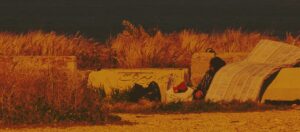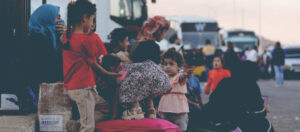

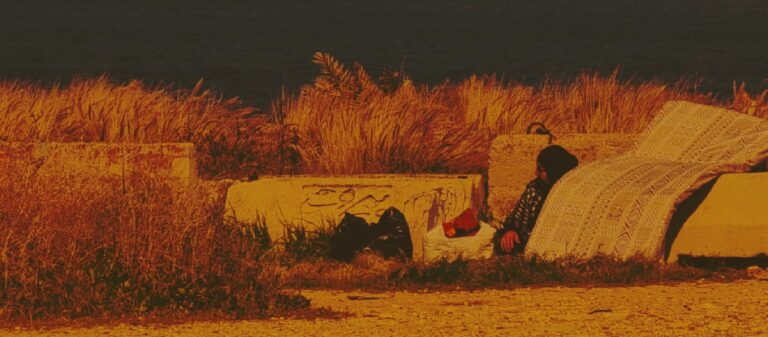
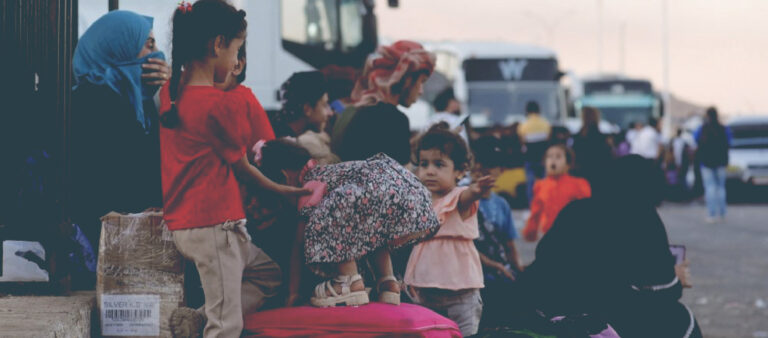



“We had to leave the house with nothing. My neighbors and I laid the children to sleep on the ground because there were no mattresses, but what mattered was safety.”
In Tyre, Hanaa Hussein shares the same suffering; she is a school teacher. She helped manage a shelter inside the Montana Hotel in Marwaniyeh, south of Sidon, which was repurposed to accommodate displaced families—up to 40 per day—using the school classrooms after they were closed. She says, “No one asked us what we needed, neither the media nor the municipalities.”
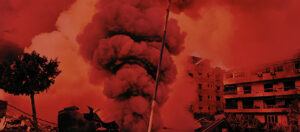
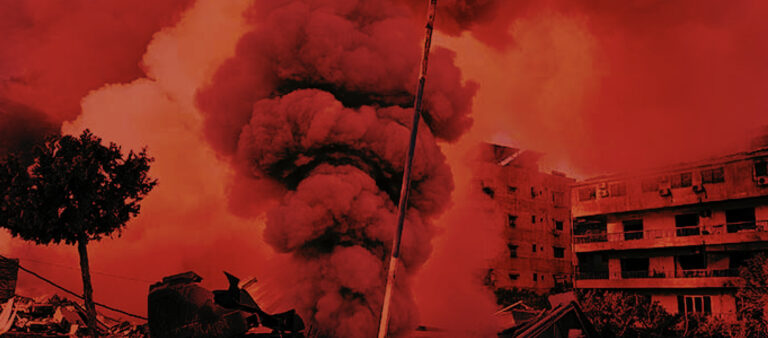
Although this scene was repeated in several southern towns, and although Lebanese women were actively present throughout it, their presence and its significance were not highlighted in media coverage during the period of tensions (from October to December 2023) and remained marginalized.
In a review of the content of political bulletins and programs during this period, conducted by the “Eye on Media” platform of the Legal Agenda, it was found that the percentage of women appearing as sources or analysts did not exceed 8% of the total guests, and they were often spokespersons for political parties or international organizations (Legal Agenda). 2024).
Is it conceivable that the presence of women would be so reduced, as some Arab channels, for example but not limited to “Al Arabiya,” have done?
And “Al-Mayadeen” and “Al Jazeera” in Sour [showing] crying mothers or bodies under the rubble, without giving them space for analysis or even testimony?
Although Lebanese women were actively present, their presence and its significance were not highlighted in media coverage during the period of tensions.
This timid coverage is not only linked to the exclusion of women from positions of decision-making but also reflects a systematic sidelining of their daily experiences, which are considered “non-newsworthy.” Amid coverage focused on military statements and political reactions, women’s silent struggles are absent: securing milk, treating children, managing and organizing life in shelters, and providing psychological support to devastated families. Most importantly, they are not hosted on political and analytical programs like any expert man in their field.
In one of the short clips circulating on Facebook, a southern activist (who refused to disclose her name) spoke about managing an informal shelter in Sour, which received more than 30 displaced people daily, providing them with food, medicine, and a place to sleep. Although her testimony represents a rich and leadership-driven experience of civil resilience during the war, she was not invited to any media outlet as a speaker, while the men who were on the ground were invited, highlighting the gap and discrimination between the field reality and its representation in media discourse.
In this context, Lebanese journalist Nada Al-Asaad, a field correspondent who worked in the south during the recent escalation, says: “We witnessed daily heroic roles of women running shelters, distributing food, providing psychological support, and even coordinating relief operations. But when I followed the bulletins or participated in preparing them, it was difficult to feature the stories of these women, because the editorial line focuses on military and political data. The media does not always deliberately exclude women, but it simply does not consider them part of the ‘bigger story’ it wants to tell.”
“The media does not always deliberately exclude women, but it simply does not consider them part of the ‘bigger story’ it wants to tell.”
In a 2023 study by UN Women on “Women, Peace, and Security in Lebanon,” it was found that women make up about 60% of workers in the care sector during crises, yet their representation in local disaster management committees does not exceed 12%, and they are often excluded from shaping emergency policies or from media coverage (UN Women, 2023).
Even global news agencies, which adopt the slogan “people first,” did not escape the stereotype of the Lebanese woman as a victim or refugee. Where are the images of nurses, paramedics, negotiators, and innovators? Where are the interviews with women who established local support networks, or provided relief or documentation?
This bias is not limited to the “quantity” of women’s representation, but also to the “way” they are represented. As scholar Joan Scott, the prominent American historian and a foundational figure in gender studies, emphasizes, the absence of women does not only mean the lack of their image, but more importantly, the absence of their perspective. In her famous article “Gender: A Useful Category of Historical Analysis” (1986), Scott stressed that representation is not neutral; it reflects structures of power and knowledge, and excluding women from the narrative means excluding a different interpretation of the world that expresses their experiences and social position (Scott, 1986).
The continuous reduction of women to humanitarian margins or tearful images reflects a male-dominated media structure that reduces war to a military scene of concern only to men.
The continuous reduction of women to humanitarian margins or tearful images reflects a male-dominated media structure that reduces war to a military scene of concern only to men. In reality, however, there are also many women who are experts in these matters. Thus, at its core, war is also the loss of homes, the collapse of schools, the breakdown of the health system—a landscape in which women move and act every day.
According to a report by the Arab Center for the Development of Social Media campaign titled “She Is Not Background” (2022), women in war reporting are often seen as the backdrop of events, not as active participants at their core. This reinforces a double erasure: the absence of representation and the distortion of the narrative.
What we need is not only the inclusion of women as regular guests, but a reworking of the very conditions of storytelling. We need coverage told in women’s languages, from the angles of their experiences, rather than merely presenting them as human-interest commentary. We need media that reflects the voice of the survivor, not just her image; media that hosts the breadwinner, not only official analysts, and listens to the south not from above, but from among its people.