

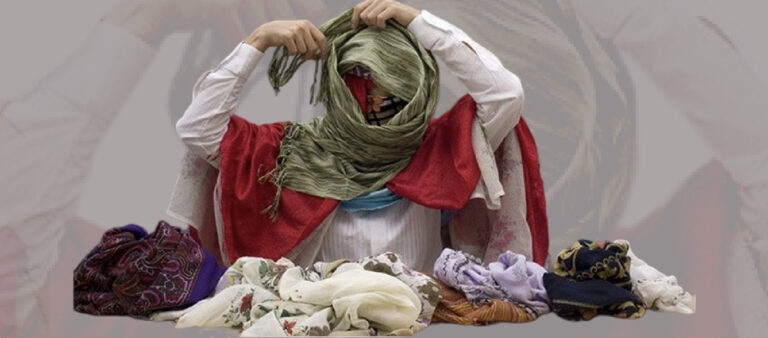





The Algerian digital sphere recently witnessed intense backlash following influencer Sarah Hannana’s announcement of her decision to remove the hijab. The issue did not stop at the circulation of the news. The virtual space quickly turned into a public tribunal. The influencer was subjected to a coordinated hate campaign and a widespread wave of social and digital ostracism. This incident is not isolated. It echoes what influencer Maya Rejil previously experienced, suggesting that digital platforms have created new arenas for amplifying misogynistic hate speech.
A closer examination of the documented discourse reveals that the reactions were not driven by sincere religious advice. They were fueled by explicit resentment and a collective desire to punish. This tendency was evident in harsh comments such as, “Unfollow her the way you made her famous,” and in labeling Hannana as a “hypocrite” or claiming that “people like you are what corrupted society.”
These terms do not reflect moral concern. They expose an implicit belief that fame and public following function as a form of payment that grants audiences ownership and control over an influencer’s appearance. This collective behavior reinforces the reality that, within the influencer economy, the hijab has shifted from being a personal choice to becoming an implicit professional requirement. Removing it is perceived as a breach of an unwritten ownership contract between influencer and audience.
Women are 27 times more likely to experience online abuse than men.
International data confirms this systematic targeting. A report by the United Nations Broadband Commission indicates that women are 27 times more likely to face digital abuse than men. Amnesty International’s Toxic Twitter report further reveals that these attacks go beyond criticism, with 27 percent containing violent content including explicit threats. This confirms that what we are witnessing is a mechanism of discipline rather than a mere difference of opinion. The continued circulation of attack videos by male content creators and the shift of debate toward evaluating the influencer’s body and appearance, as seen in campaigns targeting Maya Rejil’s face, demonstrate that the objective is punishment and guardianship.
To understand the mechanisms of this digital punishment, media expert Abdelraouf Abdi told Silat Wasel Platform that the phenomenon can be analyzed as a direct outcome of profound transformations in the structure of the digital space. Platforms are no longer mere communication tools. They have become fully formed social fields governed by power, surveillance, and symbolic capital.
Abdi adds that what happens to female influencers, particularly in matters such as the hijab, cannot be reduced to an individual choice or an emotional audience reaction. It must be understood as a complex social process.
Drawing on sociologist Pierre Bourdieu, Abdi explains that a veiled influencer accumulates symbolic capital based on an image of moral uprightness and value representation. The audience grants this capital, making the relationship reciprocal and conditional.
What happens to female influencers in issues such as the hijab
 cannot be reduced to an individual choice or an emotional audience reaction.
Abdi continues that audiences interpret a radical change such as removing the hijab as a violation of the agreed rules and a loss of the symbolic legitimacy upon which success was built.
It is important to note that the contract between influencer and audience carries both economic and moral dimensions. Using the concept of moral economy, Abdi explains that the relationship is not governed solely by market logic but also by collective ethical expectations. The audience does not see itself as a passive consumer. It perceives itself as a moral actor with the right to reward and punish.
Since the influencer is perceived as having breached this contract, the audience claims its right by launching a digital campaign. Digital cancellation becomes an economic punishment because it aligns with platform logic that links income to audience attention. The influencer’s identity becomes a condition for profit and continuity.
Thus, working on social media platforms shifts from being merely a source of income to a mechanism through which users restrict an influencer’s behavior under the banner of the contract between them. Referencing Michel Foucault, Abdi describes digital platforms as a contemporary form of the panopticon, where horizontal surveillance transforms declared freedom into conditional freedom.
Although this implicit contract can be breached in various ways, the hijab holds particular sanctity in conservative societies because it symbolizes the intersection of religion, gender, and digital economy. The female body becomes a permanent site of symbolic struggle, loaded with contradictory moral meanings and expected to represent the collective continuously. Within this framework, the hijab is viewed as a message that must align with the moral expectations of the audience.
This phenomenon reveals a central paradox in contemporary digital societies. Individuals are encouraged to express themselves, yet punished when they alter their identity outside the logic of personal branding. The issue is not the hijab itself, but the transformation of identity into a product and the self into an economic project governed by performance and consistency.
Is digital cancellation a patriarchal punishment?
The social punishment directed at female influencers does not stop at claims of bodily ownership. It takes a more dangerous turn through gendered double standards. Although digital space is presented as liberating, public acceptance of men’s choices differs markedly from that of women. For example, influencer Raouf Belkassmi shifted from simple entertainment content to a more open lifestyle display that sometimes included explicit public insults.
Yet he did not face organized cancellation campaigns or threats to his digital standing. Male influencers enjoy full freedom to alter their appearance, personal lives, or content without public accountability or threats of cancellation. Female influencers, by contrast, are subjected to conditional public guardianship. Their success is tied to adherence to unwritten social rules that exceed professional boundaries, placing them under constant surveillance.
A female influencer is punished because she dared to break the role imposed upon her.
This contradiction becomes especially visible when male influencers fuel attack campaigns, transforming a personal matter such as wearing or removing the hijab into a public issue. The involvement of male influencers is not a neutral opinion. It functions as a tool to reassert control over women in the digital sphere and to reinforce the idea that a woman’s decision must pass through male approval.
Feminist researcher Fatima Zahra Dahmani told Silat Wasel Platform that what is happening is neither debate nor moral shock. It is a clear form of patriarchal punishment in which guardianship has migrated from the street, the home, and religious discourse into digital space.
A female influencer is punished for daring to reject the disciplined body and collective moral symbol assigned to her. Meanwhile, male influencers are granted the right to contradiction, transformation, and experimentation because they are not burdened with notions of honor nor perceived as bodies requiring regulation. This contradiction is not accidental. It is the essence of patriarchy, which digital space has not dismantled but rather exposed through collective insults and socially legitimized symbolic violence.
Dahmani stresses that such comments do not stem from a desire to preserve religion. They represent collective disciplining of a woman who refused compliance. Cancellation culture thus becomes a repressive tool aimed not at accountability but at delivering a clear threat. Either remain as we want you to be, or we will socially and digitally destroy you.
Launching digital campaigns against a woman for removing the hijab reveals that society does not recognize her full humanity or her right to bodily autonomy. The hijab is treated not as a personal choice but as a perpetual obedience contract. Any withdrawal is met with organized symbolic violence. This cancellation is real violence. It leaves no blood, but it instills fear and redraws the boundaries of what is permissible for other women.
Dahmani further emphasizes that male influencers’ reactions are not neutral. Their participation legitimizes punishment, transforms symbolic violence into a moral stance, and reinforces it as a reference point that evaluates women’s choices and limits. Their involvement becomes another instrument of patriarchal control that disciplines women who step outside prescribed roles and holds them publicly accountable.
What is particularly dangerous is that this discipline does not originate from a formal institution, but from influencers possessing symbolic capital and mass appeal, making the violence more socially acceptable and less accountable.
The Influencer Body as a Symbol of Belonging and a Betrayal of Expectations
This reinforcement of digital guardianship is not an end in itself. It serves a deeper goal of combating independent female models and imposing aesthetic punishment on any attempt at divergence. The case of Maya Rejil and the subsequent bullying campaigns targeting her appearance after removing the hijab illustrate the consequences of this criminalization. Once a woman chooses to express herself outside traditional molds, her success becomes a threat to a value system fearful of losing control. When society focuses its attack on criminalizing the body itself, the message is clear. The price of conditional success is obedience. The penalty for refusing to pay that price is aesthetic defamation.
This phenomenon is not limited to Algeria. It recurs across similar regional contexts. Tunisian content creator Lina El Khawili also faced a harsh wave of hate and insults after removing her hijab.
To unpack the motivations behind this collective punishment, sociologist Mojtaba Al Hamissi Al Harmi told Silat Wasel Platform that deeper dynamics are at play. Social control, collective identity, and symbolic male dominance intersect. The hijab shifts from a personal practice to a collective identity. Removing it is interpreted as betrayal of belonging rather than individual choice, explaining the severity of punishment. The group punishes not the act itself but the breaking of expectations projected onto the female body.
Al Harmi further argues that this behavior reflects what social psychology calls collective moral anxiety. The audience does not feel religion itself is threatened. Rather, it feels that a stable and comforting image of the regulated woman is at risk. If an influencer’s hijab can destabilize a value system, then that system rests on superficial conformity rather than genuine conviction.
He points to the reduction of women to their bodies. Before the hijab, she is condemned. With the hijab, she is symbolically purified. After removing it, she is condemned again, more harshly. This rapid moral fluctuation exposes a double standard governed less by doctrine than by entrenched patriarchal norms sustained through selective religious discourse consumed without reflection.
Digital punishment becomes an informal deterrent mechanism that pressures other influencers to modify their behavior out of fear of collective rejection and stigma. Over time, such practices produce a digital space that appears morally disciplined but remains impoverished in symbolic plurality and free expression.