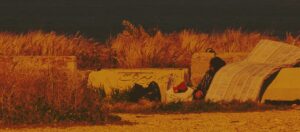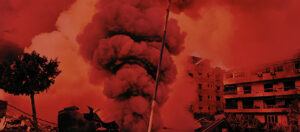





After the shelling ceased in the previous war, the land was no longer the same. In southern Lebanon, the traces of war remained embedded in details not easily seen: soil whose composition had changed, olive trees uprooted after surviving the flames, forests burned until all trace of them vanished, and farmers returning to fields they were uncertain were still capable of sustaining life. In this space between war and what is termed a ceasefire, an unspoken role of civil society emerged: documenting what happened-not as cold archiving, but as an act of defiance against forgetting and denial.
Documentation from Within: The Phone as a Tool of Survival
Documentation did not begin after the war ended-it started during it. Hussein Wehbi, a member of the Lebanese Civil Defense, recalls how they filmed fires as they erupted. He says: “We were filming while the fires were burning, because the الأرض was burning before our eyes.” He adds: “For us, photos and videos were not just visual records, but a way to prove the scale of destruction and convey a reality that cannot be reduced to brief official reports.”
This “from within” documentation was echoed among civilians. Yara Abdel Nabi, a resident from the south, began documenting the changes around her home after the war: a dried olive tree, a grapevine that suddenly died, and the disappearance of certain insects and birds. She says the documentation was not driven by curiosity, but by fear that it might later be said that “nothing happened.”
 Documentation was not driven by curiosity,
but by the fear that it might later be said that nothing happened
For journalist Tarek Mroueh, this popular documentation constitutes primary material that cannot be ignored. He notes that the environment in southern Lebanon was not a collateral victim, but a direct target: “widespread fires, incendiary bombs, uprooted trees, and the destruction of entire livelihoods.” In his coverage, documentation did not stop at the moment of shelling, but extended to what followed: the theft of olive trees, the leveling of agricultural lands, and reforestation attempts led by locals as a form of counter-resistance.
Mroueh states that documenting these practices helps dismantle the narrative of “collateral damage” and redefines it as part of a systematic strategy of environmental destruction.
Researchers Read What Cannot Be Seen
Alongside popular and media documentation, researchers are working to transform these testimonies into analyzable knowledge. Ahmed Baydoun, a PhD student, environmental researcher, and founder of the “White Phosphorus” platform, explains that documentation is not limited to images, but includes integrating them with satellite imagery and field observations. He notes that the local community documents what it directly experiences, while scientific research seeks to compare these testimonies with broader temporal and spatial data to monitor changes in vegetation cover, fires, and their long-term impacts.
From the Laboratory to the Field: Soil as an Archive
Lynn Dirani, a researcher within a scientific team at the American University of Beirut under the supervision of Dr. Rami Zurayk, complements this perspective from a methodological angle. She explains that the team developed, from the outset, a scientific plan to document environmental changes, starting with soil as a central point. She also spoke about collecting samples from affected lands and documenting locations and coordinates, in collaboration with families, students, and villagers, within the framework of “citizen science.”
Dirani says: “Reviewing previous studies on wars led the team to focus on heavy metals in the soil, due to their direct relation to food and future crops.”
Changes in vegetation cover were also monitored through preliminary images, particularly fires resulting from the use of white phosphorus, which soil tests showed were often surface burns. For her, this documentation carries two intertwined dimensions: a scientific one that provides precise answers, and an emotional one tied to collective memory and people’s anxiety about their land and future.
What Is Not Documented Is Erased, and What Is Erased Is Repeated
For his part, agricultural engineer Adel Ghannour explains how documentation has become a daily practice among farmers. He collects photos and videos, participates in taking soil samples, and communicates with laboratories for analysis. His primary goal is to help farmers determine whether their lands are safe for cultivation, while also scientifically documenting the impact of war.
Ghannour adds that the loss of part of this archive-due to a damaged phone or lost file-highlights the fragility of digital memory and reinforces the need to build a collective archive that does not depend on a single individual or device.
The Invisible Groups at the Heart of the Story
What unites these diverse voices is their belonging to groups often marginalized in dominant narratives: farmers, civil defense members, ordinary citizens, and researchers working behind the scenes. They do not possess official platforms, but they hold precise knowledge of the place. For them, the land is not merely a space, but a history and a daily relationship, making any change to it an existential event.
In southern Lebanon, where wars have repeatedly occurred, forgetting has become a parallel threat to destruction. What is not documented is erased, and what is erased is repeated. From this perspective, environmental documentation becomes an inherently political act, even if it is not explicitly named as such. It is an attempt to anchor memory in the face of denial, and to give the land a voice when politics fails to do so.
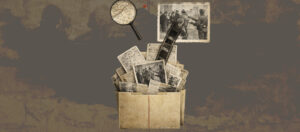
The Lebanese experience shows that the land retains the traces of war even after it ends: in the soil, in the trees, in burned forests, and in destroyed livelihoods. Between a civilian’s phone, a journalist’s camera, a soil sample, and a civil defense testimony, an unofficial yet resilient archive takes shape. An archive that does not seek sympathy, but recognition: that what happened here was not incidental, and that the land-like its people-remembers.