
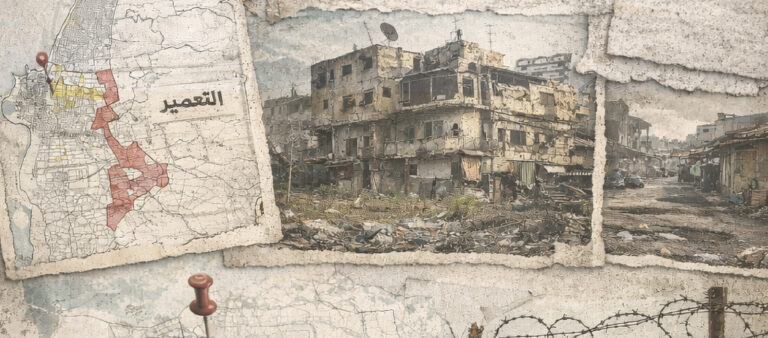
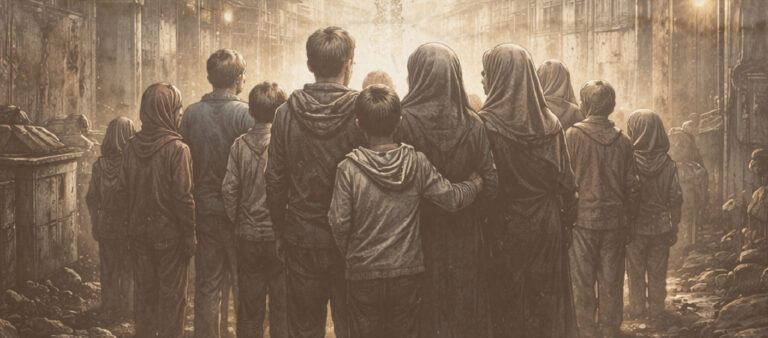



Fatima, a Lebanese woman in her seventies, has been bedridden for several months. A few neighbors care for her, bringing food and helping her reach the bathroom. She lives alone after the death of her parents and husband, in a modest two room home like many of her neighbors in Group Four of the Taamir housing buildings in the city of Sidon, known as Taamir Ain Al Hilweh.
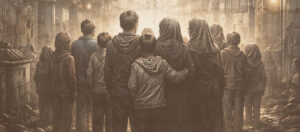
It is a marginalized neighborhood within Sidon, inhabited by socially and economically vulnerable groups whose lives lack the public services that are their right as citizens of a supposed state.
Fatima, who is ill and in need of medical care and hospitalization, cannot access adequate treatment due to the decline in services and the failure of local and central authorities to fulfill their responsibilities toward citizens.
How did this working class neighborhood come into existence in Sidon?
Lebanon in general, and Sidon in particular, experienced an earthquake in 1956 that destroyed hundreds of homes in old Sidon. In response, the Lebanese state built public housing in the Dekerman neighborhood of Sidon and on lands belonging to the adjacent town of Miyeh Miyeh.
More than 1,208 housing units were constructed, including apartments and standalone houses. Residents began receiving their homes in 1961, and construction and allocation were completed in 1968.
Since then, the area has endured the 1975 civil war and the 1982 Israeli invasion. Over time, additional unauthorized housing units were built to meet growing social needs. No comprehensive repairs or renovations have taken place since, even as buildings began suffering from problems in shelters, sewage networks, drinking water systems, and electricity grids. Common areas lack plastering and painting, and cement layers have eroded from some walls.
Most buildings suffer from wall cracks and roof leakage,
placing residents at significant risk.
Approximately 13,000 people live in the area, around 70 percent Lebanese, 27 percent Palestinian, and the remainder Syrian. Most residents belong to low income groups, working in daily wage jobs or unemployed, leaving them unable to repair their homes.
Currently, 336 families live in the Villas neighborhood, 271 families in Middle Taamir, 510 families in the Rijal Al Arbaeen buildings and Group Five, 103 families in the Bahriya buildings, 220 families in Group Four, and 165 families along the main road.
This totals 1,605 families, in addition to others who have built homes near Taamir properties.
Most buildings suffer from cracked walls, roof seepage, and damaged staircases, exposing residents to multiple dangers, as occurred last year in the Rijal Al Arbaeen buildings.
Most sewage systems in the buildings require repair, and shelters are flooded with winter rainwater and wastewater. The sewage network is outdated and requires pipe replacement and expansion. Drinking water networks also suffer from leaks visible in several locations.
The area also struggles with insufficient and poorly distributed waste containers. Garbage is not collected regularly, forcing activists to pressure the municipality to remove accumulated waste.
Approximately 13,000 people live in the area,
 around 70 percent Lebanese, 27 percent Palestinian, and the rest Syrian.
There is no permanent street lighting, creating unsafe conditions and preventing many residents, especially women, from moving freely at night. Main and secondary roads require maintenance.
The educational situation is as follows:
There is a public secondary school with capacity for 1,000 students, but enrollment does not exceed 400 due to lack of equipment and qualified teachers. As a result, most students attend schools in other parts of the city.
There is also a primary school, but due to security measures imposed by security forces, many families refrain from enrolling their children, leaving numerous vacant spots.
The Taamir area has experienced significant student dropout rates in recent years due to transportation difficulties and costs.
Regarding healthcare, there are two clinics in the area, but services are limited. The government hospital charges fees close to those of private hospitals, and residents must pay significant amounts for hospitalization if admitted.
The Municipality of Sidon is responsible for Lower Taamir but acts only after persistent calls and pressure. The Municipality of Miyeh Miyeh, responsible for Middle Taamir and the Villas area, does not fulfill required duties, claiming that residents vote in Sidon.
There are no popular committees representing residents. Political factions prevent the formation of such committees and attempt to monopolize representation to serve their own political interests. No scientific study has been conducted to assess the area’s conditions and needs.
Projects implemented by international and local organizations are fragmented and uncoordinated. Under these circumstances, how can Fatima continue her life? What Fatima experiences is shared by hundreds of Taamir residents, yet attention to their suffering remains confined largely to media coverage.