



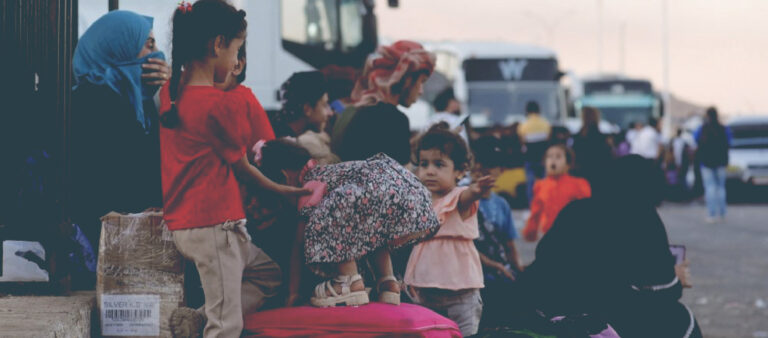







On Alawite Girls and What Their Suffering Reveals About Syria’s Pain
The abductions of Alawite girls along the Syrian coast are not fleeting stories that flare up on social media before sinking into oblivion. They are a stark marker of the deep rupture tearing through Syria’s moral and social fabric – and of how the female body has been turned into a battleground for settling political and sectarian scores.
Over the past months, reports have poured in from Latakia, Tartous, Homs, and Damascus – all carrying the same grim pattern: a young woman disappears on her way to university or work, her family receives a cryptic call or a warning to stay silent, and then… nothing. Just a long, suffocating void where pain echoes without end.
At least 66 women and girls have been kidnapped across Syria since the beginning of the year - most of them Alawite.
In October 2025, reports indicated that no fewer than 66 women and girls had been abducted since the start of the year, the majority of them from the Alawite community. These cases are concentrated in Latakia, Tartous, Homs, and Hama, where victims are taken from the streets or even from inside their homes in broad daylight, with the perpetrators remaining unknown.
According to an Amnesty International report published in July 2025, 36 Alawite women and girls were documented as kidnapped between February and July. Their ages ranged from 3 to 40. Five of these women and three underage girls were abducted in broad daylight, with authorities taking no meaningful action to investigate or assist the families.
Meanwhile, a report by the Syrian Network for Human Rights (April 2025) stated that between 50 and 60 Alawite women were kidnapped during the first months of the year, with indications that some may have been subjected to sexual enslavement.
These numbers make one thing unmistakably clear: the abduction of women in Syria is rising at an alarming rate – and Alawite women are increasingly being targeted.
Women in the Crosshairs of Chaos
This recurring pattern can no longer be explained as ordinary criminality. It is part of a broader system of unrestrained violence – a resurgence of old forms of social revenge, and a re-weaponization of fear as a tool of control. Reports from several rights organizations, including SNHR and the Syrian Observatory, affirm that enforced disappearances in Syria never truly stopped; they merely changed shape. What we are witnessing today is not a post-war residue — it is one of the clearest and cruelest faces of the ongoing conflict.
When a woman is kidnapped in a society that still sees her as the guardian of its “honor” and collective memory, the crime transcends the individual and strikes the entire community. Kidnapping becomes a symbolic weapon – one used to destabilize what remains of a fragile social structure and redraw the boundaries of fear and dominance within the group itself.
Anonymous gangs demanding ransom, local groups framing the kidnapping as political punishmen,
 or cases exploited for trafficking and forced marriage.
Alawite girls appear to have become symbols onto which an entire community’s burdens and wartime losses are projected. In a wounded public imagination, the victim’s identity becomes the justification, and the female body turns into a canvas for symbolic and political revenge.
Many testimonies from the Syrian coast point to motives that blend revenge with financial exploitation: anonymous gangs demanding ransom, local groups framing kidnappings as political retribution, and cases where victims are trafficked or forced into marriage. Different forms — one crime. All sustained by the vacuum left by the collapse of justice.
What stands out is that this phenomenon emerges at a moment of total social collapse, when the boundaries between state and society have dissolved. There is no longer an authority to fear, nor a law to appeal to. The law still exists on paper, but its power has evaporated — turning kidnapping into more than a crime. It has become a new form of social discipline, reshaping fear and loyalty.
Under Legislative Decree No. 20 of 2013, published in the Official Gazette (Issue 16), kidnapping for material, political, sectarian, or retaliatory purposes — or for ransom — is punishable by life hard labor. The penalty escalates to death if the kidnapping leads to the victim’s death, permanent disability, or sexual assault during captivity.
This is why abducting a girl from an Alawite village is not merely the removal of an individual from her family – it is a message to the entire community: You are exposed. None of you are safe.
From Syria to Lebanon
Any attempt to understand this phenomenon must account for parallel regional experiences – most notably what Lebanon witnessed in mid-2025, when disappearances of women and girls surged unexpectedly. Between June and August, more than eighteen cases were reported within weeks.
These incidents ignited public shock amid talk of hidden networks involved in luring and abducting women, despite security agencies’ attempts to intervene. What happened in Lebanon was not an act of war, but a reflection of social and security breakdown – strikingly similar to conditions in Syria, where communities are left to fend for themselves under a law that exists only in text, not in action. In both places, kidnapping becomes a mirror of state collapse and a new dialect in the language of fear.
The comparison is not a claim of equivalence, but a warning. In Lebanon, the recent wave of kidnappings stems from multiple, evolving social and security failures that could widen if left unchecked. In Syria, however, kidnapping has become a marker of internal collapse so severe that society begins to prey upon itself.
Kidnapping: A New Architecture of Fear
Kidnapping is likely to escalate wherever state protection collapses – affecting citizens of every background, whether they come from communities once aligned with the authorities or from groups long marginalized. Without security, every group becomes vulnerable, and fear becomes the only operating system.
This inversion between victim and perpetrator reflects the transformation of the Syrian conflict from a political struggle into a profound social unravelling – where everyone becomes a potential target. According to an ACAPS report (July 2025), Syrian regions, particularly the coast and central provinces, are witnessing heightened sectarian and social tensions. The conflict has morphed into a tangled web of local disputes over resources, daily security threats, and the targeted intimidation of different sectarian groups.
The absence of inclusive state policies and the retreat of the rule of law
are eroding social cohesion and producing a persistent sense of insecurity among citizens.
The report makes it clear: without effective state-led social integration policies – and with law enforcement reduced to symbolism – the social fabric weakens, and insecurity becomes the norm. This is why the Syrian conflict has shifted from a military confrontation to a deep social disintegration.
The 2025 Arab Opinion Index offers another lens into this fragmentation. Only 19% of respondents considered a shared Syrian culture as the basis of national identity, and just 17% viewed the Arabic language as a unifying element. These numbers underscore how collective identity has splintered, with individuals retreating into narrower regional and sectarian belonging. In such a climate, the rise in kidnappings – especially those targeting women and girls – becomes part of a larger pattern of coercion and intimidation.
According to the UN’s Humanitarian Situation in Syria – June 2025 report, ongoing economic collapse, social deterioration, persistent displacement, and renewed waves of violence have severely weakened traditional social bonds within families and local communities.
The report notes that humanitarian organizations are working relentlessly to fill the gaps – but without stable state structures and effective law enforcement, society remains fractured. Under these conditions, rebuilding trust and interdependence becomes extraordinarily difficult, if not impossible.
The Coast Is Crying Out
The abduction of Syrian girls cannot be separated from a long history of using women’s bodies as tools for political messaging. Since 2011, Syria has seen
What Syria needs today is not another round of condemnations but a clear acknowledgment that kidnapping and enforced disappearance are integral aspects of the ongoing war. Addressing them requires rebuilding the justice system from the ground up. There can be no security without justice, and no reconciliation without accountability. Amnesty International made this point repeatedly: any political settlement that sidelines the issue of the missing and the abducted will be fragile – and destined to explode.
Independent media today must do more than report tragedy – it must restore its human and political meaning. When a girl is kidnapped in a coastal village, the story must be told as if an entire nation has been taken with her. Because kidnapping is never an attack on one person alone – it is a symbolic declaration of the collapse of collective protection, the death of the state as an idea, and the community’s inability to defend itself.
In moments like these, writing cannot afford neutrality. The moral distance between the pen and the suffering is a luxury Syrians can no longer hold onto. As long as girls are abducted in broad daylight, any text that refuses to name the crime becomes an accomplice in its continuity.