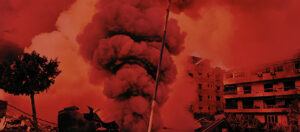










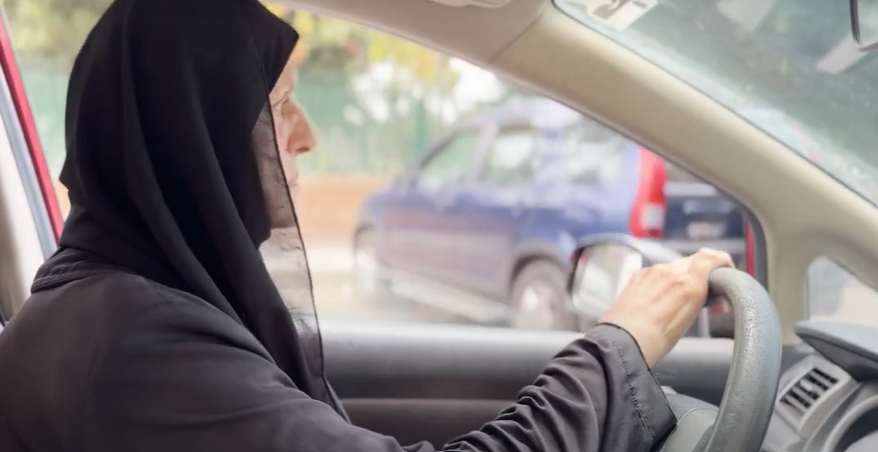
In the streets of Beirut and its suburbs—where roads intertwine and choke under traffic congestion, where daily outings have become fraught with anxiety, and under the constant hum of Israeli drones—Nada Reda Atwi works behind the wheel of her private taxi. A Lebanese woman in her seventies, she has broken a deeply rooted stereotype, simply by holding the steering wheel.
Since 2019, everything in Nada’s life has changed. The economic crisis that swept through Lebanon was not just a public event; it became a harsh personal turning point. Her husband passed away during the same period, and her son lost his job, leaving her facing compounded responsibilities at an age many consider meant for rest, not confrontation. She owned a car and was studying at a religious college after previously studying social sciences. Over time, she began giving her classmates rides home—at first simply as a gesture of help.
A Taxi That Protects from Fear
As the crisis deepened and fuel prices soared, she began selling her household belongings piece by piece to meet her basic needs. Her classmates noticed—and they also noticed that she was considering selling her car. Her friends suggested she work as a taxi driver, not only as a source of income, but because having a woman behind the wheel could provide other women with an added sense of safety, in a country where crime rates have risen alarmingly.

In 2024, 153 murders were recorded, along with 2,782 theft incidents and 40 cases of kidnapping for ransom, in addition to 585 car thefts. At the start of 2025, despite a decrease in car thefts to 87 cases in the first quarter (compared to 179 during the same period in 2024), murders rose to 57 cases from 50, thefts increased to 948 incidents from 889, and kidnappings rose to 10 cases from 8.
This fragile reality has made daily mobility—especially for women—a matter that goes beyond convenience to personal safety. From this perspective, her friends’ suggestion was not merely an economic idea, but a response to a real social need.
The Everyday Life of Women’s Safety
In the beginning, her work was limited to transporting her classmates only. She was cautious about dealing with a broader range of passengers outside the framework of the college and religious institute, driven by a natural concern about societal perceptions and the uncertainty of entering a new field unfamiliar to her. But over time, and with the accumulation of trips and daily conversations, this hesitation gradually faded.
The short distance inside the car
became a space of direct human connection between women who share similar stories and concerns
Nada says: “The short distance inside the car turned into a simple and direct space of human connection between women who share similar stories and concerns. This closeness created a sense of mutual trust and made the ride more than just a transportation service—it became a safe and comfortable experience for both sides.”
As her experience expanded, she came to see the presence of female taxi drivers in Lebanon as an important professional and social step—one that opens broader options for women in mobility and employment, while breaking barriers associated with traditional perceptions of certain professions.
Nada’s experience does not emerge in isolation, but from a broader reality faced by women in Lebanon today, where economic vulnerability intersects with declining safety and limited opportunities. According to the Global Gender Gap Report 2025 issued by the World Economic Forum, Lebanon ranked 136th out of 148 countries—an indicator reflecting deep structural inequalities, particularly in economic participation and decision-making.
Despite achieving near parity in education and health, the options available to many women remain limited, pushing them—like Nada—to carve out unconventional paths to survive and work with dignity outside dominant norms.
Safety Is Their Right
In parallel, human rights reports issued in 2025, including those by the organization “KAFA” (Enough Violence & Exploitation), indicate a worrying rise in physical, psychological, and economic violence against women, amid the absence of comprehensive legislation and effective institutional protection. This reality directly affects daily life—from mobility to employment—turning simply leaving the house into an experience marked by constant caution.
Within this context, Nada’s presence behind the wheel goes beyond being a professional choice. It becomes a mobile safe space—a practical response to an urgent need among women in a city where fear has become part of the daily rhythm.
A 33.3% Increase in Murders Was Recorded
This need becomes even more evident in light of the changes in Lebanon’s security landscape. According to a 2025 analysis by the Information International research group, murders increased by 33.3% compared to the previous year, alongside rising theft rates and the proliferation of weapons, contributing to a widespread sense of insecurity in the streets.
During the same period, repeated reports of missing girls and women sparked widespread concern, particularly as dozens of cases were listed by the Internal Security Forces, deepening fears among women and their families of dangers that are no longer distant from everyday life.
This report is supported by: