











How Has Displacement Exhausted the Residents of Lebanon’s Regions?
“Every four days we need a water delivery, and each delivery costs one million Lebanese pounds (about $11); there are kind people who lend us a sum of money every now and then until we return home. What sorrow if the displacement continues, for the debt will surely pile up!” With words full of anguish, a woman displaced from the southern town of Shhour to the town of Wardaniyeh in the Chouf district laments her bitter reality.
“Maryam” (a pseudonym) arrived in Wardaniyeh with her three children, where she found free shelter with benefactors, but she soon faced a new reality; the water that had previously been available became a daily burden requiring a cost she could not easily bear, forcing her to borrow money to secure her basic needs.
“Marwa” (a pseudonym) has a different story; the woman displaced from the town of Jmayjmeh tells the “Silat Wassel” platform that she is able to secure her water needs through tankers, but doubt about its quality often creeps in, saying: “The water is not state water, and of course we do not rely on it for drinking; it is only enough for washing and bathing, and we have no idea about its quality.”
Between the burden of cost and concerns over quality, a picture emerges of a reality growing more complex as the number of displaced people rises. So how has this pressure been reflected on the basic resources in Wardaniyeh?
Displacement and Water: Pressure Beyond a Small Town’s Capacity to Bear
Amid a reality imposing itself on a small town with meager resources such as Wardaniyeh (Chouf district), with a number of arrivals exceeding twice or more the number of its original residents, the deputy mayor, Mr. Salam Bayram, explains to the “Silat Wassel” platform that “the number of arrivals from war zones registered with the municipality exceeds 10,000 people, a figure far surpassing the town’s original population, estimated at around 5,000 residents.”
"The number of arrivals from war zones registered with the municipality exceeds 10,000 people"
This significant rise in population is directly reflected on basic resources, foremost among them water; demand increases beyond absorptive capacity, especially during the 2026 war period. In the face of this pressure, local initiatives emerge seeking to fill part of the shortfall; a number of artesian well owners volunteer to provide water, while one Lebanese association covers the cost of transporting it via tankers to the shelters, and some water plant owners contribute weekly donations estimated at around 150 gallons.
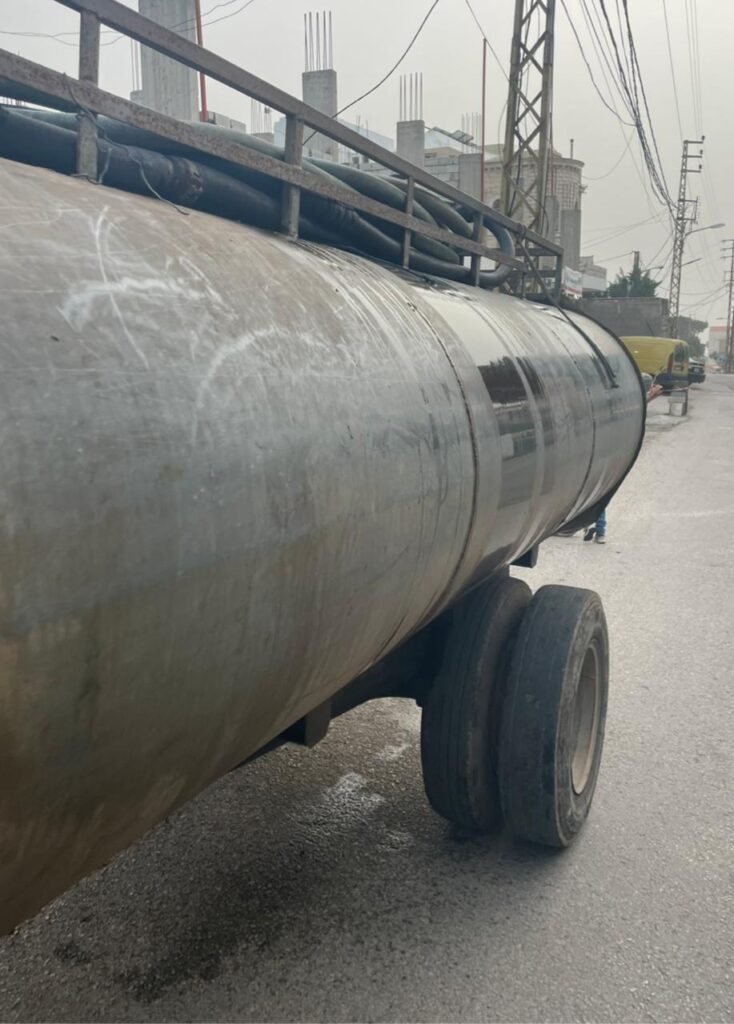
With the growing reliance on water tankers, this method becomes a realistic solution despite the questions surrounding it regarding follow-up mechanisms and water quality, given the absence of conditions allowing for regular oversight at this stage. As for the cost of a water delivery, it reaches around $10 (for a tanker holding from 8,000 to 10,000 liters of water) according to Bayram, adding a new burden on families trying to adapt to the reality of displacement, despite the individual efforts and initiatives seeking to ease the severity of these burdens. On the level of preventive measures, “the challenge remains amid the exceptional circumstances imposed by the war; there emerges a need for greater resources and organization to reduce the risks associated with contaminated water, and to ensure a safer, healthier environment for all.”
Displacement Water Between Official Follow-Up and the Challenges of War
According to a special source at the Ministry of Energy and Water, “the ministry had prepared a draft decree concerning water tankers, aiming to regulate their operation in terms of operating mechanisms and monitoring the quality of the water they transport, but this decree has not yet been signed and has not entered into force so far. As for the displaced, the source notes that they are supplied with water free of charge through the official water establishments, particularly in schools and gathering centers falling within the scope of these establishments, in an attempt to ease part of the burdens imposed by displacement.”
The source added that “monitoring water quality is not usually left to chance; under normal circumstances, a specialized department within the General Directorate of Investment handles the task of coordinating with the water establishments, which send the results of laboratory tests periodically to be studied and verified as free of any contamination. Follow-up is not limited to paperwork, but also includes field visits to the stations and keeping pace with the work of the laboratories within the scope of each establishment.” But this mechanism, as the source explains, “is tied to ordinary circumstances, while periods of war impose a different reality in which the ability to conduct regular follow-up becomes more challenging.”
Behind Tanker Water: Invisible Contaminants Threaten Safety
In a broader environmental reading to understand the types of contaminants that may be present in tankers, Dr. Maya Amasha, an environmental researcher at the American University of Beirut, explains to the “Silat Wassel” platform that environments resorting to securing water through tankers are more susceptible to contamination. She points out that this contamination may be microbial as a result of sewage leakage or loss of pressure within the networks, and may also include chemical contaminants such as nitrates and heavy metals, along with a decline in the water’s physical properties such as turbidity.
"This contamination may be microbial as a result of sewage leakage or loss of pressure within the networks"
Environmental researcher Abbas Baalbaki adds another problem to the issues of water distributed by tankers, namely the rise in the water’s salinity level, exceeding the permitted maximum of around 500 mg/liter, according to him. Regarding detection mechanisms, researchers Amasha and Baalbaki note that there are no rapid techniques that can alone fully guarantee water safety; precise laboratory analyses remain the foundation for verifying its potability, since the contamination is microbiological. Nevertheless, Amasha indicates that some preliminary indicators can be relied upon, such as measuring the residual chlorine level or the turbidity level, in addition to rapid field tests used as an initial assessment step.
Amid the growing reliance on tankers as a result of the displacement crisis, the displaced find themselves trapped in a spiral of cost and quality. Between cost and affordability, questions arise about the extent to which these tankers are subject to legal oversight; here Dr. Josiane Yazbek, a specialist in environmental laws, explains that “the private water tanker sector in Lebanon operates in an actual regulatory vacuum; the legal framework exists (Law 221 of 2000 and Law 77/2018 amended by Law 192/2020), but implementation is almost nonexistent. There are no unified licenses for water haulers, no obligation to disclose the source, no systematic bacterial testing, in addition to the existence of a large number of unlicensed groundwater wells.” She adds that “the suppliers who conduct laboratory tests do so entirely voluntarily, and documented records indicate that some major suppliers only test their water once every two years.”
"The private water tanker sector in Lebanon operates in an actual regulatory vacuum"
The legal expert continues that the Lebanese Ministry of Energy has developed a national water strategy, but the problem always remains in implementation: “The National Water Strategy (2024-2035) prepared by the Ministry of Energy acknowledges these problems and sets ambitious goals including digital monitoring systems and modernizing the establishments, but the transition from paper to actual implementation remains the greatest challenge.”
Dr. Yazbek points to several legal reforms that can be implemented to ensure the arrival of clean water at fair prices to all residents and to prevent exploitation or contamination:
- Issuing a binding decree: requiring every private water hauler to obtain a unified license, with the obligation to disclose the water source, conduct quarterly tests at an independent accredited laboratory, and post the applied tariff on the tanker.
- Establishing an independent regulatory body: for the water sector, one possessing real oversight, executive, and pricing powers, which is absent to this day; the National Strategy (2024-2035) hints at this need but does not turn it into a binding legal obligation with a timeline.
- Enshrining the right of access to clean water constitutionally: at fair prices as a fundamental constitutional right, based on United Nations General Assembly Resolution No. 64/292 of 2010 and Resolution 76/300 of 2022, both of which are binding on Lebanon. This enshrinement grants the citizen a legal tool to challenge, before the administrative judiciary, any policy that deprives them of this right.
The legal expert concludes her remarks by saying that Lebanon has sufficient legal and institutional tools, and has an announced national strategy for water safety and quality, and what it truly lacks is the political will for implementation and accountability.
During displacement, securing water becomes a real dilemma facing residents, especially the poor among them; securing water, which was once self-evident, has today become a commodity to be bought, and an anxiety accompanying every use. And between need and affordability, the gap widens.
Researchers Abbas Baalbaki and Dr. Maya Amasha point out to our platform that “the most effective solutions rely on a combination of techniques, including turbidity removal and disinfection, especially using chlorine to ensure continuous protection, along with the possibility of using additional techniques such as ultraviolet rays and ozone.” Amasha stresses the importance of applying these treatments at different stages, from the source to transport and to the point of use, to reduce the possibilities of recontamination. On the preventive level, there emerges a need for a set of measures that can be effectively applied, such as regulating the tanker filling sources, monitoring the conditions of water transport and its cleanliness, along with implementing simplified periodic follow-up programs to ensure the continuity of safety amid the existing challenges.