









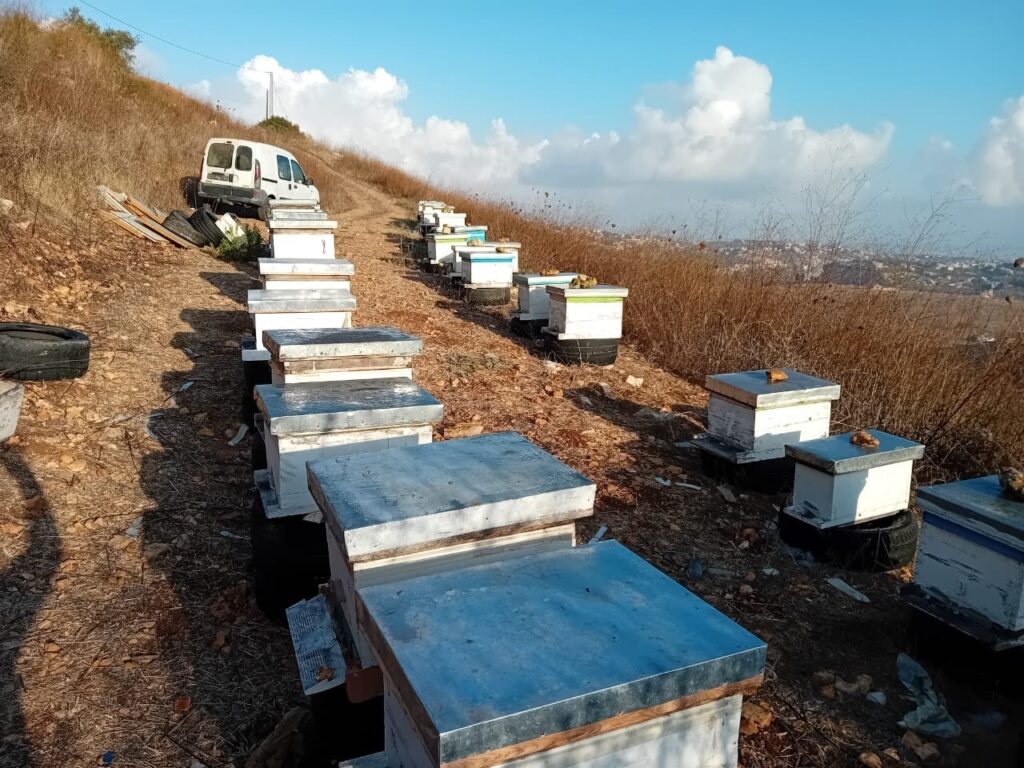
Mansour doesn’t talk about beehives that burned or were lost as losses one tallies in damage reports. He talks about a season he had been waiting for in his village of Aynata, about a spring that never came, about a small business that was slowly growing — hive by hive — until it became part of the family’s income and its plan for the coming year.
Mansour, a teacher and beekeeper, knew that spring is not a passing season in the life of bees. It is the beginning of the entire cycle: the honey season, the breeding season, and the season to expand the apiary. At this particular time, bees need daily monitoring, care, feeding, and close observation — and the beekeeper’s experienced hand that knows when to open a hive, when to add a frame, when to move a colony, and when to prevent disease before it spreads. But the war began at the threshold of this season and closed the road between the beekeeper and his bees.
“The war began at the threshold of this season and closed the road between the beekeeper and his bees”
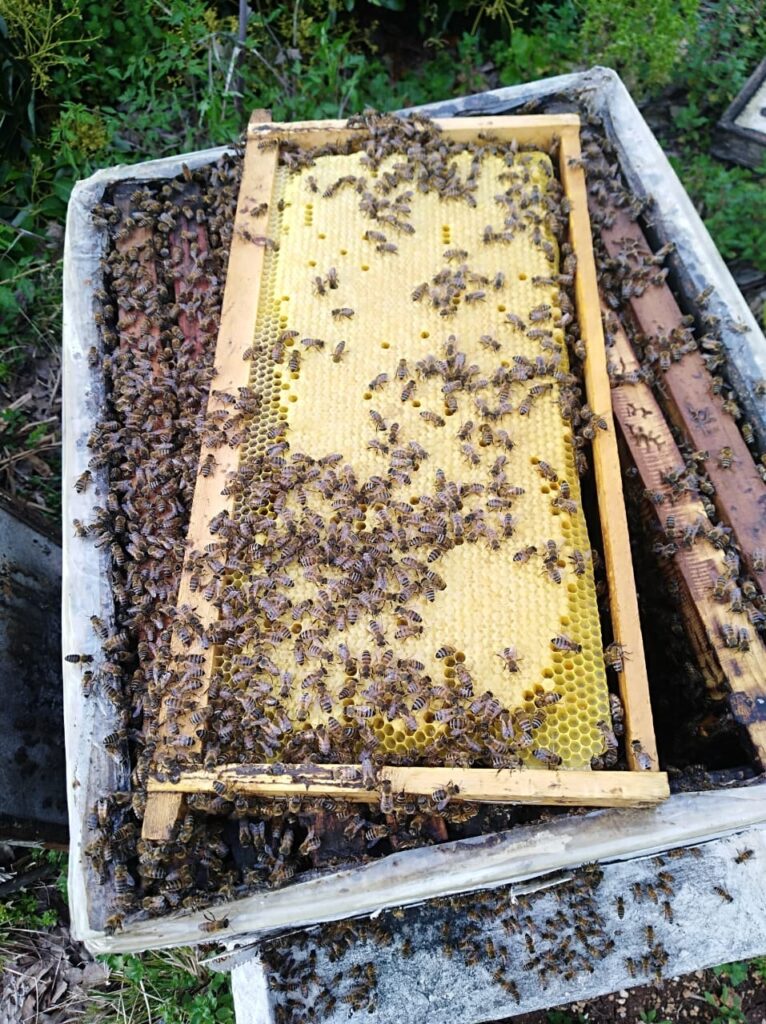
Mansour owned about a hundred hives. He says: “In a normal season, this number can produce, on average, about a ton of honey per year, worth around twenty thousand dollars or more, depending on the season and price. After accounting for beekeeping costs, this work provided my family with a monthly income exceeding a thousand dollars.” The hives were not merely an additional source of income for him — they were part of the household economy, his capacity to plan, and the idea that the countryside can give its people a reason to stay.
A Season That Doesn’t Wait for the End of War
This year, he had been waiting for spring to expand the apiary further. He says he was able to add about fifteen new hives each season — and these hives are not counted only within this year’s production, but form the foundation for the following year’s production. His plan was for the season to help him pay his daughter’s university installment. Here, the loss is no longer confined to honey not harvested or hives not opened — it extends to a deferred university installment, a monthly income cut off, and a lost season whose effects stretch well beyond the war itself.
“Even if the bees had survived,” says Mansour, “the inability to reach them or care for them was practically their loss. Bees do not wait for the war to end to resume their cycle. If nutrition is absent, or treatment delayed, or hives left without monitoring, the colony weakens, the queen retreats, and the hive collapses from within — before the loss ever shows in production numbers.” By his estimate, a beekeeper who lost his hives or was unable to tend them throughout this period will not be able to resume production immediately after the war ends — and may not be able to sell honey again before spring 2027.
The same story repeats among various beekeepers. Others — including Ahmad Ibrahim Nasreddin, Ali Musa Shaker, and Rabah Mohammad Hamza, from Hadatha, Aynata, and Jmayjmeh — spoke of losses in their apiaries ranging between ten and fifty hives during the ongoing war in southern Lebanon.
These losses, according to the beekeepers, translated into a near-complete severance of a basic family income source, amid displacement, difficulty returning, and the absence of any compensation to date.
The Beekeeping Sector Within a Broader Agricultural Collapse
What Ahmad Ibrahim Nasreddin, Ali Musa Shaker, and Rabah Mohammad Hamza recount does not stand outside a broader context of agricultural collapse in southern Lebanon. According to a report published by L’Orient-Le Jour based on the Ministry of Agriculture’s fifth weekly report within the national response plan, 56,264 hectares of agricultural land were damaged, 64 villages were affected by shelling, land bulldozing, and the destruction of irrigation networks and rural infrastructure, while 77.9% of small farmers in the south were forced to flee — halting production seasons and supply chains across wide areas.
Within this picture, the beekeeping sector bore a clear share of the losses. Ministry of Agriculture data indicate the loss of more than 29,000 beehives during the war — a loss that affects not only honey production but also breeding seasons, agricultural pollination, and the annual income of hundreds of rural families. On World Bee Day, May 20, Agriculture Minister Nizar Hani confirmed that the beekeeping economy is no longer a marginal sector — it has become a core part of the food security system, biodiversity protection, and strengthening the resilience of rural communities.
“The loss of more than 29,000 beehives during the war”
The Loss of Expertise, Not Just Hives
The losses do not stop at the boundaries of hives and seasons. Environmental and rights platforms circulated testimonies about beekeepers killed during the war, among them Marouf Ramal and Mohammad Abdel Salam Nasrallah — well-known names in Lebanon’s beekeeping sector.
These losses reveal an additional dimension in the sector: recovery of production is not tied to hives alone, but also to the accumulated expertise of beekeepers — their knowledge of seasons, treatment, breeding, and the movement of bees between areas and pastures. In a sector that depends greatly on inherited local knowledge, losing a beekeeper can mean losing years of expertise that are difficult to compensate for quickly.
From Honey to Food Security
Bee losses cannot be separated from a broader picture of food system disruption in Lebanon. In a statement published by “Al-Mayadeen Lebanon,” the National Coordinator for Food System Transformation, Deputy Inaya Ezzedine, stated that the Israeli aggression “threatens Lebanon’s food system and undermines its foundations deeply.” According to the figures presented, the agricultural sector incurred direct losses of $118 million, plus $586 million in production and income losses, while the number of people suffering from food insecurity rose to 1.26 million during 2024.
When War Strikes the Rural Life Cycle
In southern Lebanon, the loss of bees does not appear as merely a line item on the agricultural damage list. It is the loss of a production season, a family income source, rural expertise, and a daily capacity to provide food and income.
With continued displacement, difficulty accessing border villages, and the absence of any compensation to date, many beekeepers — especially those for whom apiaries were their primary livelihood and main family support — find themselves facing compounded loss: the loss of their income source on one hand, and the absence of any economic alternative on the other. Thus, the urgent need emerges for rapid and fair support and compensation mechanisms that protect the most affected beekeepers and prevent a single season’s loss from becoming a permanent exit of entire families from this sector.