





Investigative Report – Part One
Lebanon is grappling with escalating environmental crises resulting from systematic and deliberate mismanagement of the country’s resources — a situation that poses a serious threat to the nation’s future and endangers public health. Understanding the extent of these environmental failures is critical to comprehending the reality of the challenges facing the Lebanese people and assessing their causes and catastrophic consequences.
Key Environmental Failures: Causes and Consequences
Although Lebanon’s environmental issues date back decades, the pace of environmental degradation has sharply accelerated in recent years, particularly with regard to air pollution. Air pollution levels in Lebanon have now surpassed permissible thresholds set by the World Health Organization (WHO). According to the latest statistics from Our World in Data, Lebanon’s annual carbon dioxide emissions reached 23.90 million tons in 2022, while greenhouse gas emissions — including carbon dioxide, methane, nitrous oxide, ozone, and perfluorocarbons — totaled 30.2 million tons annually. The report highlighted that the electricity sector is the largest contributor to these emissions.
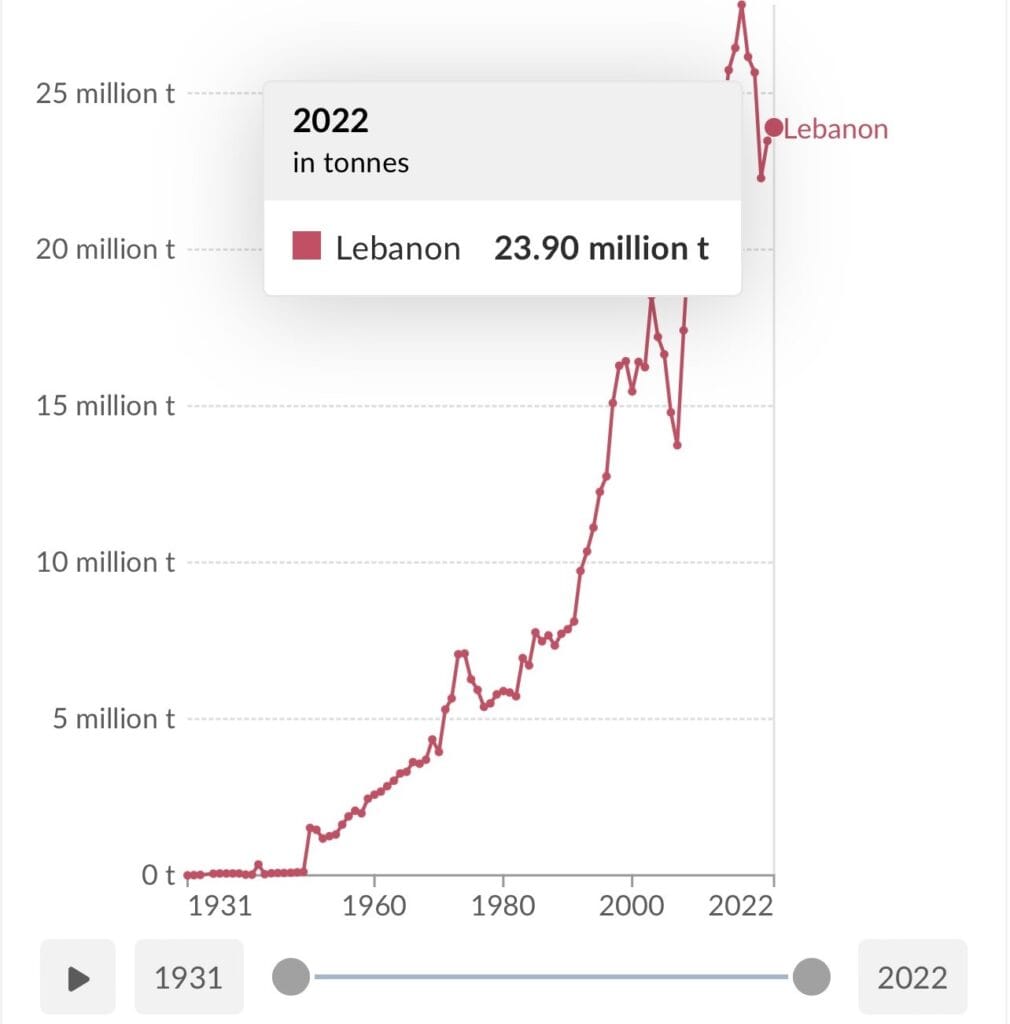
Lebanon’s annual carbon dioxide emissions reached 23.90 million tons in 2022.
Following the 2019 economic collapse, austerity measures slashed the Environment Ministry’s budget, leading to the shutdown of air quality monitoring stations across the country. Environmental expert and head of the NGO “Earth Association”, Paul Abi Rached, confirmed this to Silat Wassel platform.
The primary sources of air pollution stem from multiple factors, most notably the electricity sector, which relies on outdated thermal power plants that burn heavy fuel oil — a fuel type that fails to meet international standards — alongside diesel-powered generators, one of the most polluting fossil fuels. The situation has worsened amid chronic nationwide blackouts, especially since the start of the economic crisis, with power outages reaching up to 20 hours a day, while the state remains incapable of supplying adequate electricity to citizens.
Toxic emissions have increased by 300% following Lebanon’s electricity crisis.
As a result, private diesel generators have become the alternative power source for most Lebanese households, compensating for the huge shortfall in electricity supplied by the state-owned utility. While these generators were originally intended to serve as backup power sources during emergencies, they have effectively replaced the national grid. According to a report from Lebanon’s National News Agency, Beirut alone hosts over 9,000 private generators, while the total number nationwide exceeds 30,000 units.
This situation is largely attributed to decades of mismanagement, corruption, and neglect within Lebanon’s energy sector. For nearly 30 years, successive governments have failed to reform or properly manage the state electricity company, leading to the complete collapse of the sector and leaving the country without power for most of the day.
The massive and unregulated spread of diesel generators across Lebanon — installed between homes, businesses, on rooftops, trucks, public squares, hospitals, and shopping areas — poses a serious threat to both the environment and public health. Most generators fail to comply with environmental standards and emit large volumes of toxic air pollutants — up to 40 different hazardous compounds, including many known or suspected carcinogens, according to a report from the American Thoracic Society.
Researchers at the American University of Beirut have warned of a 300% rise in toxic emissions — including carbon monoxide, nitrogen dioxide, sulfur dioxide, and diesel particulates — compared to pre-crisis levels, due to the heavy reliance on generators operating for extended hours in low-lying, poorly ventilated areas. The problem is compounded by poor maintenance, the lack of air filtration systems, and the use of low-quality diesel, resulting in dense emissions and severe environmental and health damage.
Lebanon’s transportation sector further exacerbates pollution, relying heavily on an aging fleet of cars with worn-out engines. With the economic crisis preventing many citizens from purchasing newer, cleaner vehicles, the country has seen a surge in the use of old cars, diesel-powered vehicles, and motorcycles — all of which significantly increase harmful emissions and worsen air quality.
Researchers have warned of a 300% increase in toxic emissions in Lebanon compared to pre-electricity-crisis levels due to the growing reliance on diesel generators.
Lebanon is also witnessing a significant surge in road traffic, ranging between 15% and 50%, largely driven by the influx of Syrian refugees fleeing the war in their country. According to the book “Impacts of the Syrian Crisis and Displacement on Lebanon”, this influx has heavily strained Lebanon’s infrastructure. Last month, Prime Minister Najib Mikati announced that the number of Syrian refugees in Lebanon now equals nearly one-third of the Lebanese population. Official Lebanese estimates place the number of Syrian refugees at 1.8 million, with around 880,000 registered with the UNHCR.
Lebanon also faces a solid waste management crisis as municipalities stopped sorting and processing waste, leading to mountains of garbage piling up across city streets and beaches. Hundreds of unsanitary temporary dumpsites openly burn waste, releasing toxic emissions, while government contracts for waste treatment facilities have expired without alternative plans. Multiple governmental initiatives to build new landfills or export waste abroad have failed due to lack of political will.
Households, markets, and commercial institutions are the main sources of municipal solid waste, which threatens to push Lebanon toward desertification. According to the Ministry of Environment, Lebanon produces about 5,514 tons of waste daily, with 99% ending up in random dumps or landfills. Over 60% of this waste is organic, yet only 8% of total waste is processed, compared to 77% in 2018, due to the collapse of waste treatment infrastructure.
Shocking Numbers
Lebanon’s concentration of fine particulate matter (PM2.5) — the smallest and most dangerous air pollutants — now exceeds the World Health Organization’s air quality guidelines by 2.2 times, according to a report by IQAir, a global air quality monitoring company. These microscopic particles penetrate deep into lung tissue and can enter the bloodstream, causing severe health issues. A World Bank report links PM2.5 exposure to heart disease, strokes, lung cancer, chronic obstructive pulmonary disease (COPD), and pneumonia.
Prime Minister Najib Mikati stated: “Cancer has become one of the greatest health challenges of our time. Statistics clearly show that cancer is now a leading cause of death worldwide, and particularly in Lebanon.”
Oncologists in Lebanese hospitals paint an even darker picture, estimating a 30% surge in cancer cases in recent years.
According to the International Agency for Research on Cancer (IARC), Lebanon recorded 33,576 cancer cases between 2018 and 2022, with 40% of them — approximately 13,000 cases — diagnosed in 2022 alone. Breast and lung cancers represent the highest proportion of these cases.

Lebanon is also grappling with an escalating marine and river pollution crisis that threatens both the environment and public health. According to the 2023 annual report by the National Council for Scientific Research titled “The Environmental Reality of the Lebanese Coast”, 40% of seawater samples tested along Lebanon’s coastline showed high contamination levels. Out of 37 monitored coastal sites, 15 locations — stretching from Akkar in the north to Naqoura in the south — were classified as ranging from “unsafe” to “heavily polluted” and unfit for swimming.
40% of seawater samples are contaminated, while 73% of river water samples are unsuitable for irrigation.
A 2021 study conducted by the Department of Nutrition and Food Sciences at the American University of Beirut (AUB) assessed the water quality of 14 major Lebanese rivers. The results revealed extremely high contamination levels, with 48.73% of samples exceeding safe irrigation standards, 61.3% exceeding acceptable recreational limits, and 31.81% deemed unsafe altogether.
A UNICEF report further warned that the health of millions in Lebanon — particularly children — is at risk due to the spread of waterborne diseases such as dysentery, hepatitis A, leishmaniasis, and typhoid fever, which disproportionately affect children.
Key Causes of Water Pollution
Untreated wastewater discharge: Vast amounts of untreated sewage are discharged directly into Lebanon’s rivers and the Mediterranean Sea, with only 8% of total wastewater receiving treatment. The Litani River, Lebanon’s largest, is now considered among the most polluted rivers in the world due to the dumping of untreated sewage. It receives waste from approximately 174 sewage outfalls, with an estimated 45.5 million cubic meters of untreated household wastewater flowing annually into its upper basin. Additionally, about 65% of Lebanon’s total household sewage is discharged directly into the sea through 53 coastal outflow points.
This crisis is largely attributed to the shutdown of most wastewater treatment plants. While around 60% of the Lebanese population is connected to sewage collection networks, less than 30% of the collected wastewater actually reaches operational treatment facilities. This is due to insufficient network connectivity and the limited functionality of treatment plants.
In regions not covered by sewage networks, residents rely mainly on septic tanks and soak pits, which pose significant groundwater contamination risks due to leakage.
According to Fanack Water, microbiological contamination has been documented in 11 rivers — including the Orontes, Al-Kabir, Al-Bared, Arqa, Abu Ali, Ibrahim, Antelias, Beirut, Damour, Awali, and Litani Rivers. The contamination primarily stems from the discharge of untreated household sewage. Furthermore, heavy metals such as copper, zinc, strontium, chromium, and nickel have been detected in the Al-Kabir River in northern Lebanon.
Pesticide and chemical fertilizer misuse: Some farmers use unregulated pesticides and chemical fertilizers without approval from governmental authorities, discharging these substances into Lebanon’s river systems. Weak governmental oversight, poor law enforcement, and low awareness of health risks exacerbate the issue. Additionally, the high cost of licensed agricultural chemicals drives many farmers to rely on cheap but harmful alternatives to boost crop yields.
Mustafa Raad: “Farmers in remote Lebanese areas use smuggled pesticides.”
According to Mustafa Raad, environmental and media advisor at the Lebanese NGO “Fasila Point”, several farmers in border regions of Lebanon use pesticides smuggled via Syria. He explained to Silat Wassel that these chemicals contaminate many agricultural products, including strawberries, certain types of melons, and mallow leaves, posing serious public health threats.
Solid waste dumping is another significant contributor to water pollution in Lebanon. A World Bank assessment titled “Baseline for Marine Litter in Lebanon – 2021” revealed that marine litter was widespread across Lebanese beaches. The study found that 76% of collected waste was plastic. Surveys also indicated that marine litter density increased by 37% between April and October 2021, jumping from 7.9 to 10.4 items per square meter.
The study further highlighted that over 82% of marine waste originates from land-based sources. The most common items included single-use plastics such as bottle caps, beverage bottles, cigarette butts, cups, and straws, typically left behind by beachgoers.
In conclusion, Lebanon urgently needs a unified national stance to address its environmental collapse. How can the environment forgive neglect and corruption when resources are wasted, ecosystems are destroyed, and pollution threatens public health? Without serious reform and strict enforcement of environmental policies, Lebanon’s natural wealth may be irreversibly damaged, leaving future generations to face an environmental disaster.
To be continued…